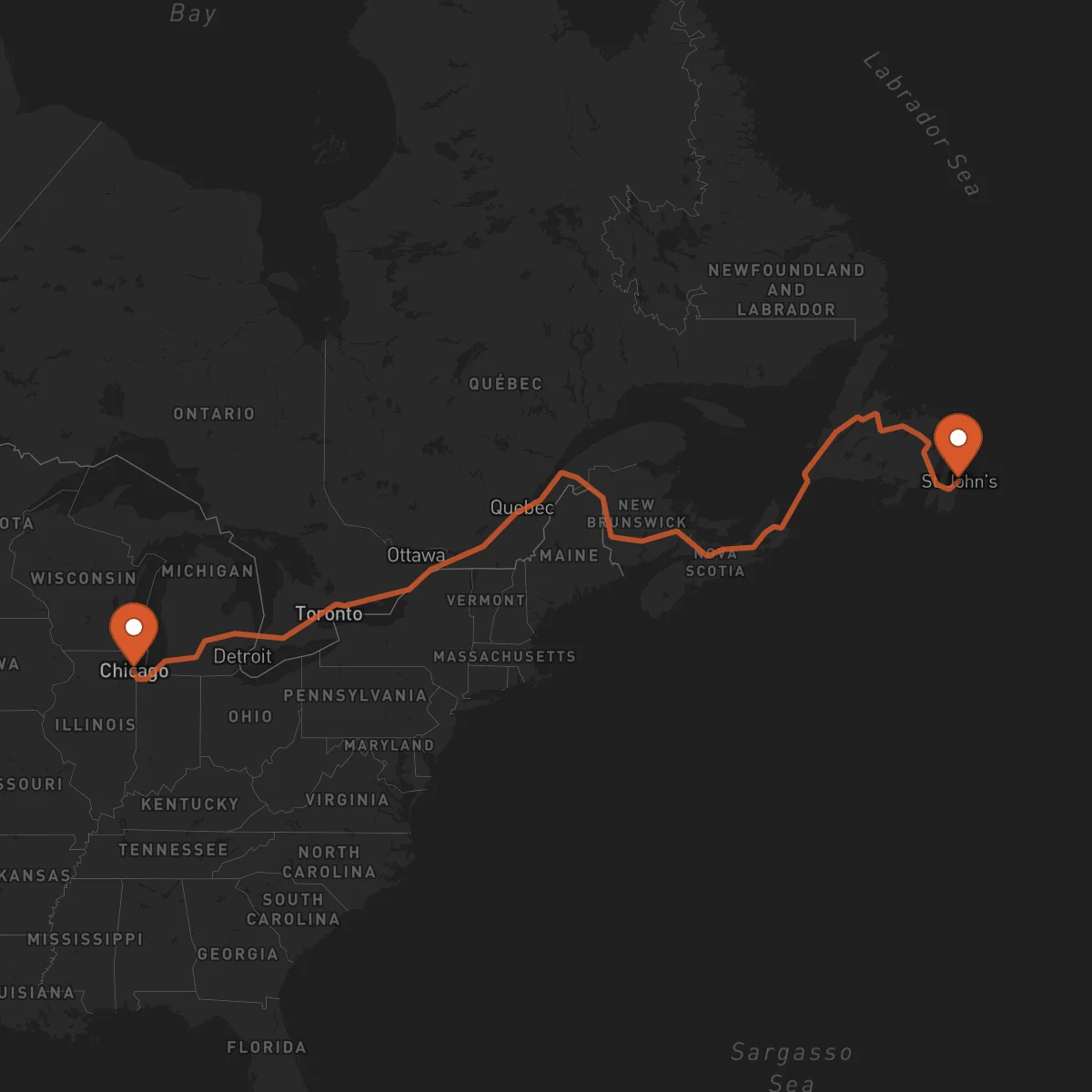
St. John's to Chicago
Chicago → St. John'sFTL freight transportation service between St. John's and Chicago. Reliable logistics solutions for your business.
Route Description
Everything you need to know about the corridor St. John's - Chicago
The San Juan de Terranova (St. John's) to Chicago corridor represents a vital logistics connection spanning over 2,800 kilometers across eastern Canada and the American Midwest. This cross-border route links the easternmost port city of North America with one of the continent's most important inland logistics hubs. The corridor traverses diverse terrain and crosses multiple provincial and state boundaries, making it a complex but strategically important freight lane for industries requiring transcontinental distribution.
The economic significance of this corridor stems from its role in connecting Atlantic Canada's resource-based industries with the manufacturing and distribution centers of the American Midwest. Industries along this route include seafood processing from Newfoundland, forestry products, and increasingly, technology and aerospace components from the St. John's area. Chicago serves as the endpoint for these goods, providing access to the North American rail network, major distribution centers, and connections to the broader US market.
Transportation infrastructure along this corridor includes the Trans-Canada Highway (Route 1) through Newfoundland and Labrador, connecting to the Confederation Bridge to Prince Edward Island, then major highways through New Brunswick, Quebec, and into the United States via Michigan or New York before reaching Chicago. Key border crossings include those near Sarnia-Port Huron or Buffalo-Niagara Falls, depending on the specific route chosen. Control Terrestre's expertise in cross-border logistics ensures seamless customs clearance and regulatory compliance throughout this journey, with our certified carriers handling all necessary documentation and security requirements.
Services for this Route
Available services for the corridor St. John's - Chicago
 Origin
St. John's
San Juan de Terranova (St. John's), located on the eastern tip of Newfoundland and Labrador, serves as Canada's easternmost major port and logistics hub. The city's strategic position makes it the closest North American port to Europe, providing significant advantages for transatlantic shipping and logistics operations. St. John's benefits from the Port of St. John's, which handles containerized cargo, bulk commodities, and specialized freight, connecting the island to global supply chains. The region's economy is anchored in offshore oil and gas, fisheries, marine technology, and increasingly, the technology and aerospace sectors. Transportation infrastructure includes the St. John's International Airport for air cargo, the port facilities for maritime freight, and road connections via the Trans-Canada Highway. Control Terrestre leverages these multimodal capabilities to provide seamless door-to-door service from this strategic Atlantic gateway.
 Destination
Chicago
Chicago stands as one of North America's most critical logistics and transportation hubs, strategically positioned at the crossroads of major east-west and north-south freight corridors. The city's location provides unparalleled access to the US Midwest's vast manufacturing base, agricultural heartland, and consumer markets. Chicago's extensive transportation infrastructure includes O'Hare International Airport (one of the world's busiest for cargo), multiple intermodal rail terminals operated by Class I railroads, and a network of interstate highways including I-90, I-94, and I-80/90. The region is home to numerous distribution centers, warehousing facilities, and logistics parks that serve as consolidation points for national and international freight. Chicago's significance as a freight gateway is further enhanced by its access to the Great Lakes shipping network and connections to major US consumer markets within a day's drive. Control Terrestre's presence in Chicago ensures efficient last-mile delivery and distribution capabilities for goods arriving from Atlantic Canada.










