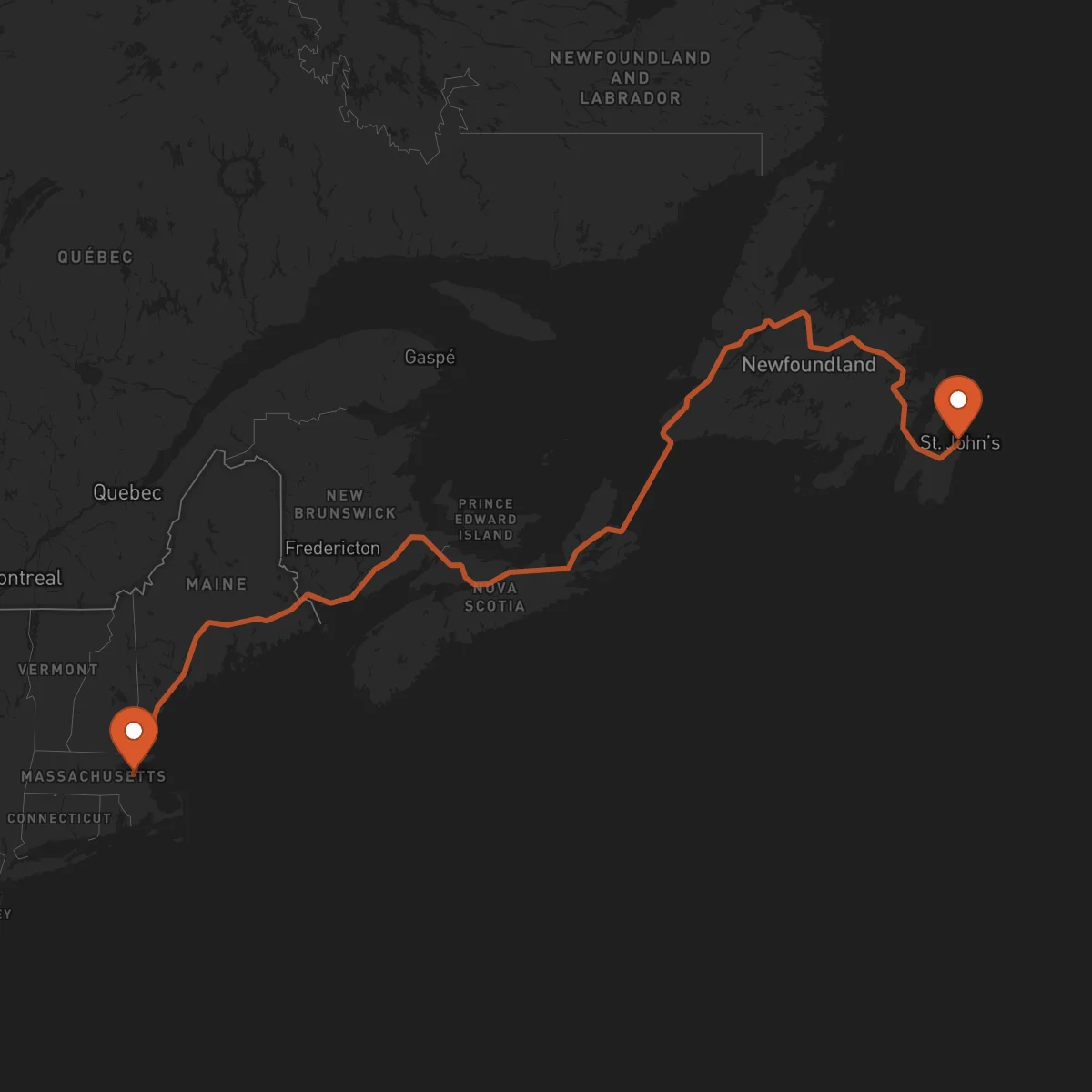
St. John's to Boston
Boston → St. John'sFTL freight transportation service between St. John's and Boston. Reliable logistics solutions for your business.
Route Description
Everything you need to know about the corridor St. John's - Boston
The logistics corridor connecting San Juan de Terranova (St. John's) to Boston represents a vital link between the easternmost province of Canada and one of the most important economic centers in the northeastern United States. This cross-border route spans approximately 1,548 kilometers and serves as a crucial artery for trade between Newfoundland and Labrador and the New England region. The corridor facilitates the movement of goods from the Atlantic coast to the heart of the American industrial corridor, connecting two regions with complementary economic strengths.
The economic relationship between these regions is strengthened by their industrial complementarity. St. John's serves as a hub for the offshore oil and gas industry, fisheries, and emerging technology sectors, while Boston stands as a global center for education, healthcare, biotechnology, and financial services. The corridor supports the exchange of specialized equipment, raw materials, and finished products between these distinct economic ecosystems. Major industries utilizing this route include energy sector logistics, seafood and perishable goods, industrial machinery, and high-tech equipment.
Transportation infrastructure along this corridor combines maritime access in St. John's with an extensive highway network connecting through Nova Scotia and into the United States. The primary route utilizes the Trans-Canada Highway (Highway 1) to connect with the U.S. Interstate system, specifically I-95, which leads directly into Boston. Key border crossings include Calais-St. Stephen in Maine, where customs clearance and documentation compliance are essential for smooth cross-border operations. Control Terrestre's expertise in managing cross-border documentation, regulatory compliance, and specialized equipment ensures efficient freight movement along this strategic corridor.
Services for this Route
Available services for the corridor St. John's - Boston
 Origin
St. John's
San Juan de Terranova (St. John's) serves as the primary logistics gateway for Newfoundland and Labrador, strategically positioned on the eastern edge of North America. The port of St. John's provides deep-water access for international shipping and connects to continental transportation networks through ferry services to Nova Scotia. The region's economy is anchored by the offshore oil and gas industry, with the Hibernia, Terra Nova, and White Rose oil fields requiring specialized logistics support. The fisheries sector remains vital, with seafood processing facilities requiring temperature-controlled transportation solutions. Transportation infrastructure includes the St. John's International Airport for air cargo, the Port of St. John's for maritime freight, and connections to the provincial highway system that links to the mainland via Marine Atlantic ferry services.
 Destination
Boston
Boston stands as a major logistics hub in the northeastern United States, offering unparalleled access to the New England market and beyond. The city's strategic location provides connections to major metropolitan areas including New York, Philadelphia, and Washington D.C. within hours. Boston's economy is driven by world-class universities, research institutions, and a thriving biotechnology sector, creating demand for specialized freight services. The Port of Boston handles significant container traffic and bulk cargo, while Logan International Airport serves as a major air cargo gateway. The region's extensive highway network, including I-90 and I-95, provides efficient distribution throughout the northeastern United States. Boston's diverse economy spans healthcare, education, finance, technology, and advanced manufacturing, requiring comprehensive logistics solutions for both imports and exports.










