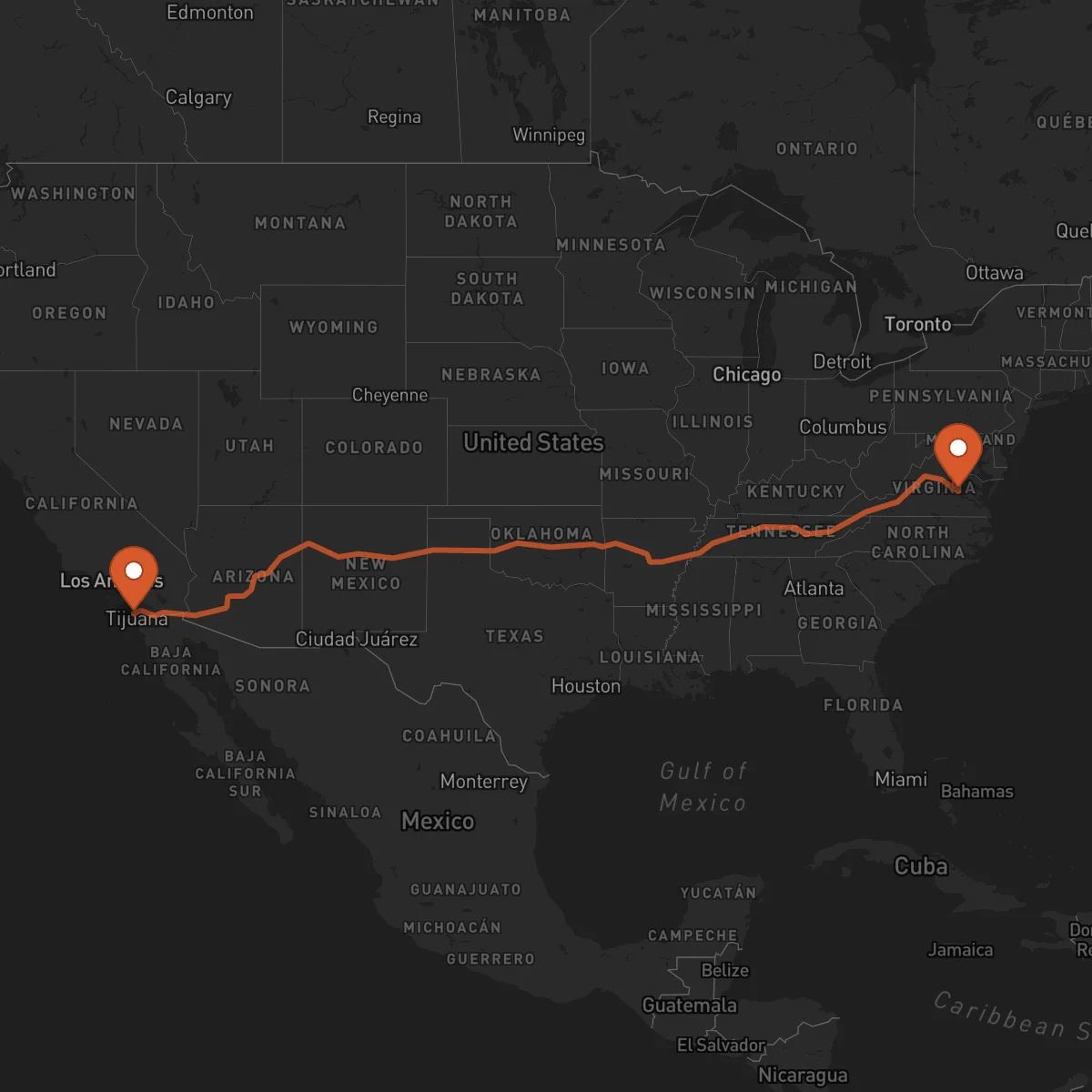
San Diego to Richmond
Richmond → San DiegoFTL freight transportation service between San Diego and Richmond. Reliable logistics solutions for your business.
Route Description
Everything you need to know about the corridor San Diego - Richmond
The San Diego to Richmond corridor represents one of the most critical freight transportation routes across the United States, connecting the Pacific coast with the Atlantic seaboard. This 3,625 km journey traverses diverse terrain and crosses multiple states, serving as a vital link in the North American supply chain. The corridor's strategic importance lies in its ability to move goods efficiently between two major economic hubs, facilitating commerce and trade across the country.
The economic significance of this route cannot be overstated. San Diego, a major port city and technology center, generates substantial freight volume that needs to reach the East Coast markets. Richmond, with its rich industrial heritage and strategic Mid-Atlantic location, serves as a gateway to the Northeast and Southeast markets. This corridor supports numerous industries including automotive, technology, pharmaceuticals, and consumer goods, all of which rely on timely and reliable freight transportation.
The transportation infrastructure along this route is robust, primarily utilizing Interstate 8 and Interstate 40 to connect the West Coast with the central United States, before transitioning to Interstate 64 and Interstate 95 for the final leg to Richmond. These major highways provide efficient connectivity and are maintained to high standards, ensuring smooth transit for freight operations. Control Terrestre leverages this infrastructure to provide seamless FTL transportation services, offering dedicated trucks and experienced drivers who understand the nuances of this extensive route.
Services for this Route
Available services for the corridor San Diego - Richmond
 Origin
San Diego
San Diego, California, stands as a strategic logistics hub on the Pacific coast, boasting a world-class port that handles significant international cargo volumes. The city's proximity to the US-Mexico border creates additional cross-border freight opportunities, making it a crucial entry point for goods entering the United States. San Diego's transportation infrastructure includes multiple interstate highways, rail connections, and the San Diego International Airport, providing diverse options for freight movement. The region's strong technology, defense, and manufacturing sectors generate consistent freight demand, particularly for specialized and high-value cargo.
 Destination
Richmond
Richmond, Virginia, serves as a strategic logistics center in the Mid-Atlantic region, offering excellent connectivity to major East Coast markets. The city's location at the fall line of the James River historically made it a transportation hub, a role it continues to fulfill today. Richmond benefits from its proximity to major ports in Norfolk and its position along the I-95 corridor, one of the busiest freight routes in the country. The region's diverse economy, including government, finance, and manufacturing sectors, creates steady freight demand. Richmond's well-developed transportation infrastructure, including multiple interstate highways and rail connections, facilitates efficient distribution throughout the Eastern United States.










