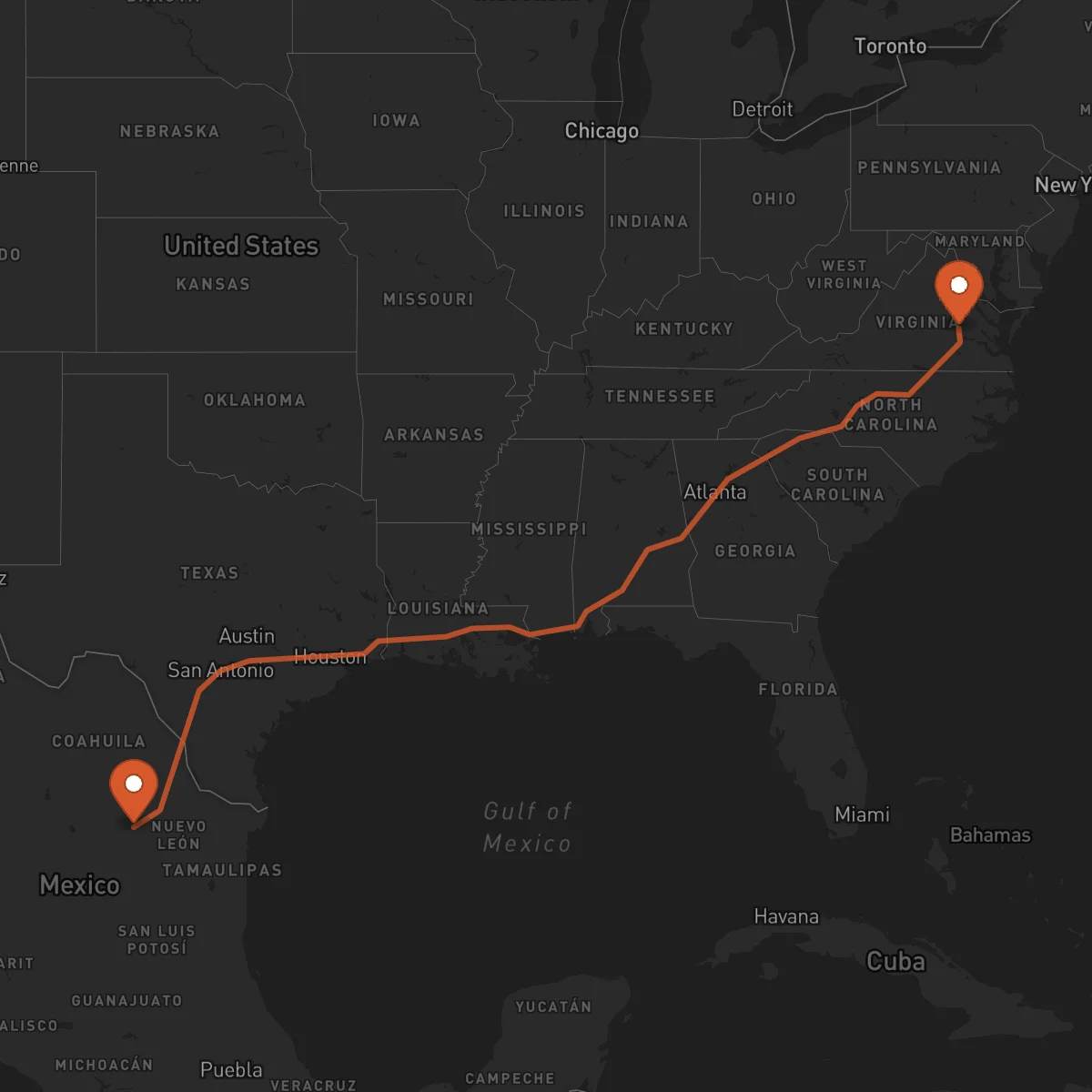
Saltillo to Richmond
Richmond → SaltilloFTL freight transportation service between Saltillo and Richmond. Reliable logistics solutions for your business.
Route Description
Everything you need to know about the corridor Saltillo - Richmond
The Saltillo to Richmond corridor represents a vital cross-border logistics route connecting Mexico's industrial heartland with the strategic East Coast of the United States. This 2,595-kilometer transportation artery facilitates the movement of manufactured goods, automotive components, and industrial materials between two major economic regions. The corridor traverses diverse terrain and crosses multiple state and federal jurisdictions, requiring expert coordination and compliance with international trade regulations.
The economic significance of this route cannot be overstated, as it links Coahuila's manufacturing sector with Virginia's distribution networks and consumer markets. Major automotive manufacturers in Saltillo rely on this corridor to supply assembly plants and distribution centers throughout the eastern United States. The route serves as a critical supply chain link for industries including automotive, aerospace, electronics, and heavy machinery.
Transportation infrastructure along this corridor includes Mexico's Federal Highway 40 and 85, connecting to major U.S. interstates such as I-35, I-40, and I-64. The primary border crossing at Laredo/Nuevo Laredo provides efficient access to U.S. transportation networks. Control Terrestre's expertise in cross-border operations ensures seamless customs clearance, regulatory compliance, and optimized routing to minimize transit times and maximize supply chain efficiency.
Services for this Route
Available services for the corridor Saltillo - Richmond
 Origin
Saltillo, the capital of Coahuila, stands as a strategic logistics hub in northern Mexico, leveraging its proximity to the U.S. border and its robust industrial base. The city hosts major automotive manufacturing facilities, including General Motors and Kia plants, making it a critical production center for export-oriented industries. Saltillo's transportation infrastructure includes direct access to Mexico's federal highway network, rail connections through Ferromex, and the Plan de Guadalupe International Airport for air cargo operations.
The region's economic strength lies in its diversified manufacturing sector, encompassing automotive, aerospace, electronics, and metalworking industries. Saltillo's strategic location provides efficient access to both U.S. markets and Mexican ports, making it an ideal origin point for cross-border freight movements. The city's industrial parks and logistics zones are equipped with modern facilities designed to support just-in-time manufacturing and international trade operations.
 Destination
Richmond
Richmond, Virginia serves as a strategic logistics gateway on the U.S. East Coast, offering exceptional connectivity to major metropolitan areas and international ports. The city's location provides access to the Port of Virginia, one of the largest container ports on the East Coast, as well as proximity to Washington D.C., Baltimore, and the Research Triangle in North Carolina. Richmond's transportation infrastructure includes extensive highway networks (I-95, I-64, I-295), rail connections through CSX and Norfolk Southern, and the Richmond International Airport for air cargo services.
The Richmond metropolitan area supports diverse economic sectors including advanced manufacturing, healthcare, technology, and government services. The region's logistics advantages include its central East Coast location, which reduces transportation costs to major population centers, and its well-developed distribution infrastructure. Richmond's industrial parks and logistics facilities are strategically positioned to support both domestic distribution and international trade, making it an ideal destination for cross-border freight from Mexico.










