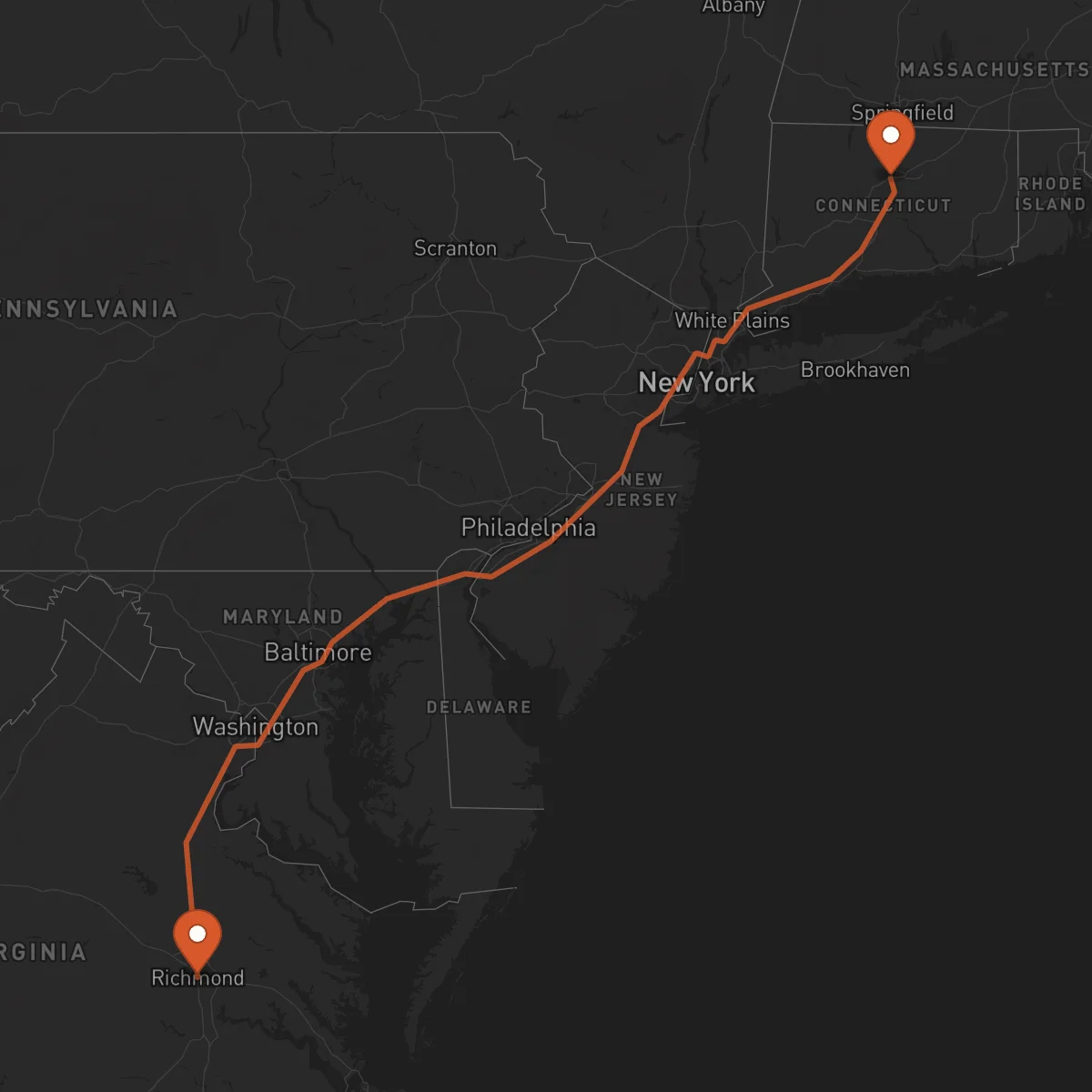
Richmond to Hartford
Hartford → RichmondFTL freight transportation service between Richmond and Hartford. Reliable logistics solutions for your business.
Route Description
Everything you need to know about the corridor Richmond - Hartford
The Richmond to Hartford corridor represents a vital freight transportation link connecting Virginia's capital with Connecticut's capital city. This 622-kilometer domestic route traverses the heart of the Eastern United States, facilitating the movement of goods between two strategically important economic centers. The corridor serves as a crucial artery for commerce, connecting the Mid-Atlantic and New England regions through a well-established network of transportation infrastructure.
The economic significance of this corridor cannot be overstated. Richmond serves as a major distribution hub for the Southeast, while Hartford functions as a key commercial center for New England. Together, these cities anchor a transportation network that supports manufacturing, retail distribution, and industrial supply chains. The route passes through multiple states, each contributing to the diverse economic landscape that relies on efficient freight movement between these two capitals.
Key industries utilizing this corridor include automotive manufacturing and parts distribution, retail and consumer goods, industrial equipment, and technology products. The route also supports the movement of agricultural products from Virginia's rich farming regions to Connecticut's urban markets. Manufacturing facilities in both cities depend on reliable transportation to maintain their supply chains and distribution networks.
Control Terrestre optimizes operations on this corridor through our network of certified transportation providers. We leverage strategic partnerships to ensure consistent service quality across the entire route, from Richmond's port connections to Hartford's industrial parks. Our dedicated FTL services provide the reliability and capacity that businesses require for their critical freight movements along this essential East Coast transportation corridor.
Services for this Route
Available services for the corridor Richmond - Hartford
 Origin
Richmond
Richmond, Virginia stands as a strategic logistics hub positioned along the I-95 corridor, providing seamless access to both coastal and inland transportation networks. The city's location at the fall line of the James River historically established it as a critical distribution point, a role that continues today in modern freight logistics. Richmond's proximity to major ports and its central position within the Mid-Atlantic region make it an ideal origin point for freight distribution throughout the Eastern United States.
The Richmond metropolitan area hosts a diverse economic base including advanced manufacturing, financial services, biotechnology, and food processing industries. The region is home to several Fortune 500 companies and numerous distribution centers that rely on efficient transportation networks. Richmond's economic diversity creates consistent freight demand across multiple sectors, supporting year-round transportation needs.
Transportation infrastructure in Richmond includes extensive highway networks with I-95, I-64, and I-295 providing multiple routing options. The city also benefits from rail connections through CSX Transportation and access to the Port of Richmond for international freight. Richmond International Airport supports air cargo operations, while the city's central location minimizes transit times to major Eastern markets.
 Destination
Hartford
Hartford, Connecticut serves as a strategic logistics endpoint in New England, positioned to serve the dense population centers of the Northeast Corridor. The city's location provides access to major metropolitan areas including Boston, New York City, and Providence within a few hours' drive. Hartford's central Connecticut location makes it an ideal distribution point for reaching the broader New England market and beyond.
The Hartford region's economy is anchored by insurance and financial services, advanced manufacturing, healthcare, and education sectors. The presence of numerous corporate headquarters and distribution facilities creates consistent freight demand for both inbound raw materials and outbound finished products. Hartford's industrial base includes aerospace components, precision instruments, and medical devices that require reliable transportation services.
Transportation infrastructure in Hartford includes access to I-91 and I-84, two major interstate highways that connect the city to regional markets. Bradley International Airport provides air cargo capabilities, while rail freight services operate through the Connecticut River Valley. The city's infrastructure supports efficient distribution throughout Connecticut and neighboring states, with multiple highway options reducing congestion and improving transit reliability.










