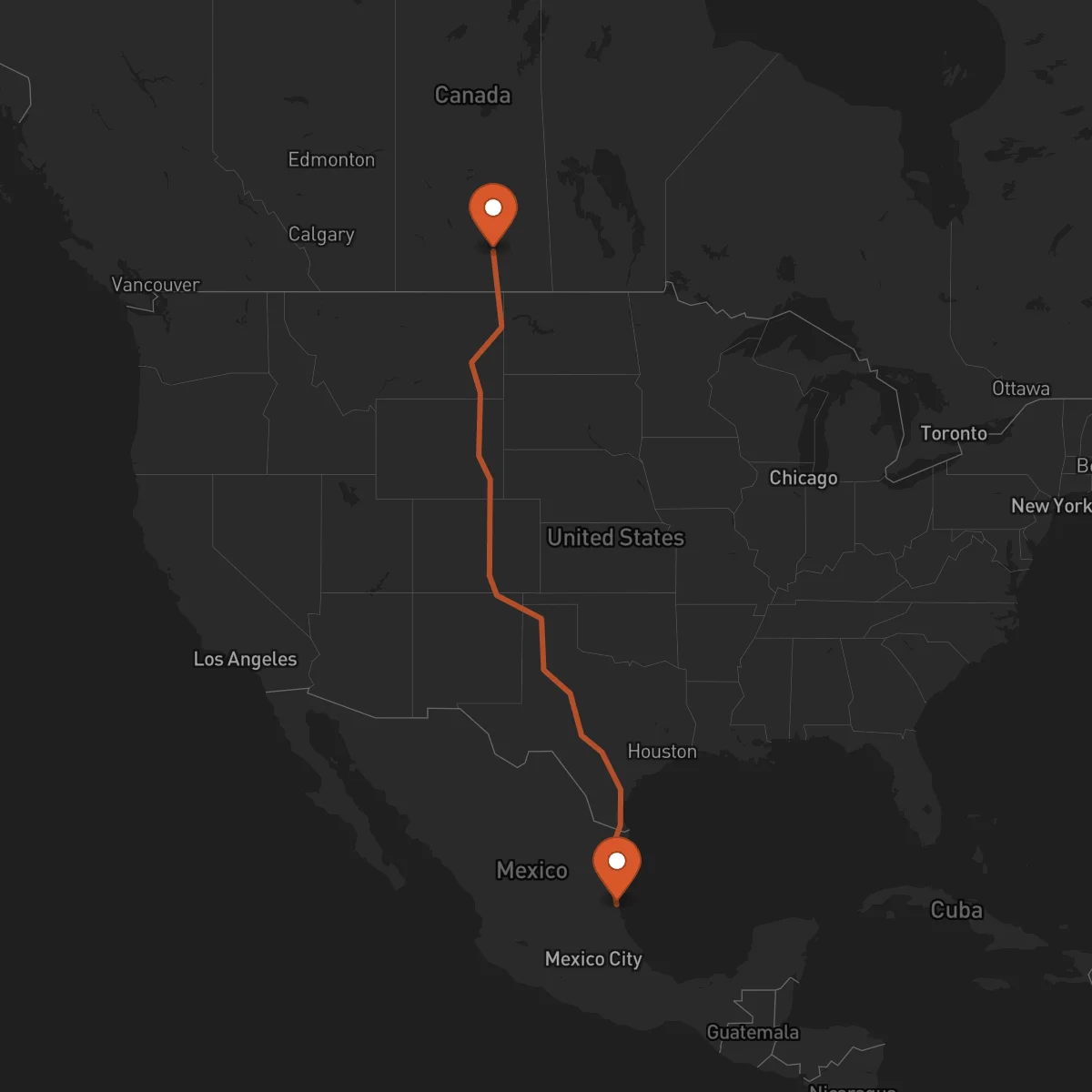
Regina to Tampico
Tampico → ReginaFTL freight transportation service between Regina and Tampico. Reliable logistics solutions for your business.
Route Description
Everything you need to know about the corridor Regina - Tampico
The Regina to Tampico corridor represents a vital cross-border logistics route connecting the Canadian Prairies with Mexico's eastern coast. This 3,194 km transportation corridor serves as a crucial link between Canada's agricultural heartland and Mexico's industrial and port facilities, facilitating the movement of goods across three countries. The route traverses diverse terrain and crosses multiple international borders, requiring specialized expertise in cross-border operations and customs compliance.
The corridor's strategic importance stems from the complementary economic activities of both regions. Saskatchewan's agricultural production, including grains, pulses, and oilseeds, flows south to meet Mexico's growing food processing and manufacturing demands. Meanwhile, Tampico's petrochemical industry and port facilities provide access to international markets for products originating from both Canadian and American sources. The route also supports the automotive supply chain, with parts and components moving between manufacturing facilities across North America.
Key transportation infrastructure includes major highways such as Highway 1 in Saskatchewan, connecting through the United States via Interstate systems, and Mexican Federal Highways 85 and 180 leading to Tampico. The corridor typically crosses at major border points like Laredo/Nuevo Laredo or Reynosa/McAllen, where C-TPAT and FAST certified carriers can expedite customs clearance. Control Terrestre's expertise in cross-border logistics ensures seamless coordination across all jurisdictions, with dedicated teams managing documentation, compliance, and real-time tracking throughout the journey.
Services for this Route
Available services for the corridor Regina - Tampico
 Origin
Regina
Regina, the capital city of Saskatchewan, serves as a strategic logistics hub in Canada's prairie region. Located in the heart of Canada's agricultural belt, Regina provides excellent access to major transportation networks including the Trans-Canada Highway and extensive rail connections. The city's central location makes it an ideal origin point for freight distribution across western Canada and into the United States. Regina's logistics infrastructure includes modern warehousing facilities, intermodal yards, and proximity to major agricultural processing centers that generate significant freight volume.
The Regina region's economy is anchored by agriculture, mining, and energy sectors, with substantial production of grains, potash, and oil. These industries create consistent demand for full truckload transportation services, particularly for bulk commodities and specialized equipment. The city's well-developed transportation infrastructure, including Regina International Airport and connections to major rail lines, provides multiple options for freight consolidation and distribution, making it an efficient starting point for cross-border shipments to Mexico.
 Destination
Tampico
Tampico, located in the state of Tamaulipas on Mexico's eastern Gulf coast, is a strategic logistics gateway for maritime and cross-border trade. The city's proximity to the Gulf of Mexico provides access to one of Mexico's most important port facilities, handling both imports and exports for the central and northern regions of the country. Tampico's location near the US-Mexico border and its connection to major industrial centers make it a crucial node in North American supply chains, particularly for industries requiring ocean freight connectivity.
The Tampico region's economy is diverse, with strong presence in petrochemical processing, food manufacturing, and agricultural exports. The area hosts numerous industrial parks and manufacturing facilities that require reliable inbound logistics for raw materials and outbound transportation for finished goods. The city's transportation infrastructure includes modern port facilities, rail connections to central Mexico, and highway access to major border crossings. This multimodal capability, combined with proximity to industrial clusters in Monterrey and other northern cities, makes Tampico an essential destination for cross-border freight movements originating from Canada.










