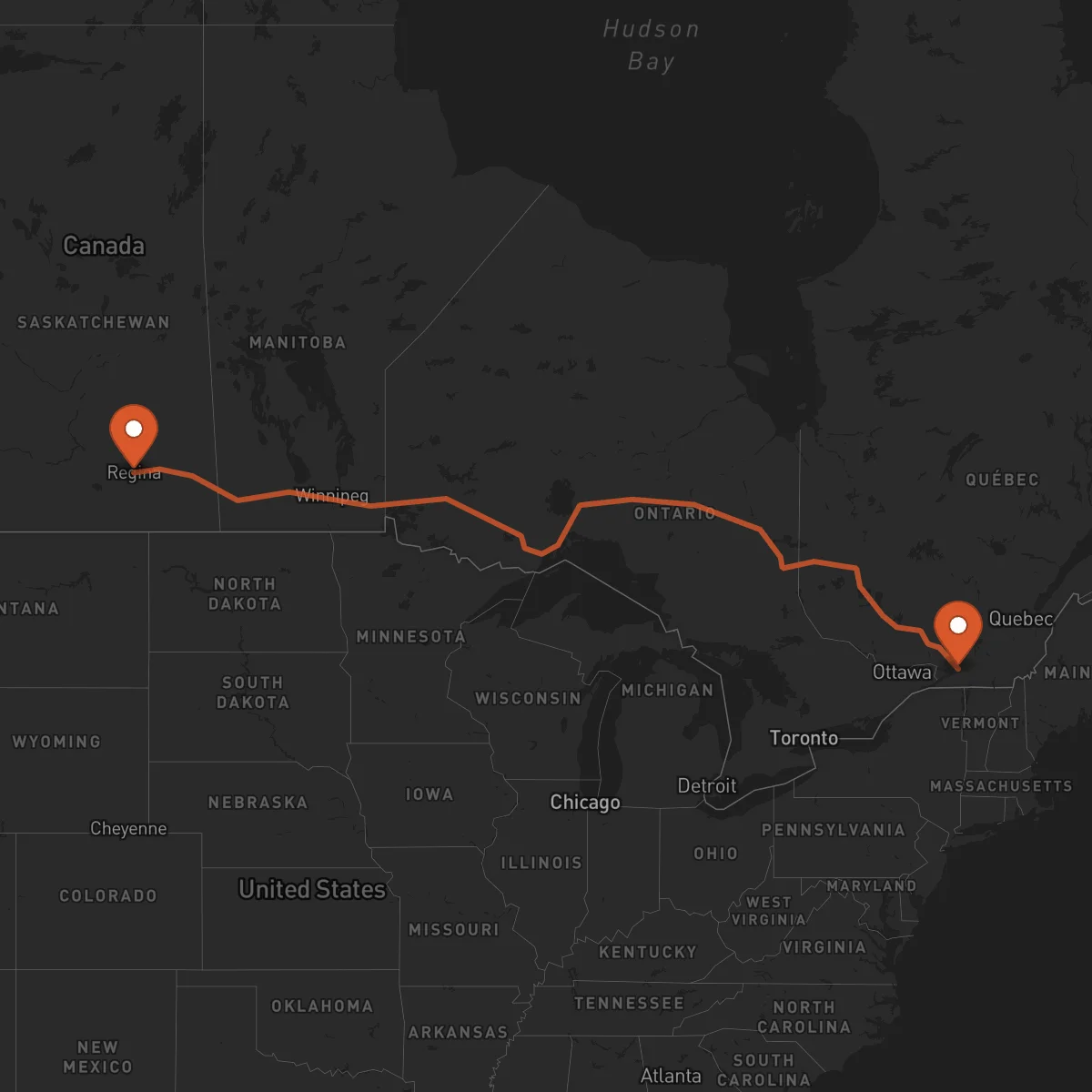
Regina to Montreal
Montreal → ReginaFTL freight transportation service between Regina and Montreal. Reliable logistics solutions for your business.
Route Description
Everything you need to know about the corridor Regina - Montreal
The Regina-Montreal corridor represents one of Canada's most important domestic freight transportation routes, connecting the economic heart of Saskatchewan with Quebec's largest commercial center. This 2,357 km route traverses the vast Canadian landscape, linking the agricultural and energy-rich Prairies with the industrial and commercial powerhouse of Eastern Canada. The corridor is vital for maintaining the flow of goods between Canada's major economic regions, supporting both interprovincial trade and international commerce through the Port of Montreal.
The transportation infrastructure along this route is robust, primarily utilizing the Trans-Canada Highway system and major provincial routes. Highway 1 (Trans-Canada) provides the western connection from Regina through Manitoba, while Ontario's Highway 17 and Quebec's Autoroutes 20 and 40 complete the eastern journey. This well-maintained highway network ensures reliable transit times and supports the heavy freight volumes characteristic of this corridor.
Control Terrestre specializes in providing dedicated full truckload (FTL) services along this corridor, offering companies a reliable partner for their freight transportation needs. Our strategic alliances with certified transportation providers ensure that shipments move efficiently and securely between Regina and Montreal, whether it's agricultural products from Saskatchewan's farms, industrial equipment from Regina's manufacturing sector, or consumer goods destined for Quebec's markets. We understand the unique challenges of this long-haul route and provide tailored solutions to meet our clients' specific requirements.
Services for this Route
Available services for the corridor Regina - Montreal
 Origin
Regina
Regina, the capital city of Saskatchewan, serves as a strategic logistics hub in the Canadian Prairies. Located in the heart of Canada's agricultural and energy regions, Regina benefits from its position as a central distribution point for goods moving throughout Western Canada. The city's economy is anchored by government services, agriculture, and energy sectors, with a growing presence in manufacturing and technology. Regina's transportation infrastructure includes the Regina International Airport, extensive rail connections through Canadian National Railway and Canadian Pacific Railway, and direct access to major highways including the Trans-Canada Highway. The city's central location makes it an ideal origin point for freight distribution across the country.
 Destination
Montreal stands as Quebec's economic powerhouse and one of Canada's most important commercial centers. As the largest city in Quebec and the second-largest in Canada, Montreal serves as a critical gateway for international trade through the Port of Montreal, one of the largest inland ports in the world. The city's diverse economy encompasses aerospace, technology, pharmaceuticals, manufacturing, and finance sectors. Montreal's transportation infrastructure is exceptionally well-developed, featuring Pierre Elliott Trudeau International Airport, extensive rail networks, and a comprehensive highway system including Autoroutes 20, 25, and 40. The Port of Montreal provides crucial connections to global markets, making the city an essential destination for freight from across Canada.










