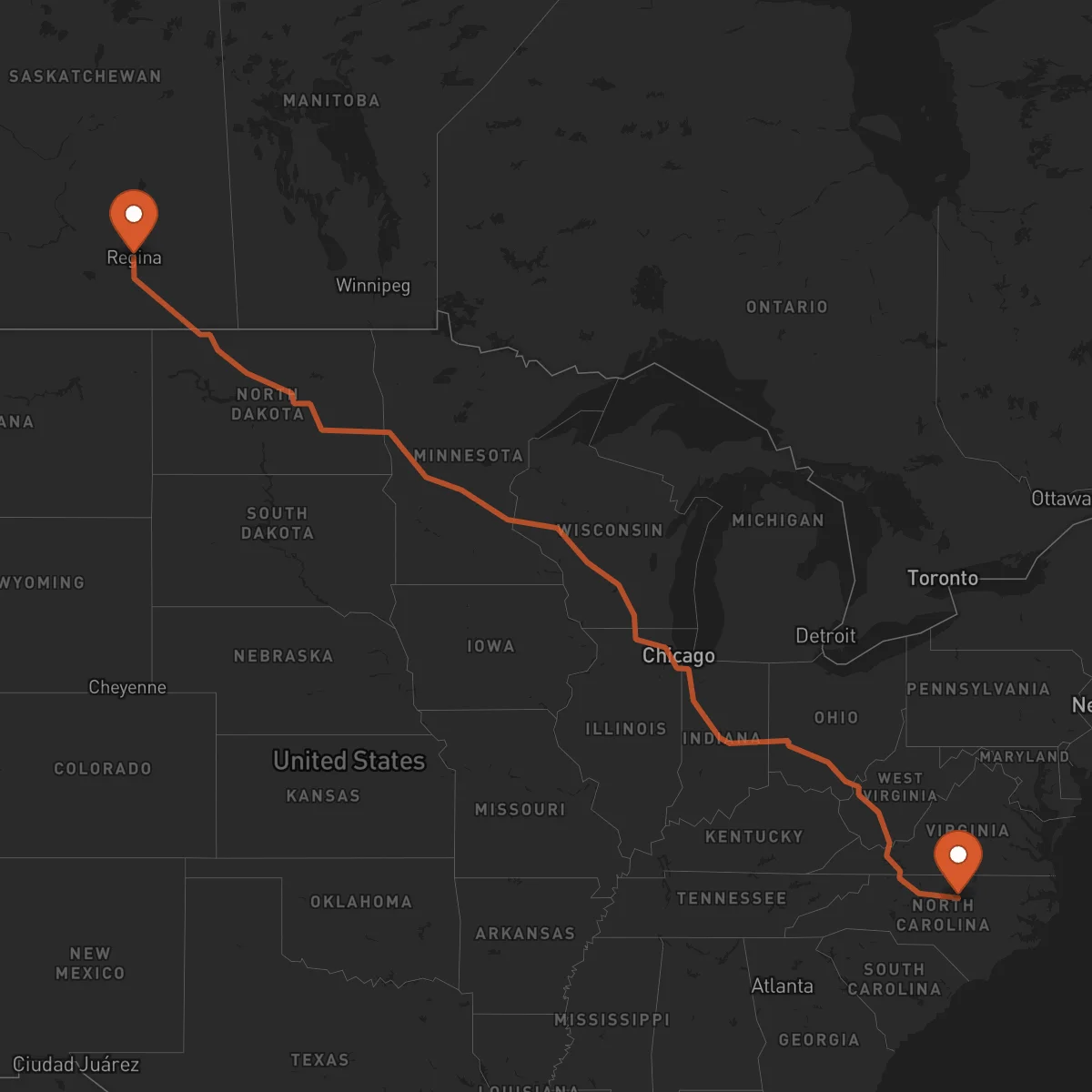
Regina to Durham
Durham → ReginaFTL freight transportation service between Regina and Durham. Reliable logistics solutions for your business.
Route Description
Everything you need to know about the corridor Regina - Durham
The Regina-Durham corridor represents a vital cross-border freight transportation route connecting the Canadian prairies with the southeastern United States. This 2,609 km journey traverses diverse economic regions, linking Saskatchewan's agricultural and energy powerhouse with North Carolina's thriving research and technology hub. The corridor primarily utilizes Interstate 29 South through the United States, connecting with major east-west arteries that facilitate efficient freight movement between these strategic locations.
The economic significance of this route extends beyond simple distance, as it connects two distinct industrial ecosystems. Regina serves as a critical distribution point for Canadian agricultural products, mining equipment, and energy sector materials, while Durham has emerged as a center for pharmaceutical research, biotechnology, and advanced manufacturing. This complementary economic relationship creates consistent freight demand moving in both directions, with specialized equipment often required for oversized industrial components and temperature-sensitive pharmaceutical products.
Transportation infrastructure along this corridor includes well-maintained highways, with key border crossings at locations such as Pembina or Portal, depending on the specific route chosen. Control Terrestre's expertise in cross-border operations ensures seamless customs clearance and compliance with both Canadian and US regulations. Our network of certified carriers provides dedicated full truckload services, offering door-to-door solutions that optimize transit times and maintain the integrity of valuable cargo throughout this extensive journey.
Services for this Route
Available services for the corridor Regina - Durham
 Origin
Regina
Regina, the capital city of Saskatchewan, stands as a strategic logistics hub in Western Canada. Located in the heart of the Canadian prairies, the city benefits from its position at the intersection of the Trans-Canada Highway and major north-south corridors. Regina's transportation infrastructure includes the Regina International Airport, extensive rail connections through Canadian National Railway and Canadian Pacific Railway, and a well-developed road network that facilitates efficient distribution throughout the region.
The city's economy is anchored in agriculture, mining, and energy sectors, with Saskatchewan being a global leader in potash and uranium production. Regina serves as a central distribution point for these commodities, along with agricultural products from the surrounding prairie provinces. The presence of major government institutions, educational facilities, and growing technology sectors has diversified the local economy, creating consistent demand for specialized freight services. Regina's strategic location makes it an ideal origin point for cross-border shipments to US markets, particularly for oversized equipment and bulk commodities that require dedicated transportation solutions.
 Destination
Durham
Durham, North Carolina, represents a dynamic logistics destination in the southeastern United States, strategically positioned within the Research Triangle region. The city benefits from proximity to major transportation arteries including Interstate 85 and Interstate 40, providing excellent connectivity to regional and national markets. Raleigh-Durham International Airport and the nearby Port of Wilmington offer multimodal transportation options that enhance the region's distribution capabilities.
The Durham area has evolved into a powerhouse of innovation, with strong presence in pharmaceutical research, biotechnology, and advanced manufacturing. Home to Duke University and numerous research institutions, the region attracts significant investment in life sciences and technology sectors. This industrial composition creates specific freight transportation needs, particularly for temperature-controlled shipments, specialized equipment, and time-sensitive deliveries. The area's growing population and economic development have increased demand for consumer goods distribution, making Durham an important destination for cross-border freight from Canadian suppliers and manufacturers.










