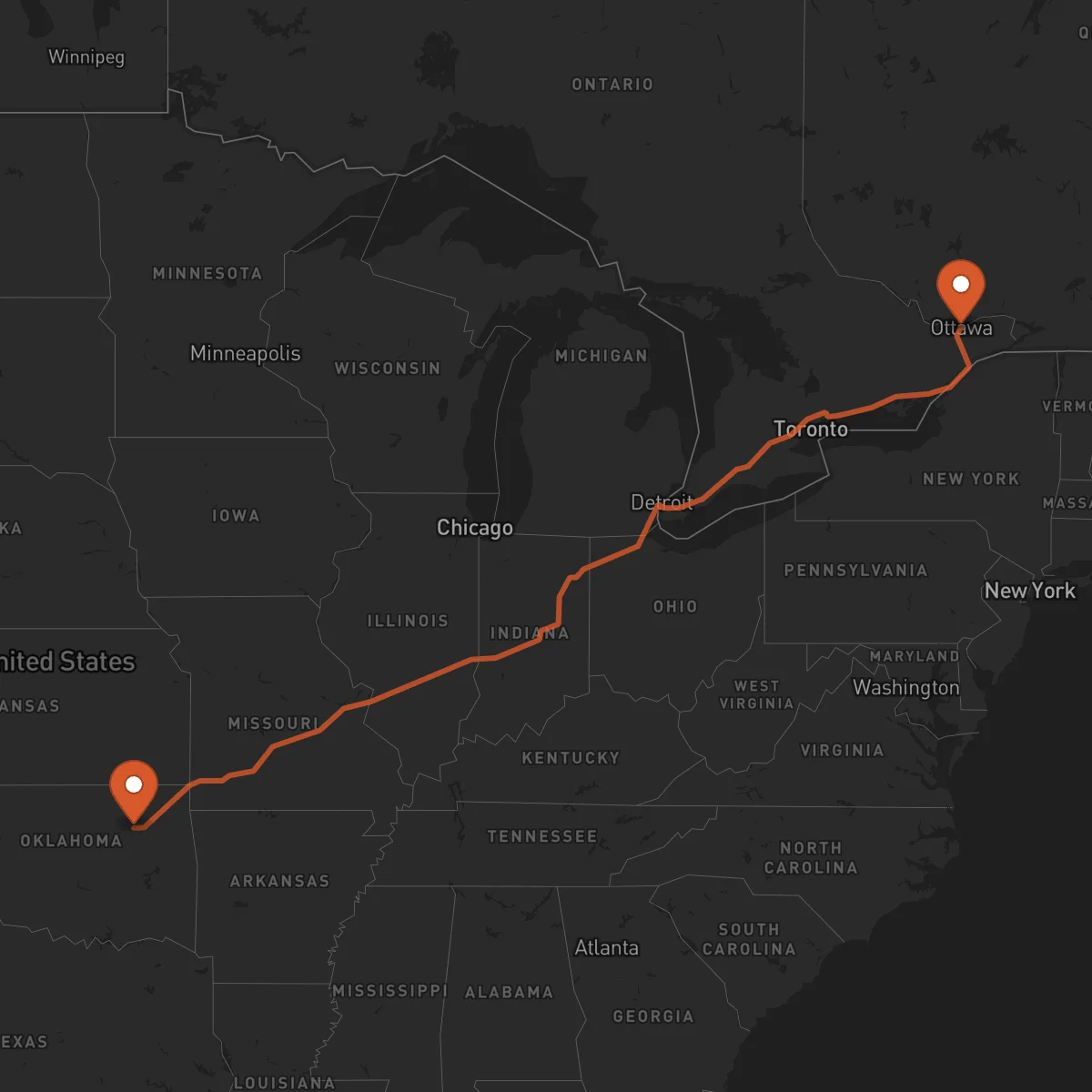
Ottawa to Tulsa
Tulsa → OttawaFTL freight transportation service between Ottawa and Tulsa. Reliable logistics solutions for your business.
Route Description
Everything you need to know about the corridor Ottawa - Tulsa
The Ottawa-Tulsa corridor represents a vital cross-border logistics connection between Canada and the United States, spanning approximately 1986 kilometers through key industrial regions. This route links Canada's capital region with Oklahoma's energy and manufacturing hub, creating essential supply chain opportunities for businesses operating in both countries. The corridor traverses major economic zones, connecting Ontario's manufacturing base with the central United States' industrial heartland.
This transportation route serves critical industries including automotive manufacturing, aerospace components, energy equipment, and agricultural products. Ottawa's technology sector and government institutions generate significant B2B freight volumes, while Tulsa's oil and gas industry, along with its manufacturing capabilities, creates substantial inbound and outbound logistics demand. The corridor particularly benefits companies requiring specialized freight services for heavy equipment, industrial machinery, and temperature-sensitive products.
Key transportation infrastructure includes Interstate 69 and Interstate 44 in the United States, connecting with Ontario's provincial highways and the Ottawa region's road network. The corridor crosses at major border points, with customs clearance procedures streamlined through our C-TPAT-certified partners. Control Terrestre facilitates seamless cross-border operations with dedicated FTL services, ensuring compliance with customs regulations while maintaining transit efficiency. Our specialized team manages documentation, border procedures, and provides real-time tracking throughout this important North American trade route.
Services for this Route
Available services for the corridor Ottawa - Tulsa
 Origin
Ottawa serves as a strategic logistics hub in eastern Ontario, offering excellent connectivity to major Canadian and U.S. markets. The city's location provides direct access to Highway 417, connecting to Highway 401 and onward to the U.S. border. Ottawa's transportation infrastructure includes Ottawa International Airport, rail connections through CN and CP rail networks, and proximity to major ports via the Great Lakes shipping routes. The region's logistics capabilities are enhanced by its position as Canada's capital, with specialized facilities for government and defense-related freight movements.
 Destination
Tulsa
Tulsa functions as a crucial logistics center in the central United States, strategically positioned for freight distribution across the Midwest and South. The city benefits from its location at the intersection of major interstate highways, including I-44 and I-244, providing efficient access to regional markets. Tulsa International Airport and nearby regional airports support air freight operations, while the Tulsa Port of Catoosa offers inland waterway access via the McClellan-Kerr Arkansas River Navigation System. The city's rail infrastructure, served by BNSF and Union Pacific, further strengthens its position as a multimodal transportation hub.










