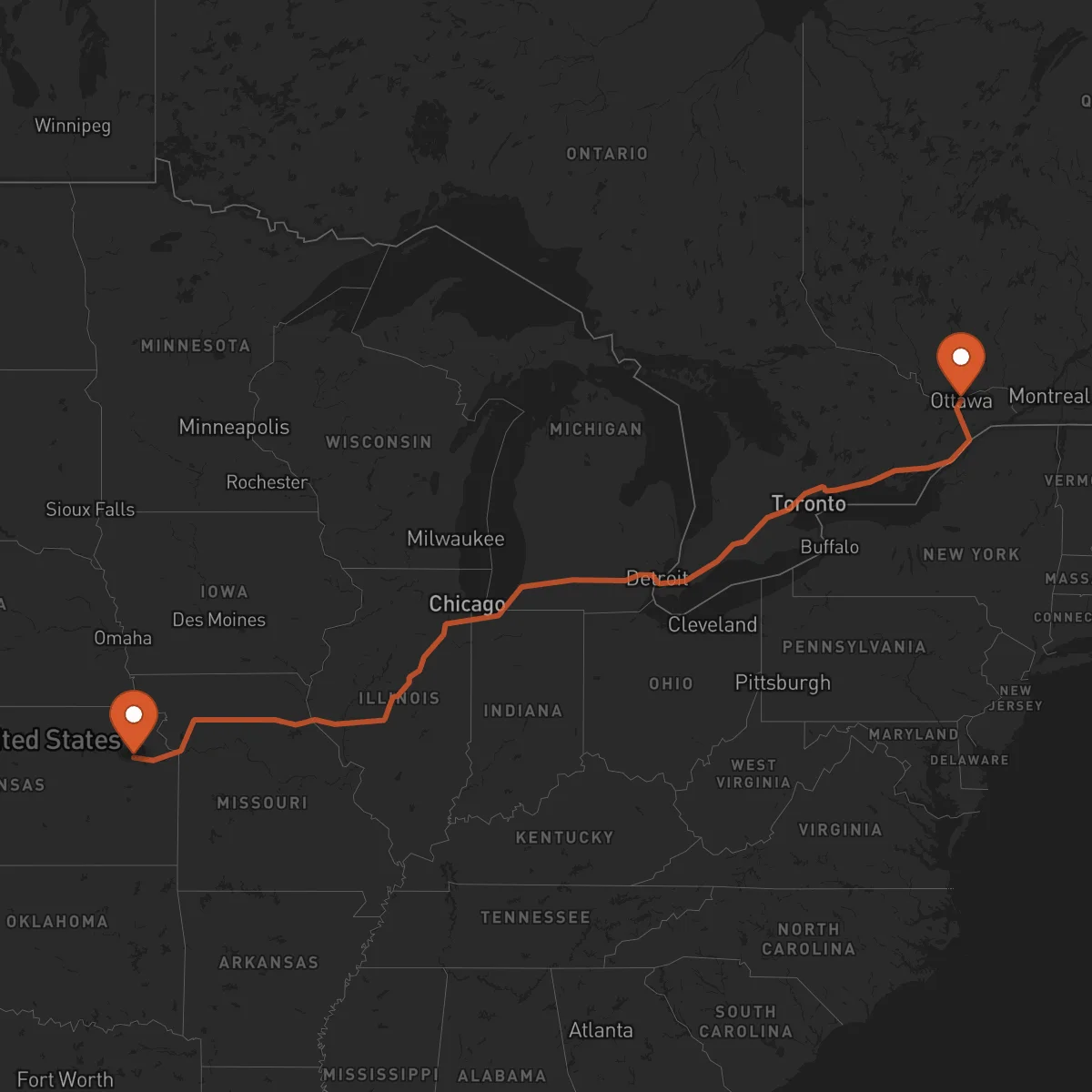
Ottawa to Topeka
Topeka → OttawaFTL freight transportation service between Ottawa and Topeka. Reliable logistics solutions for your business.
Route Description
Everything you need to know about the corridor Ottawa - Topeka
The Ottawa to Topeka corridor represents a vital cross-border freight route connecting the economic heart of Canada's capital region with the industrial center of Kansas. This 1785 km transportation link facilitates the movement of goods between two major North American markets, serving as a critical artery for supply chain operations. The route traverses diverse terrain and crosses international borders, requiring expertise in customs procedures and cross-border logistics coordination.
The economic significance of this corridor is substantial, supporting trade between Canada's technology and government sectors in Ottawa with Kansas's manufacturing, agricultural, and food processing industries in Topeka. Key industries utilizing this route include automotive parts, agricultural equipment, food products, and industrial machinery. The corridor benefits from well-developed transportation infrastructure, primarily utilizing Interstate 81 and Interstate 70 for the U.S. segment, providing efficient transit between major economic centers.
Cross-border operations at key points such as the Thousand Islands Bridge or Ogdensburg-Prescott Bridge require specialized knowledge of customs documentation and procedures. Control Terrestre's expertise in managing these complexities ensures seamless freight movement across the Canada-U.S. border. Our strategic partnerships with certified carriers and customs brokers facilitate efficient clearance processes, minimizing delays and ensuring compliance with all regulatory requirements. We provide dedicated FTL services that maintain cargo integrity throughout the journey, offering reliable transportation solutions for businesses operating between these two important markets.
Services for this Route
Available services for the corridor Ottawa - Topeka
 Origin
Ottawa serves as a strategic logistics hub in Eastern Canada, leveraging its position as the nation's capital and a major technology center. The city's location along the Ottawa River provides access to both road and rail transportation networks, with major highways including the 416 and 417 connecting to the broader Canadian transportation system. Ottawa's economy is characterized by government services, technology, and healthcare sectors, creating diverse freight transportation needs. The city's infrastructure includes the Ottawa Macdonald-Cartier International Airport and extensive warehousing facilities that support both domestic and international trade operations.
 Destination
Topeka
Topeka functions as a strategic logistics center in the heart of the American Midwest, benefiting from its central location within the United States. The city's position along major transportation corridors provides excellent connectivity to regional and national markets. Topeka's economy is anchored by manufacturing, healthcare, and government services, with significant activity in food processing and agricultural equipment production. The city's transportation infrastructure includes access to Interstate 70 and rail connections through the Topeka Regional Airport, supporting efficient distribution networks for businesses operating in the region.










