Ottawa to Los Angeles
Los Angeles → OttawaFTL freight transportation service between Ottawa and Los Angeles. Reliable logistics solutions for your business.
Route Description
Everything you need to know about the corridor Ottawa - Los Angeles
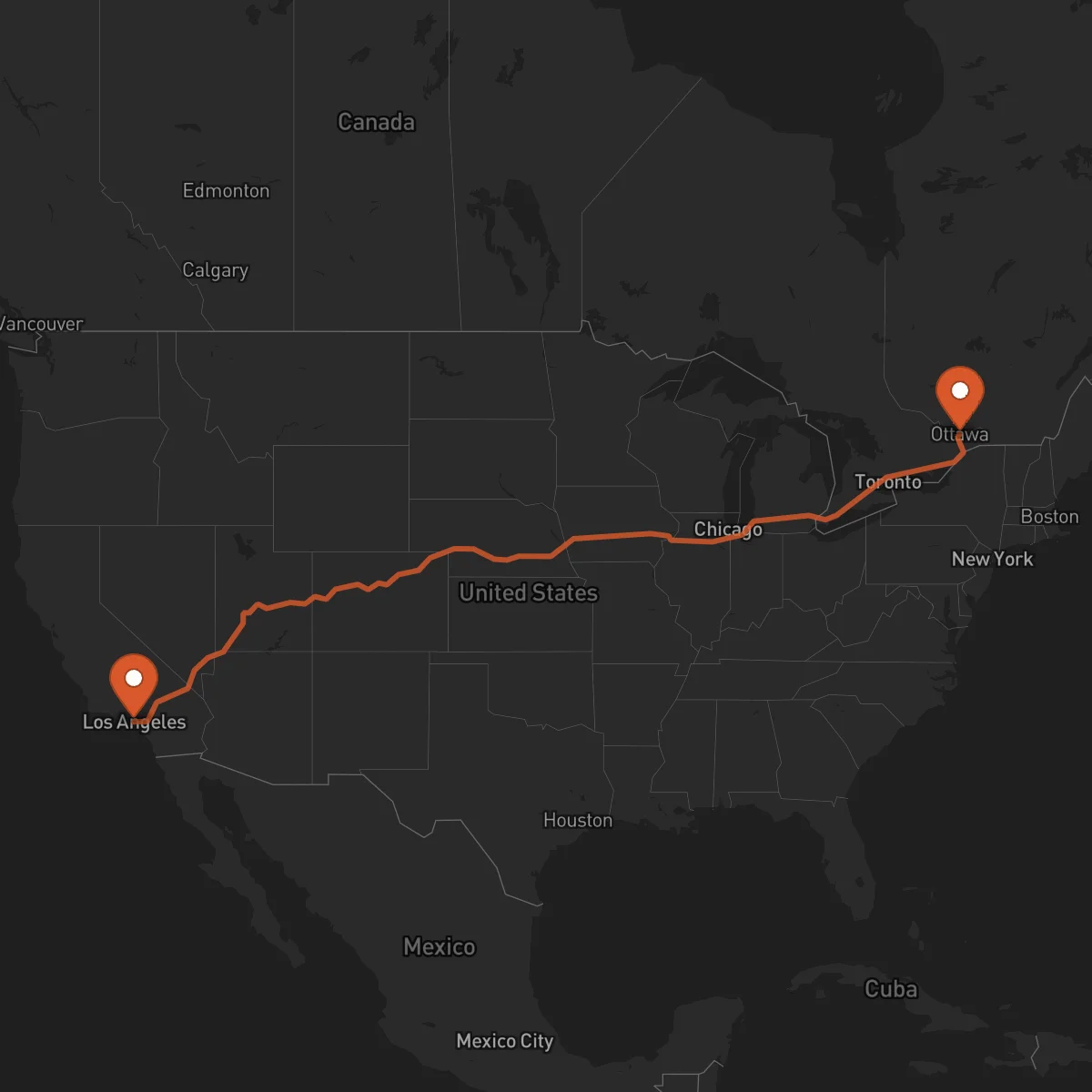
The logistics corridor connecting Ottawa, Ontario, to Los Angeles, California, represents a vital cross-border freight route spanning approximately 3,800 kilometers. This corridor links Canada's capital region with one of the United States' most important economic hubs, facilitating the movement of goods between two major North American markets. The route traverses diverse landscapes and crosses multiple states and provinces, making it a complex but essential transportation pathway for businesses engaged in international trade.
The economic significance of this corridor is substantial, connecting Ottawa's government and technology sectors with Los Angeles' entertainment, manufacturing, and international trade industries. Ottawa serves as a major center for technology, research, and public administration, while Los Angeles functions as a global gateway for international commerce, particularly through the Port of Los Angeles and its extensive manufacturing base. This complementary economic relationship drives consistent freight demand along the route.
Key industries utilizing this corridor include technology and telecommunications equipment, automotive parts, aerospace components, and general manufactured goods. The route primarily follows major transportation infrastructure including Interstate 80 and Interstate 70 through the United States, with Ontario's Highway 401 serving as the Canadian segment. The corridor crosses at several potential border points, with Detroit-Windsor being a primary option, though other crossings may be utilized based on specific routing requirements and customs considerations.
Control Terrestre facilitates seamless operations along this corridor by providing dedicated FTL transportation services with experienced drivers familiar with cross-border requirements. Our C-TPAT-certified carriers ensure efficient customs clearance and compliance with all regulatory requirements. We coordinate all aspects of the journey, from origin pickup in Ottawa to final delivery in Los Angeles, maintaining consistent communication throughout the transit process to ensure reliable and timely freight movement between these two strategic locations.
Services for this Route
Available services for the corridor Ottawa - Los Angeles
 Origin
Ottawa, Ontario, serves as a strategic logistics hub in eastern Canada, combining its role as the nation's capital with a growing technology and innovation sector. The city's location along the Ottawa River provides access to major transportation networks, including the Trans-Canada Highway system and connections to Highway 401, Canada's busiest highway. Ottawa's economy is anchored by government operations, but has diversified significantly with the presence of technology companies, research institutions, and advanced manufacturing facilities. The city's logistics infrastructure includes multiple freight terminals, warehousing facilities, and proximity to major airports and rail connections, making it well-equipped to handle cross-border freight movements efficiently.
 Destination
Los Angeles
Los Angeles, California, stands as one of North America's most critical logistics and transportation hubs, serving as the primary gateway for trans-Pacific trade. The city's strategic location on the Pacific Coast provides direct access to one of the world's busiest ports, the Port of Los Angeles, which handles millions of containers annually. Los Angeles boasts an extensive transportation infrastructure including multiple interstate highways, a major international airport, and comprehensive rail networks connecting to inland distribution centers. The region's economy is diverse, encompassing entertainment, aerospace, technology, and manufacturing sectors, all of which generate substantial freight transportation demand. The city's position as a distribution center for goods throughout the western United States makes it an essential endpoint for cross-border freight corridors.










