Ottawa to Lincoln
Lincoln → OttawaFTL freight transportation service between Ottawa and Lincoln. Reliable logistics solutions for your business.
Route Description
Everything you need to know about the corridor Ottawa - Lincoln
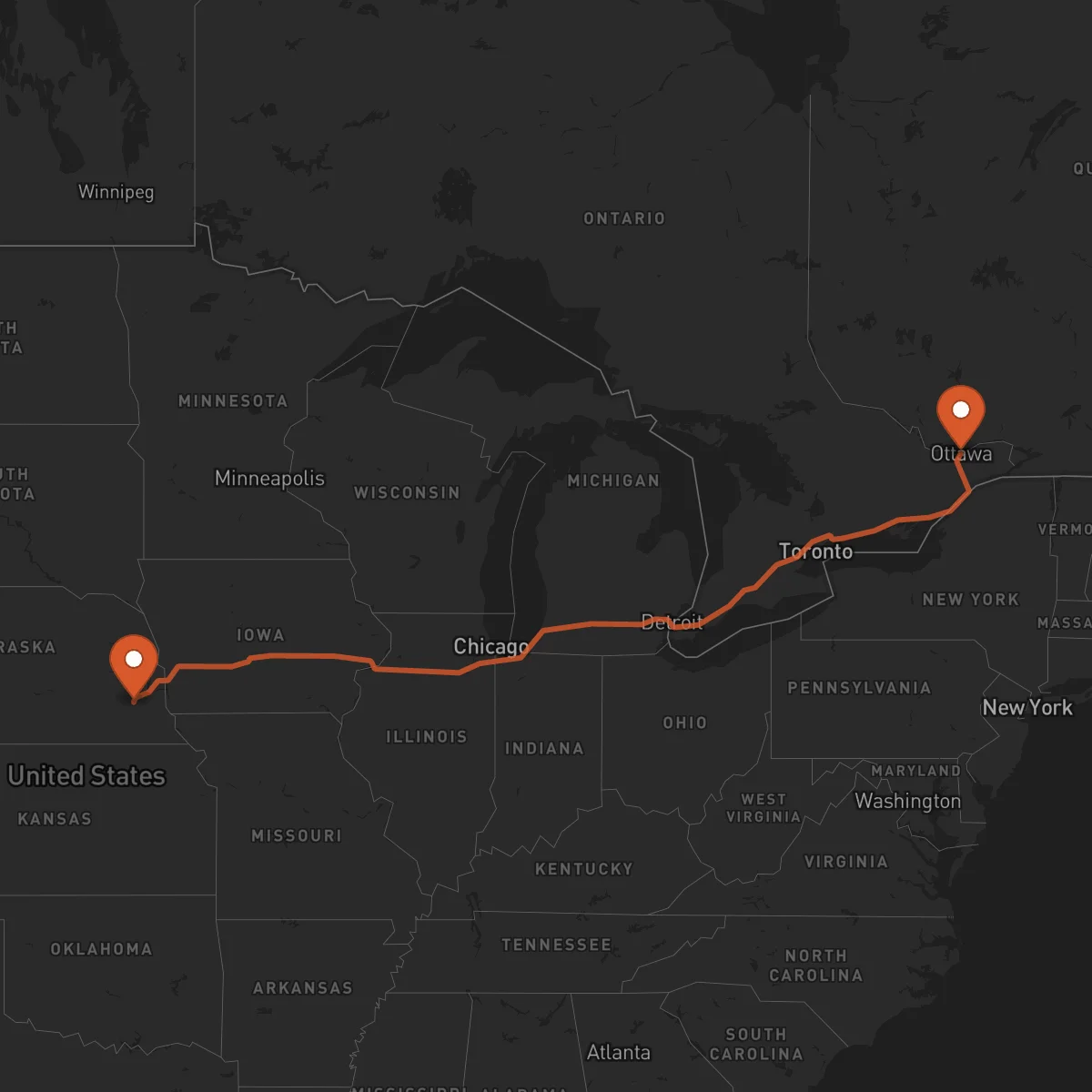
The Ottawa-Lincoln corridor represents a vital cross-border logistics route connecting Canada's capital with the heart of the United States. This 1,774 km transportation link bridges two dynamic economic regions, facilitating the movement of goods between Ontario's manufacturing hub and Nebraska's agricultural and industrial centers. The corridor traverses major urban centers and rural landscapes, offering diverse freight opportunities for businesses operating in both countries.
The economic significance of this route extends beyond its geographical span. Ottawa serves as Canada's political and technological epicenter, while Lincoln anchors Nebraska's thriving agricultural and manufacturing sectors. This complementary economic relationship creates substantial freight demand, with Ottawa's tech exports meeting Lincoln's industrial needs and Nebraska's agricultural products flowing northward to Canadian markets.
Key industries utilizing this corridor include technology equipment, agricultural machinery, processed foods, and industrial components. The route primarily follows Interstate 80 through the United States, connecting with Canadian Highway 401 at the Ontario border. Major border crossings at Detroit-Windsor and Sarnia-Port Huron provide efficient customs processing for cross-border freight, with Control Terrestre's C-TPAT certification ensuring expedited clearance for eligible shipments.
Control Terrestre optimizes this corridor through our extensive network of certified carriers and strategic partnerships. Our expertise in cross-border documentation, customs compliance, and dedicated FTL services ensures seamless transportation from origin to destination. We provide real-time tracking, temperature-controlled options for sensitive cargo, and specialized handling for oversized or hazardous materials, making us the trusted partner for businesses requiring reliable freight movement between Ottawa and Lincoln.
Services for this Route
Available services for the corridor Ottawa - Lincoln
 Origin
Ottawa stands as Canada's capital and a strategic logistics hub in Eastern Ontario. The city's location at the confluence of the Ottawa, Rideau, and Gatineau rivers provides natural transportation advantages, while its proximity to major highways like the 417 and 416 creates excellent ground transportation connectivity. Ottawa's economy thrives on technology, government services, and advanced manufacturing, generating consistent freight demand for specialized equipment and high-value goods.
The city's transportation infrastructure includes Ottawa International Airport for air freight, extensive rail connections through CN and CP rail networks, and a well-developed highway system. The Port of Montreal, though several hours away, provides ocean freight access for international shipments. Ottawa's tech corridor, often called 'Silicon Valley North,' produces significant electronics and telecommunications equipment that requires specialized FTL transportation services to various U.S. destinations.
 Destination
Lincoln
Lincoln serves as Nebraska's capital and a strategic logistics center in the American Midwest. Located in the southeastern part of the state, Lincoln provides excellent access to major freight corridors including Interstate 80, which connects the East and West Coasts. The city's central location makes it an ideal distribution point for goods moving throughout the central United States, with its transportation infrastructure supporting efficient freight movement in all directions.
The Lincoln economy centers on agriculture, manufacturing, education, and healthcare, creating diverse freight transportation needs. The city hosts the University of Nebraska system, numerous food processing facilities, and growing technology companies. Lincoln Airport provides air cargo services, while the city's rail connections through Union Pacific support bulk freight movements. The surrounding agricultural region generates substantial freight volume for both inbound agricultural inputs and outbound processed agricultural products.










