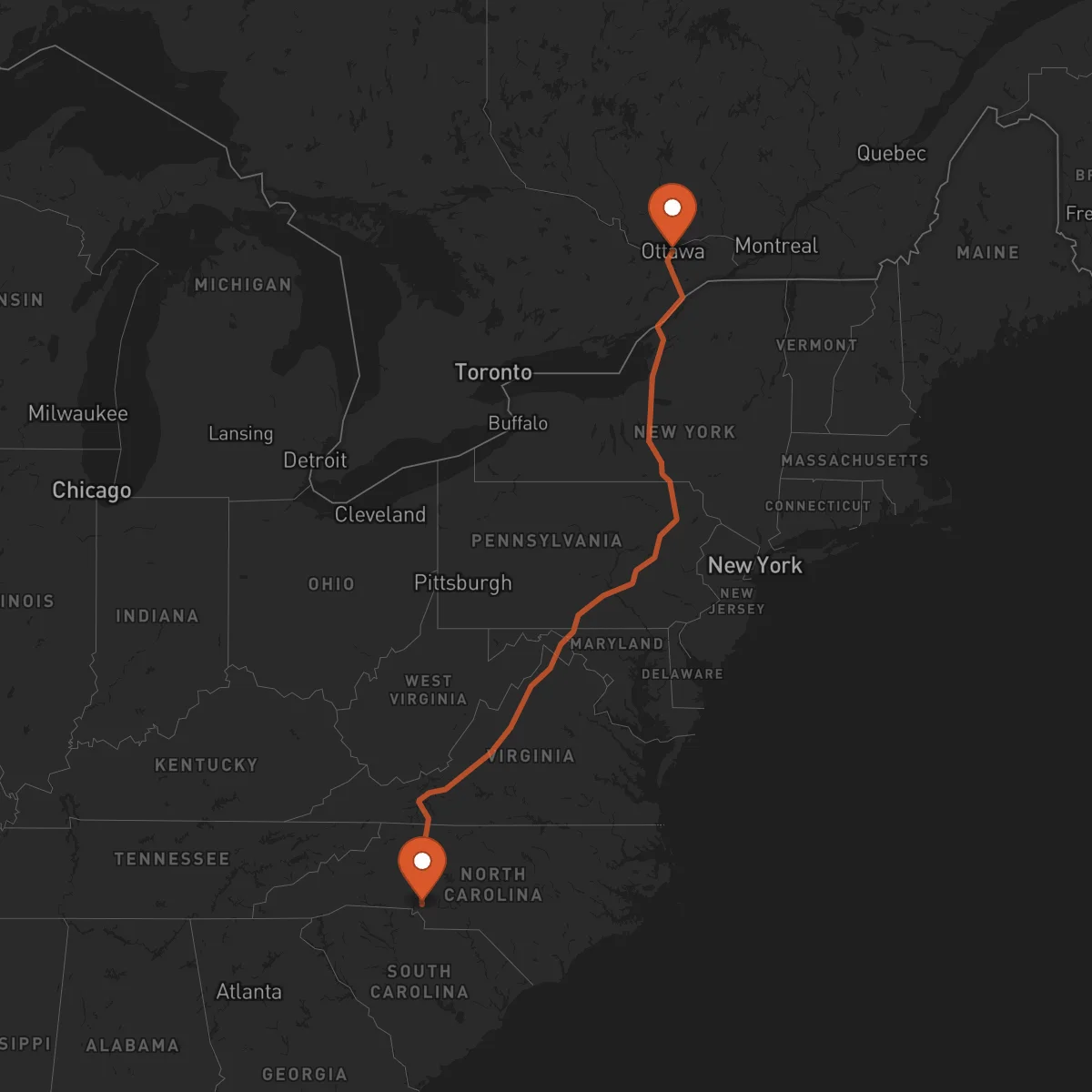
Ottawa to Charlotte
Charlotte → OttawaFTL freight transportation service between Ottawa and Charlotte. Reliable logistics solutions for your business.
Route Description
Everything you need to know about the corridor Ottawa - Charlotte
The logistics corridor between Ottawa, Ontario, and Charlotte, North Carolina, represents a vital cross-border connection between Canada and the United States. This 1,214 km route traverses diverse economic regions, linking Canada's capital with one of the Southeast's most dynamic metropolitan areas. The corridor serves as a critical supply chain artery for industries requiring efficient transportation between the Great Lakes region and the growing markets of the Carolinas.
The route follows major transportation infrastructure including Highway 401 through Ontario, connecting to Interstate 81 and Interstate 77 in the United States. This network provides reliable access through key economic zones and industrial centers. The corridor crosses at strategic border points, facilitating smooth customs clearance for cross-border freight movements. Control Terrestre's expertise in managing cross-border logistics ensures seamless operations through customs procedures, documentation requirements, and regulatory compliance for shipments moving between these two important North American markets.
This corridor is particularly significant for automotive, technology, and manufacturing sectors that operate on both sides of the border. Ottawa's role as a governmental and technological hub complements Charlotte's emergence as a financial and logistics center. The route supports just-in-time inventory systems and time-sensitive deliveries essential for modern supply chains. Control Terrestre provides dedicated FTL services along this corridor, offering the reliability and capacity that businesses need for their full truckload shipments between these strategic locations.
Services for this Route
Available services for the corridor Ottawa - Charlotte
 Origin
Ottawa, Ontario, serves as a strategic logistics hub in Canada's capital region. Located at the confluence of the Ottawa, Rideau, and Gatineau rivers, the city benefits from excellent transportation connectivity through Highway 417 (Queensway) and proximity to major cross-border routes. Ottawa's economy is diverse, with strong sectors in technology (often called 'Silicon Valley North'), government services, healthcare, and education. The city hosts numerous federal government operations and has become a center for research and development, particularly in telecommunications, software, and photonics. Ottawa's transportation infrastructure includes the Macdonald-Cartier International Airport, extensive rail connections through Via Rail, and access to the Port of Montreal via road and rail for international freight. The region's logistics capabilities are enhanced by its educated workforce and proximity to major Canadian markets.
 Destination
Charlotte
Charlotte, North Carolina, stands as a strategic logistics and distribution center in the southeastern United States. Located in the Piedmont region, Charlotte offers excellent connectivity through Interstates 77, 85, and 485, providing efficient access to major East Coast markets. The city has emerged as the second-largest banking center in the nation and hosts the East Coast headquarters of major financial institutions. Charlotte's economy is diverse, with significant presence in energy (particularly banking and finance), motorsports, technology, and advanced manufacturing. The region benefits from the Charlotte Douglas International Airport, one of the busiest airports in the world for aircraft movements, and extensive rail infrastructure operated by Norfolk Southern and CSX. The city's pro-business environment and central East Coast location make it an attractive destination for logistics operations, warehousing, and distribution centers serving the Southeast and beyond.










