Ottawa to Boston
Boston → OttawaFTL freight transportation service between Ottawa and Boston. Reliable logistics solutions for your business.
Route Description
Everything you need to know about the corridor Ottawa - Boston
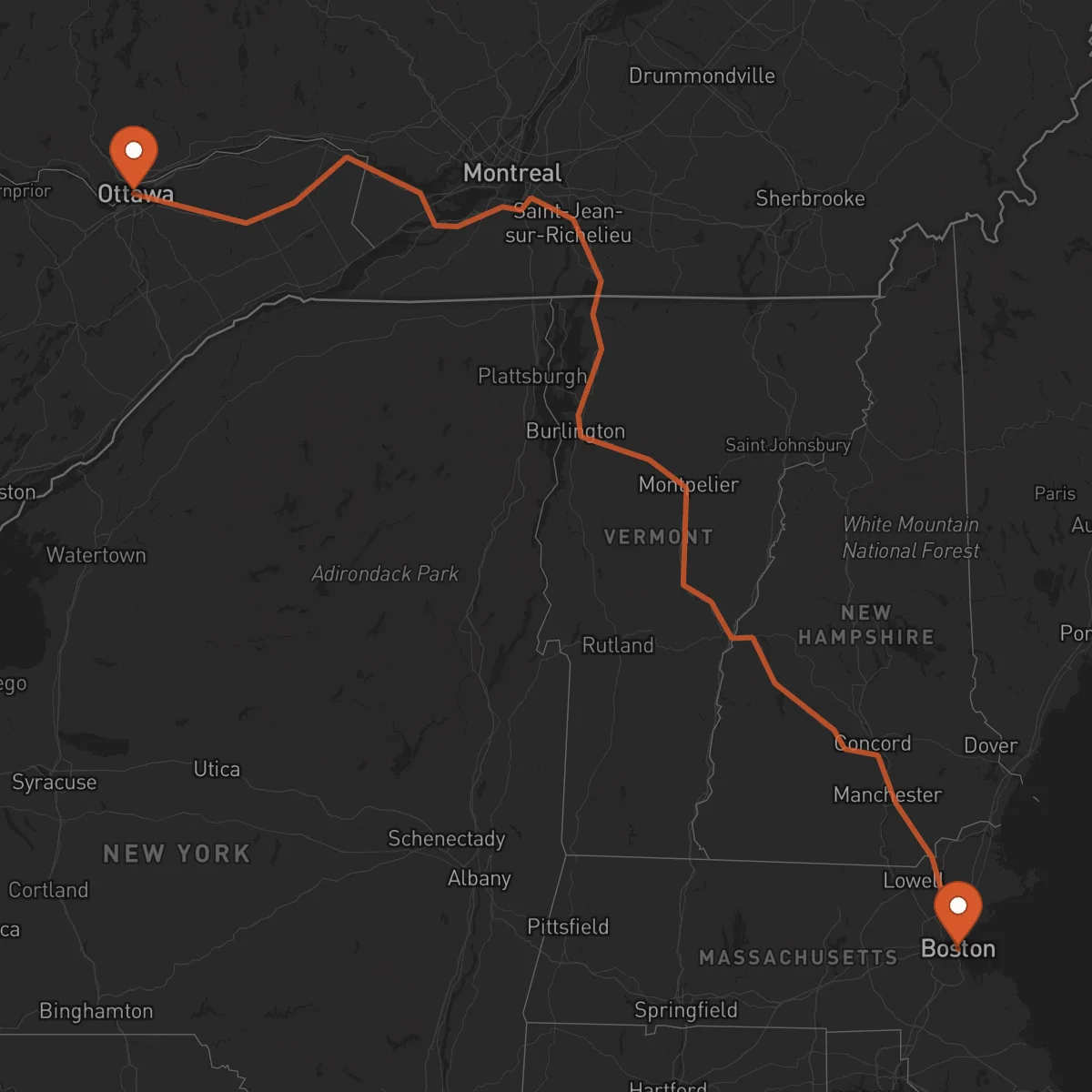
The Ottawa-Boston corridor represents a vital cross-border logistics connection between Canada and the United States, spanning approximately 504 kilometers through the heart of North America. This strategic route links Canada's capital region with one of New England's most important economic centers, facilitating the movement of goods between two major industrial and commercial hubs. The corridor traverses diverse terrain and crosses the international border, requiring specialized knowledge of customs procedures and cross-border regulations.
The economic significance of this corridor is substantial, connecting Ottawa's government, technology, and research sectors with Boston's renowned biotechnology, healthcare, and educational institutions. Major industries utilizing this route include advanced manufacturing, pharmaceuticals, electronics, and high-tech equipment. The corridor also supports the movement of agricultural products from the Ottawa Valley and specialized goods from both metropolitan areas.
Transportation infrastructure along the Ottawa-Boston corridor includes major highways such as Autoroute 20 and Interstate 89, providing reliable freight movement. The primary border crossing at Highgate Springs-St. Armand facilitates efficient customs clearance for cross-border shipments. Control Terrestre's expertise in managing cross-border documentation, compliance requirements, and dedicated FTL services ensures seamless operations along this corridor, providing our clients with reliable, timely delivery of their freight between Ottawa and Boston.
Services for this Route
Available services for the corridor Ottawa - Boston
 Origin
Ottawa, Canada's capital city, serves as a strategic logistics hub in Eastern Ontario with excellent transportation connectivity. The city's location at the confluence of the Ottawa, Gatineau, and Rideau rivers provides natural advantages for freight movement. Ottawa's economy is driven by government services, technology (earning it the nickname 'Silicon Valley North'), research institutions, and advanced manufacturing. The city boasts comprehensive transportation infrastructure including major highways (Autoroutes 5, 7, 50, and 416), Ottawa International Airport, and rail connections through Via Rail and freight services. The Port of Montreal, accessible via highway, provides additional maritime freight options. Ottawa's skilled workforce and concentration of knowledge-based industries create consistent demand for specialized freight services, particularly for high-tech equipment, biotechnology products, and government-related shipments.
 Destination
Boston
Boston, Massachusetts stands as a premier logistics destination on the East Coast of the United States, offering unparalleled access to the New England market and beyond. As one of America's oldest and most economically vibrant cities, Boston serves as a gateway to the northeastern United States with its strategic coastal location. The city's economy is anchored by world-class healthcare institutions, prestigious universities, financial services, biotechnology, and advanced manufacturing. Boston's transportation infrastructure is exceptionally robust, featuring Logan International Airport (one of the busiest in the northeastern US), extensive highway networks (I-90, I-93, I-95), and the Port of Boston for maritime freight. The city's concentration of research institutions and hospitals creates consistent demand for specialized freight services, including temperature-controlled shipments, high-value equipment, and time-sensitive medical supplies. Boston's role as a regional economic powerhouse makes it a critical destination for cross-border freight from Canada.










