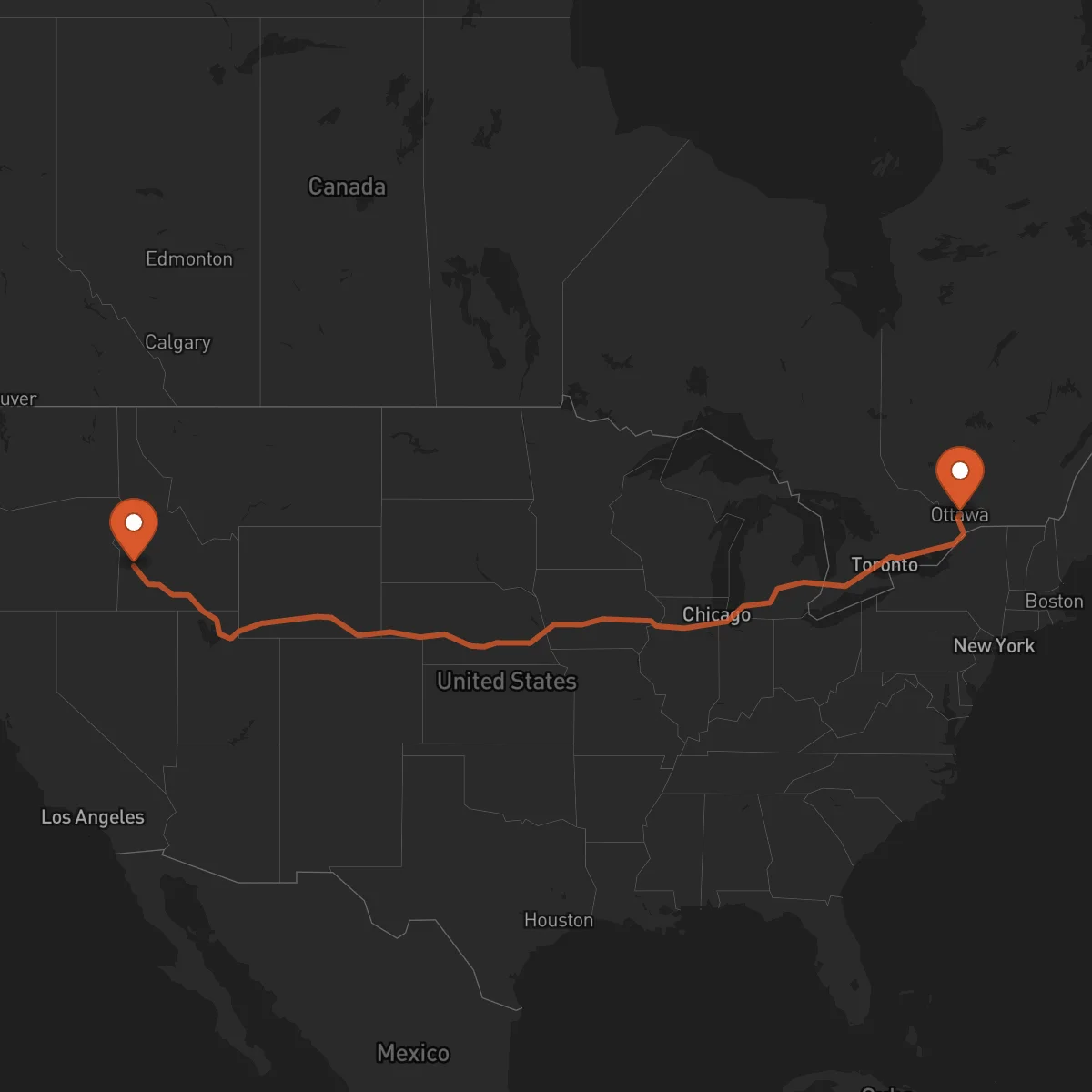
Ottawa to Boise
Boise → OttawaFTL freight transportation service between Ottawa and Boise. Reliable logistics solutions for your business.
Route Description
Everything you need to know about the corridor Ottawa - Boise
The Ottawa-Boise corridor represents a vital cross-border freight transportation route connecting Canada's capital with the growing industrial center of Idaho. This 3,183 km route traverses the Great Lakes region, crosses the U.S. Midwest, and extends through the Rocky Mountains, creating a strategic link between the Canadian manufacturing sector and the American Northwest's expanding logistics network.
The corridor's significance stems from the complementary economic activities it connects. Ottawa serves as a major government and technology hub, while Boise has emerged as a center for food processing, technology, and distribution. This route facilitates the movement of high-value technology equipment, agricultural products, and industrial machinery between these complementary markets.
Transportation infrastructure along this corridor includes major highways such as Ontario Highway 401, Interstate 90, and Interstate 84, providing reliable access through key distribution hubs in Chicago, Minneapolis, and Salt Lake City. The corridor crosses at the Thousand Islands Bridge, a major international crossing that offers efficient customs processing for commercial freight.
Control Terrestre specializes in managing cross-border operations on this corridor, ensuring seamless customs clearance and compliance with both Canadian and U.S. regulations. Our experienced team coordinates all documentation requirements, including NAFTA/USMCA certificates, commercial invoices, and specific permits for regulated commodities, allowing your shipments to move efficiently between Ottawa and Boise.
Services for this Route
Available services for the corridor Ottawa - Boise
 Origin
Ottawa's strategic location in eastern Ontario positions it as a key logistics hub for Canadian exports. The city benefits from proximity to major transportation corridors including Highway 401, which connects to Montreal and Toronto, and rail networks operated by CN and CP Rail. Ottawa International Airport provides air cargo capabilities for time-sensitive shipments, while the Port of Montreal offers access to international maritime shipping.
The region's economy is characterized by advanced technology, aerospace, defense, and government-related industries. Ottawa is home to numerous tech companies specializing in telecommunications, software development, and cybersecurity. The manufacturing sector includes precision equipment, electronics, and specialized machinery. These industries generate consistent demand for reliable freight transportation to U.S. markets, particularly for high-value, time-sensitive cargo requiring secure handling and temperature-controlled environments.
 Destination
Boise
Boise's location in southwestern Idaho provides strategic access to the Pacific Northwest and Mountain West regions. The city sits at the intersection of major transportation routes including Interstate 84, which connects to Portland and Salt Lake City, and is served by Boise Airport for air cargo operations. The region's rail infrastructure, operated by Union Pacific, provides additional freight capacity for bulk and industrial shipments.
The Boise metropolitan area has experienced significant economic growth, particularly in food processing, technology, and distribution sectors. The region is a major center for potato processing, agricultural product manufacturing, and food packaging. Additionally, Boise has attracted technology companies and serves as a regional distribution hub for major retailers. These industries create consistent demand for cross-border freight services, particularly for refrigerated transportation of food products and secure handling of technology equipment from Canadian suppliers.










