Newark to Calgary
Calgary → NewarkFTL freight transportation service between Newark and Calgary. Reliable logistics solutions for your business.
Route Description
Everything you need to know about the corridor Newark - Calgary
The logistics corridor connecting Newark, New Jersey, to Calgary, Alberta, represents a vital cross-border freight transportation route spanning approximately 3,247 kilometers. This corridor links the industrial and commercial hub of the northeastern United States with the energy and technology center of western Canada, facilitating the movement of diverse cargo types across international borders.
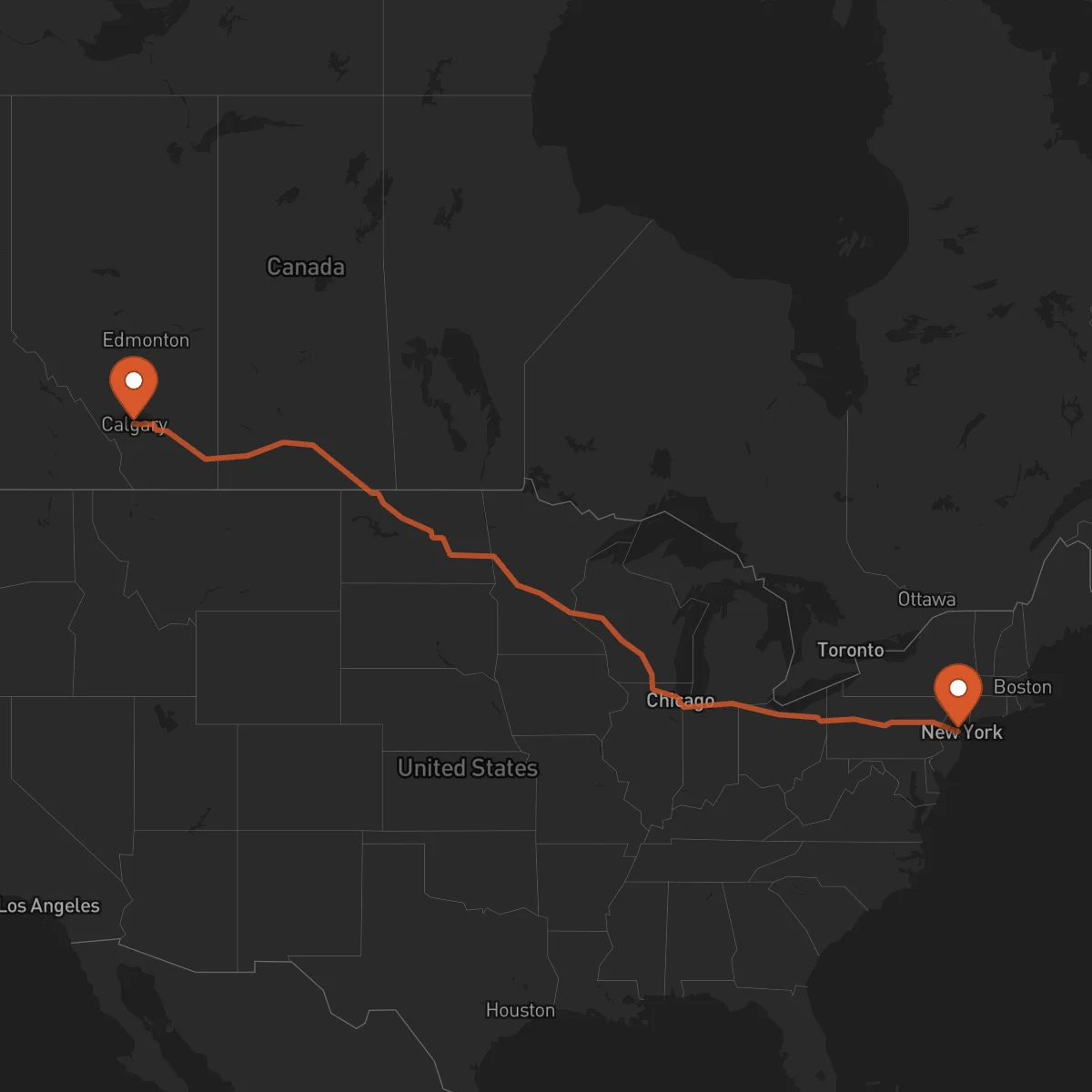
The route traverses major transportation infrastructure including the I-80 and I-94 highways through the United States, connecting with Canadian highways such as the Trans-Canada Highway (Highway 1) as it approaches Calgary. The journey typically involves crossing at major border points such as the Peace Bridge in Buffalo or the Blue Water Bridge in Port Huron, depending on the specific logistics strategy employed.
This corridor serves numerous industries including energy equipment, manufacturing components, automotive parts, and technology products. The energy sector plays a particularly significant role, with Calgary's status as Canada's energy capital driving substantial freight volumes to and from industrial centers in the northeastern United States. Manufacturing and distribution companies also rely heavily on this route for just-in-time inventory management and supply chain optimization.
Control Terrestre facilitates seamless operations along this corridor through our network of certified transportation providers. Our expertise in cross-border logistics ensures efficient customs clearance, compliance with international regulations, and reliable door-to-door service. We understand the unique requirements of this route, including temperature-controlled shipments for sensitive products and specialized handling for oversized or hazardous materials, providing our clients with comprehensive freight solutions that maintain the integrity of their supply chains.
Services for this Route
Available services for the corridor Newark - Calgary
 Origin
Newark
Newark, New Jersey, serves as a strategic gateway for freight transportation on the East Coast of the United States. Located just 8 miles from New York City, Newark benefits from exceptional multimodal connectivity including the Port Newark-Elizabeth Marine Terminal, one of the busiest container ports on the East Coast, extensive rail connections through major freight lines, and proximity to Newark Liberty International Airport. The region's robust infrastructure supports efficient distribution to major metropolitan areas along the eastern seaboard.
The area's economic base includes diverse industries such as pharmaceuticals, telecommunications, financial services, and advanced manufacturing. Newark's location within the Northeast megalopolis provides access to a consumer market of over 50 million people within a day's drive, making it an ideal origin point for both domestic distribution and international exports. The concentration of warehousing and distribution centers in the surrounding New Jersey area further enhances its role as a logistics hub.
 Destination
Calgary, Alberta, stands as a major logistics center in western Canada, strategically positioned at the crossroads of major transportation routes. Located approximately 300 kilometers from the U.S. border, Calgary serves as the primary commercial center for Canada's energy industry and provides excellent connectivity to both Pacific ports and central Canadian markets. The city's location near the foothills of the Rocky Mountains positions it as a natural distribution point for goods moving between western Canada and the United States.
The Calgary economy is anchored by the energy sector, with significant presence from oil and gas, renewable energy, and related industries. The region also hosts growing technology, manufacturing, and agricultural sectors. Calgary's transportation infrastructure includes extensive highway networks, rail connections through Canadian Pacific Railway and Canadian National Railway, and Calgary International Airport, which supports both passenger and cargo operations. The city's role as an energy capital drives substantial freight volumes, particularly for specialized equipment and materials needed in the sector.










