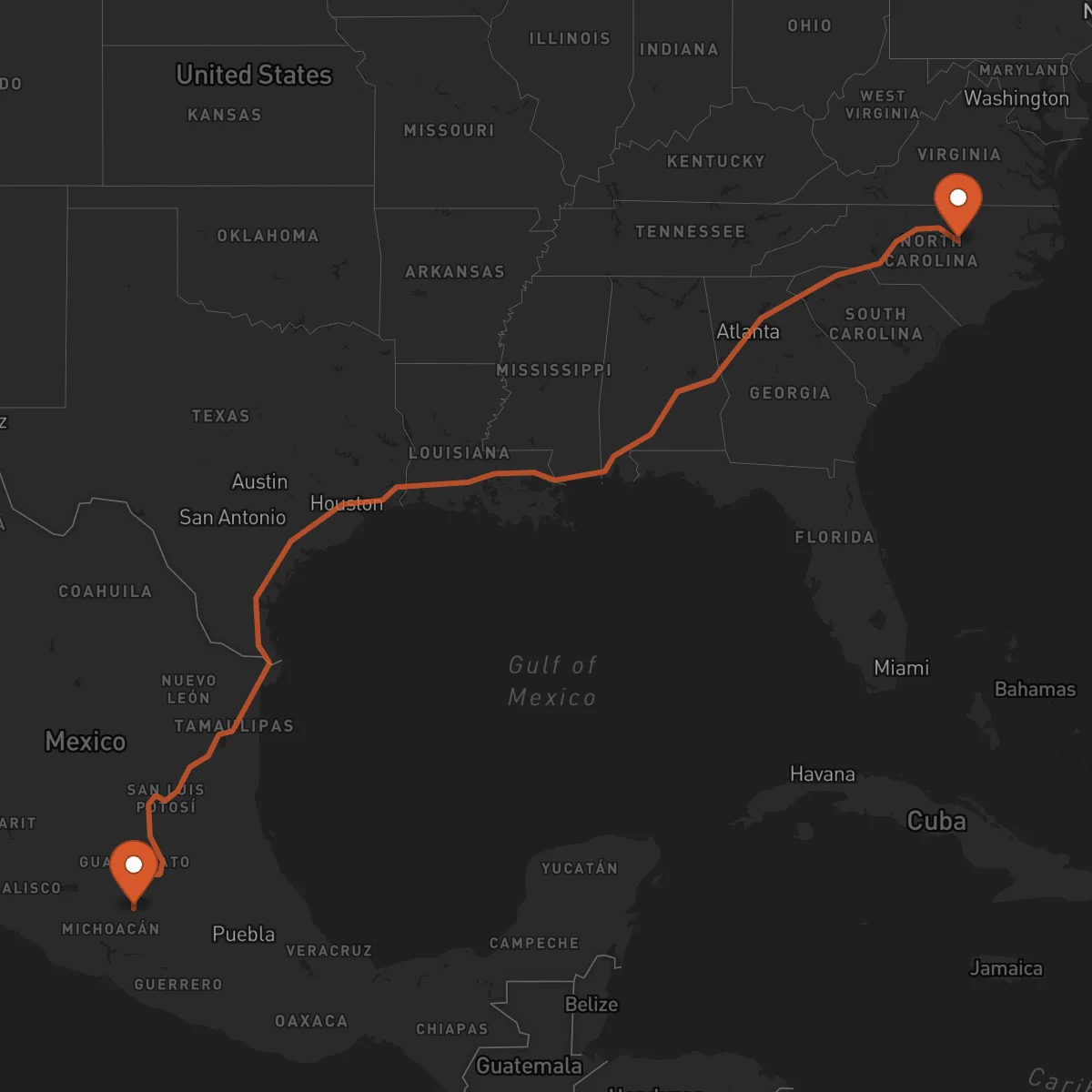
Morelia to Raleigh
Raleigh → MoreliaFTL freight transportation service between Morelia and Raleigh. Reliable logistics solutions for your business.
Route Description
Everything you need to know about the corridor Morelia - Raleigh
The logistics corridor connecting Morelia, Michoacán, to Raleigh, North Carolina, represents a vital trade link between Mexico's central highlands and the southeastern United States. This 2,837 km cross-border route traverses diverse terrain and crosses multiple state lines, facilitating the movement of goods between two dynamic economic regions. The corridor serves as a critical artery for companies engaged in North American trade, connecting Mexico's industrial heartland with one of America's fastest-growing technology and research hubs.
The economic significance of this corridor is underscored by the complementary industrial strengths of both regions. Morelia stands as a manufacturing powerhouse in Michoacán, with strong automotive, aerospace, and electronics sectors, while Raleigh has emerged as a major center for technology, pharmaceuticals, and research institutions. This creates a natural flow of goods between specialized manufacturing facilities and high-tech distribution centers, with automotive parts, electronics components, and industrial machinery representing key cargo categories.
Transportation along this corridor primarily utilizes Mexico's Federal Highway 15 and Federal Highway 45, connecting to major U.S. interstates including I-40 and I-85. The Laredo-Nuevo Laredo crossing serves as the main port of entry, offering efficient processing through C-TPAT and FAST-certified lanes. Control Terrestre's expertise in cross-border operations ensures seamless customs clearance, real-time shipment tracking, and dedicated FTL services that maintain the integrity of time-sensitive cargo throughout the journey from central Mexico to North Carolina's Research Triangle.
Services for this Route
Available services for the corridor Morelia - Raleigh
 Origin
Morelia, the capital of Michoacán, occupies a strategic position in Mexico's central highlands, serving as a crucial logistics hub for the Bajío region. The city's elevation and central location provide excellent connectivity to major industrial centers including Guadalajara, Querétaro, and Mexico City. Morelia benefits from its proximity to key automotive and aerospace manufacturing clusters, with specialized logistics zones supporting just-in-time delivery requirements for these industries.
The transportation infrastructure in Morelia includes modern highways connecting to major cargo airports and rail terminals. The city's industrial parks are equipped with advanced warehousing facilities, while the surrounding region produces a diverse range of goods from automotive components to processed foods. This infrastructure, combined with Morelia's skilled workforce and competitive operating costs, makes it an ideal origin point for cross-border freight movements to the United States.
 Destination
Raleigh
Raleigh, North Carolina, serves as a strategic logistics gateway to the southeastern United States, positioned within the thriving Research Triangle metropolitan area. The city's location provides excellent access to major East Coast markets while offering proximity to the Port of Virginia for international ocean freight connections. Raleigh's robust transportation network includes major interstate highways, an international airport, and extensive rail connections supporting diverse freight movements.
The region's economy is characterized by strong technology, pharmaceutical, and research sectors, creating consistent demand for specialized logistics services. Raleigh's concentration of universities and research institutions drives the movement of high-value, time-sensitive cargo requiring dedicated transportation solutions. The city's growing population and business environment have spurred development of modern distribution centers and logistics facilities, making it an ideal destination for cross-border freight from Mexico's manufacturing centers.










