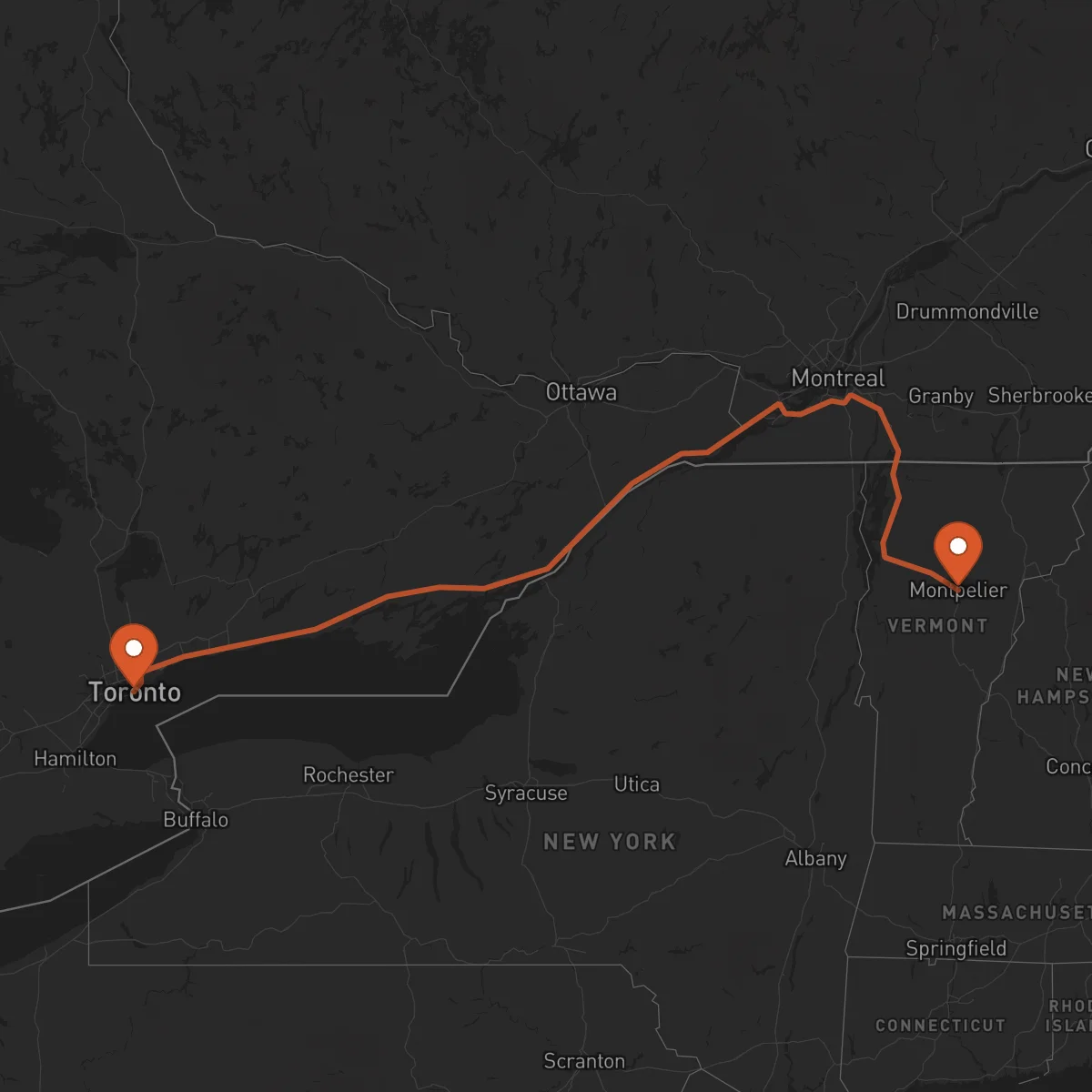
Montpelier to Toronto
Toronto → MontpelierFTL freight transportation service between Montpelier and Toronto. Reliable logistics solutions for your business.
Route Description
Everything you need to know about the corridor Montpelier - Toronto
The logistics corridor connecting Montpelier, Vermont, to Toronto, Ontario, represents a vital cross-border transportation route in North America. This 549-kilometer corridor links the capital of Vermont with Canada's largest city, facilitating the movement of goods between the United States and Canada. The route traverses diverse terrain and crosses the international border, requiring specialized knowledge of customs procedures and cross-border regulations.
The economic significance of this corridor is substantial, connecting Vermont's manufacturing and agricultural sectors with Toronto's massive industrial and commercial hub. Toronto serves as a gateway to Canadian markets and beyond, while Montpelier provides access to New England's distribution networks. This route is particularly important for industries requiring temperature-controlled transportation, given Vermont's dairy production and Toronto's pharmaceutical and food processing sectors.
Key transportation infrastructure along this corridor includes Interstate 89 and Interstate 93 in Vermont and New Hampshire, connecting to Highway 401 in Ontario, Canada's busiest highway. The primary border crossing used is the Highgate Springs-Swanton crossing in Vermont, which connects to Highway 401 via Highway 85 in Ontario. Control Terrestre's expertise in cross-border operations ensures seamless customs clearance and compliance with both US and Canadian regulations, providing reliable FTL transportation services that maintain the integrity of supply chains between these two important economic centers.
Services for this Route
Available services for the corridor Montpelier - Toronto
 Origin
Montpelier
Montpelier, Vermont, serves as a strategic logistics hub in the northeastern United States, offering access to New England's extensive distribution networks. As Vermont's capital city, it provides excellent connectivity to major transportation routes including Interstate 89, which runs north-south through the state. The city's location in the heart of Vermont makes it an ideal origin point for freight moving in all directions, particularly toward Canadian markets and the broader northeastern United States.
The region's economy is characterized by diverse industries including manufacturing, technology, and agriculture. Vermont is renowned for its dairy production, craft beverages, and specialty food products, all of which require reliable transportation solutions. The state's commitment to sustainable practices aligns well with modern logistics requirements, and Montpelier's infrastructure supports various freight transportation needs, from standard dry goods to temperature-sensitive products requiring refrigerated transport.
 Destination
Toronto, Ontario, stands as one of North America's most important logistics and commercial centers, offering unparalleled access to Canadian and international markets. As Canada's largest city and economic capital, Toronto provides sophisticated transportation infrastructure including major highways, rail connections, and proximity to international airports and seaports. The city's strategic location on Lake Ontario and its position as a border hub make it a critical node in North American supply chains.
The Toronto metropolitan area hosts a diverse range of industries including finance, technology, manufacturing, pharmaceuticals, and food processing. The region's advanced logistics infrastructure supports complex supply chain operations, with extensive warehousing and distribution facilities throughout the Greater Toronto Area. Toronto's status as a multicultural hub also creates unique freight transportation needs, particularly for specialized cargo and time-sensitive deliveries. The city's comprehensive transportation network, including the 400-series highways and connections to US interstates, ensures efficient movement of goods throughout the region and beyond.










