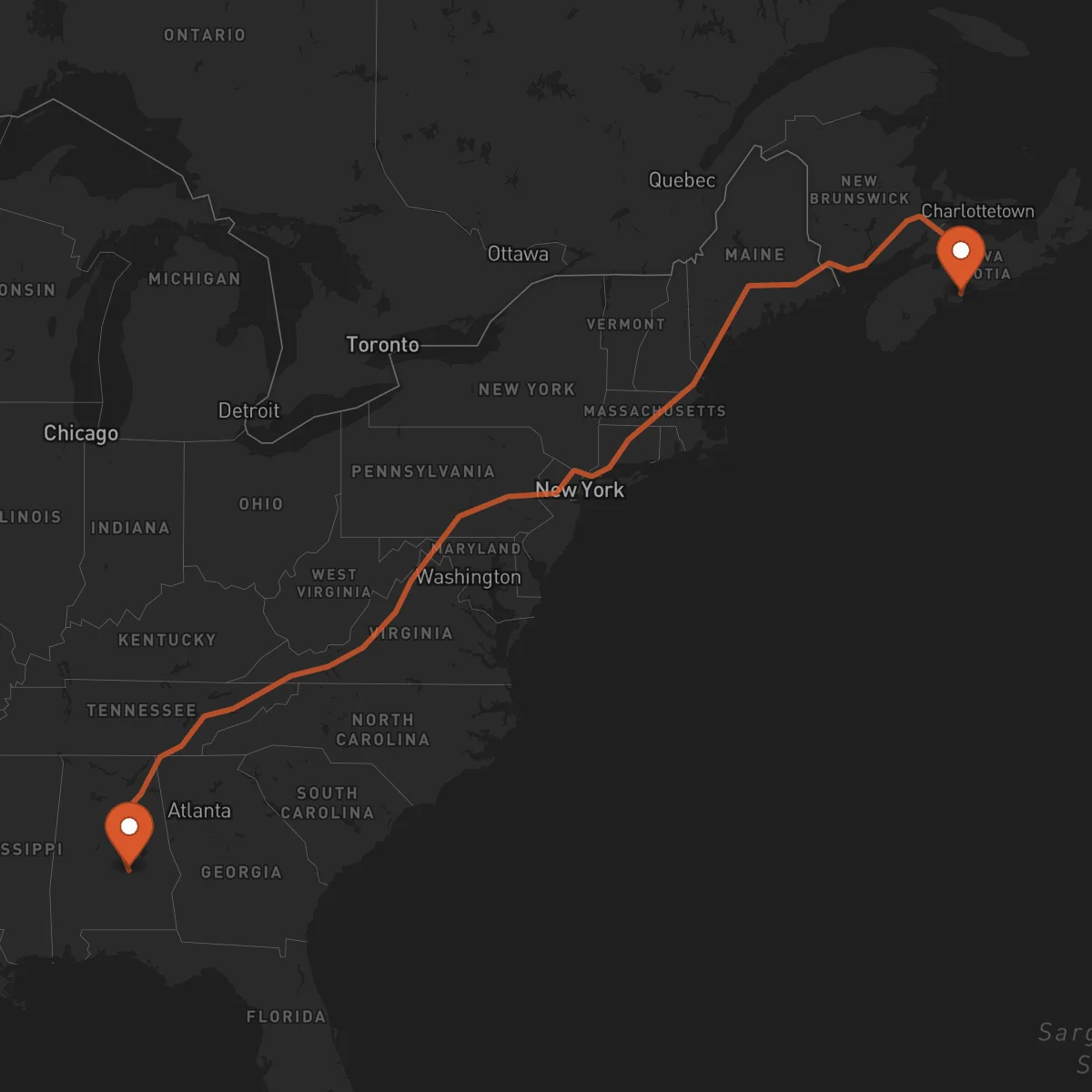
Montgomery to Halifax
Halifax → MontgomeryFTL freight transportation service between Montgomery and Halifax. Reliable logistics solutions for your business.
Route Description
Everything you need to know about the corridor Montgomery - Halifax
The Montgomery, Alabama to Halifax, Nova Scotia corridor represents a vital north-south freight route connecting the southeastern United States with Atlantic Canada. This 2,388-kilometer cross-border corridor traverses diverse terrain and passes through major industrial centers, making it a critical artery for international trade between the U.S. and Canada.
The corridor begins in Montgomery, a strategic logistics hub in Alabama's River Region, and extends northeast through the Appalachian Mountains into the maritime provinces. Along the route, freight passes through major transportation nodes including Atlanta, Charlotte, and Montreal before reaching Halifax's deep-water port facilities. The corridor serves as a crucial link for manufacturers, distributors, and retailers operating across both countries.
Primary industries utilizing this corridor include automotive manufacturing, aerospace components, agricultural products, and general manufacturing goods. The route particularly benefits companies in Alabama's automotive sector and Nova Scotia's seafood and forestry industries. Montgomery's proximity to major automotive assembly plants and Halifax's status as Atlantic Canada's primary container port create significant freight volumes in both directions.
Control Terrestre specializes in managing the complexities of this cross-border corridor, offering full truckload (FTL) services that ensure efficient border crossings and timely deliveries. Our expertise in customs documentation, border procedures, and regulatory compliance helps clients navigate the intricacies of U.S.-Canada trade while maintaining optimal supply chain performance.
Services for this Route
Available services for the corridor Montgomery - Halifax
 Origin
Montgomery
Montgomery, Alabama serves as a strategic logistics hub in the southeastern United States, positioned at the intersection of major transportation routes. The city benefits from its location in Alabama's River Region, with access to the Alabama River for barge transportation and proximity to Interstate 65, which connects to major freight corridors. Montgomery's logistics infrastructure includes the Montgomery Regional Airport, multiple rail connections via CSX and Norfolk Southern, and the Montgomery Intermodal Transfer Facility.
The region's economy is anchored by diverse industries including automotive manufacturing, with major facilities operated by Hyundai and its suppliers. Aerospace and defense sectors also contribute significantly to the local economy, alongside healthcare, government services, and education. The presence of these industries creates consistent freight demand, particularly for automotive parts, aerospace components, and general manufacturing materials. Montgomery's central Alabama location provides excellent connectivity to major southeastern markets including Atlanta, Birmingham, and Mobile.
 Destination
Halifax
Halifax, Nova Scotia stands as Atlantic Canada's premier maritime gateway and logistics center, strategically positioned on the Atlantic coast. The Port of Halifax, one of North America's deepest and ice-free natural harbors, handles over 1.5 million TEUs annually and serves as a critical entry point for international cargo. The city's transportation infrastructure includes the Halifax Stanfield International Airport, extensive rail connections via CN Rail, and modern highway systems including Highway 102 and the Nova Scotia Highway network.
The Halifax region's economy is diverse, with key sectors including ocean technology, defense and aerospace, information technology, and financial services. The port city serves as the primary distribution center for Atlantic Canada's import and export activities, particularly for seafood products, forestry goods, and manufactured items. Halifax's strategic location makes it an essential node for companies serving the Maritime provinces, with its port facilities providing direct access to European and Mediterranean markets. The combination of port capabilities, air cargo facilities, and land transportation options creates a comprehensive logistics ecosystem that supports both domestic and international trade.










