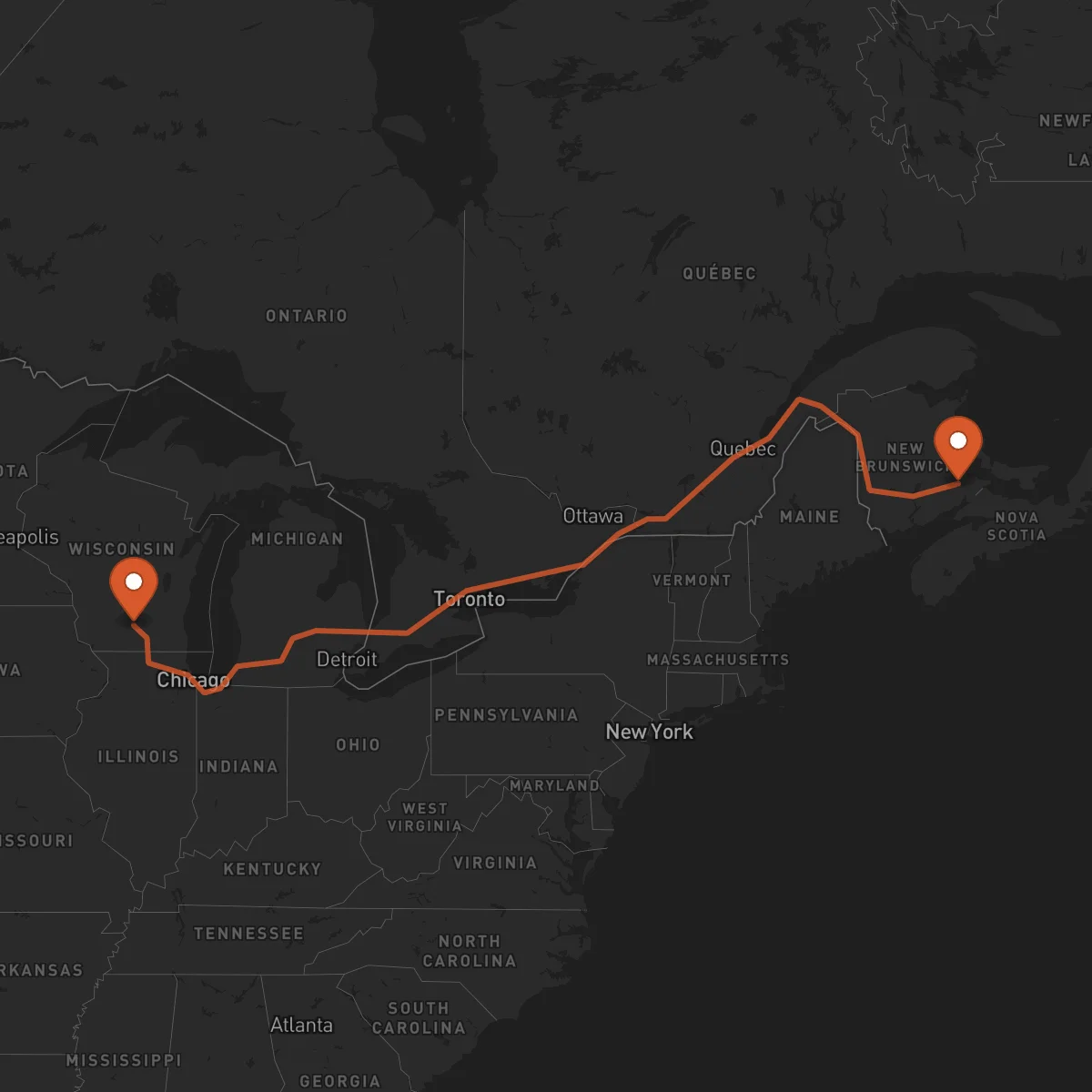
Moncton to Madison
Madison → MonctonFTL freight transportation service between Moncton and Madison. Reliable logistics solutions for your business.
Route Description
Everything you need to know about the corridor Moncton - Madison
The Moncton-Madison corridor represents a vital cross-border freight transportation link connecting Atlantic Canada with the industrial Midwest of the United States. This 1971 km route traverses diverse landscapes and economic regions, facilitating the movement of goods between Canada's maritime provinces and Wisconsin's manufacturing and technology hubs. The corridor serves as a crucial artery for businesses seeking to optimize their supply chains between these strategic locations.
The economic significance of this corridor is substantial, supporting trade between New Brunswick's export-oriented industries and Wisconsin's diverse manufacturing sector. Moncton serves as a logistics gateway for Atlantic Canada, while Madison anchors a region known for advanced manufacturing, biotechnology, and food processing. This route enables companies to leverage the complementary strengths of both regions, creating integrated supply chains that span the international border.
Transportation infrastructure along this corridor includes major highways such as the Trans-Canada Highway (Route 2) through New Brunswick and Quebec, connecting to Interstate 94 in the United States. The route typically involves crossing at strategic border points like the Thousand Islands Bridge or other northern crossings, depending on specific cargo requirements and traffic conditions. Control Terrestre's expertise in cross-border operations ensures seamless movement through customs and compliance with all regulatory requirements.
Control Terrestre facilitates efficient operations on this corridor through our network of certified transportation providers and specialized knowledge of cross-border logistics. Our team handles all aspects of international freight movement, from documentation and customs clearance to temperature-controlled transportation for sensitive cargo. We provide dedicated full truckload services that ensure your goods move directly from origin to destination without unnecessary delays or transfers, maintaining the integrity and security of your shipments throughout the journey.
Services for this Route
Available services for the corridor Moncton - Madison
 Origin
Moncton
Moncton, located in New Brunswick, serves as a strategic logistics hub for Atlantic Canada, positioned at the geographic center of the Maritimes. The city's transportation infrastructure includes the Greater Moncton Roméo LeBlanc International Airport, extensive highway networks, and the Moncton Intermodal Terminal, which connects to major rail lines. This multimodal connectivity makes Moncton an ideal origin point for freight distribution throughout the region and beyond.
The local economy is diverse, with strong sectors in information technology, advanced manufacturing, and transportation services. Moncton is home to the headquarters of national and international companies, particularly those focused on call centers and IT services. The Port of Halifax, though not in Moncton, is within reasonable driving distance and complements Moncton's role as a distribution center for Atlantic Canada. The region's forestry, agriculture, and seafood industries also contribute significantly to the local economy, creating demand for specialized freight transportation services.
 Destination
Madison
Madison, Wisconsin, strategically located between Milwaukee and Minneapolis, serves as a major logistics and distribution center in the American Midwest. The city benefits from excellent transportation infrastructure, including the Dane County Regional Airport, direct access to Interstate 90/94, and proximity to major rail hubs. Madison's location provides efficient connections to Chicago, Minneapolis, and other major Midwest markets, making it an ideal destination for freight distribution.
The Madison metropolitan area is known for its diverse and innovative economy, with particular strengths in manufacturing, healthcare, and technology. The region hosts numerous biotechnology firms, food processing companies, and advanced manufacturing operations. The University of Wisconsin-Madison contributes to a highly educated workforce and drives research and development in various sectors. The city's robust economy creates consistent demand for freight transportation services, particularly for specialized cargo and time-sensitive shipments between Canadian suppliers and Wisconsin manufacturers.










