Moncton to Boston
Boston → MonctonFTL freight transportation service between Moncton and Boston. Reliable logistics solutions for your business.
Route Description
Everything you need to know about the corridor Moncton - Boston
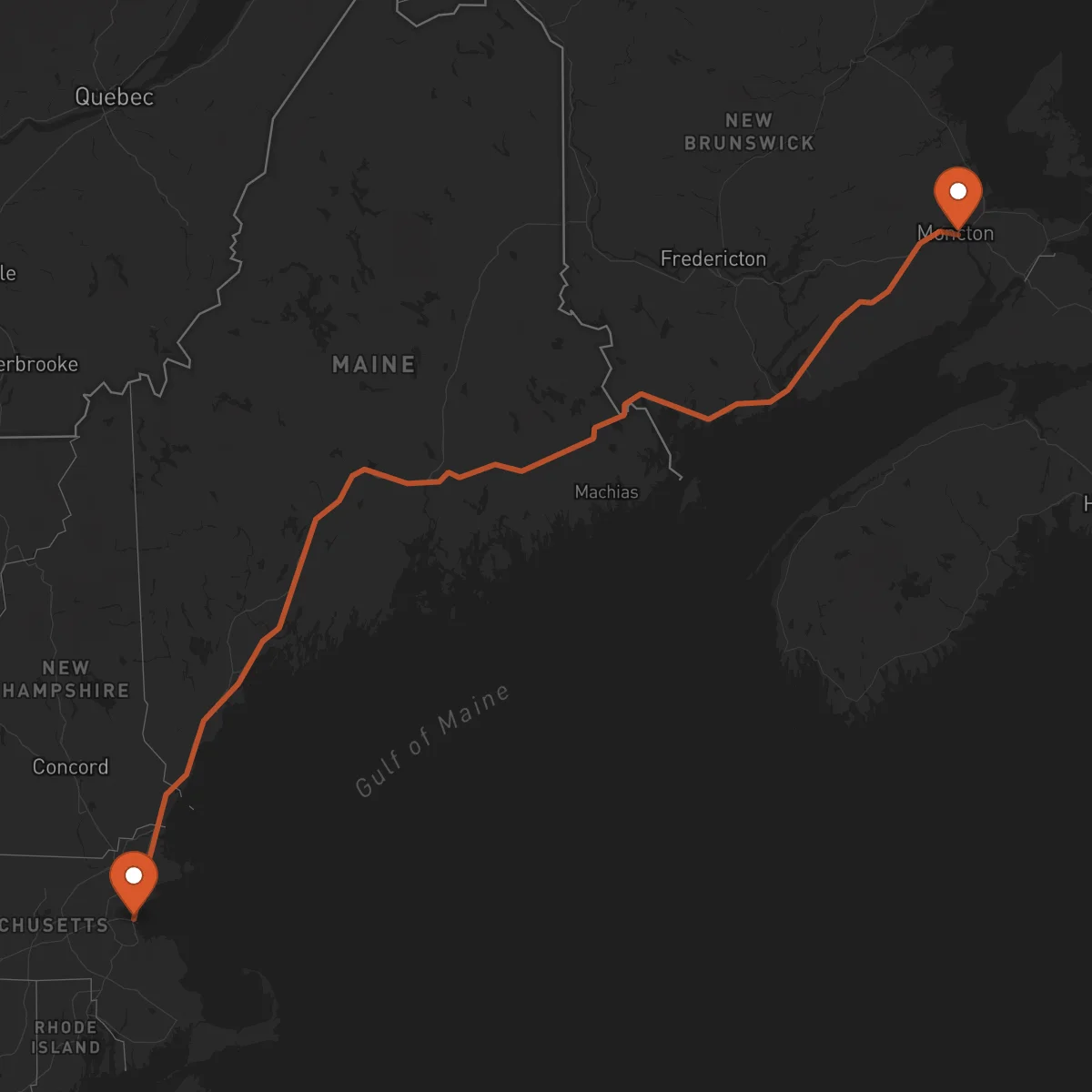
The Moncton-Boston corridor represents a vital trade link between Atlantic Canada and the northeastern United States. This 650 km cross-border route connects the economic hub of Moncton in New Brunswick with the major metropolitan area of Boston, Massachusetts. The corridor serves as a critical artery for goods moving between Canada and the United States, facilitating trade in various sectors including manufacturing, technology, and consumer goods.
The transportation infrastructure along this corridor is well-developed, primarily utilizing Highway 2 (Trans-Canada Highway) from Moncton to the border, then connecting to Interstate 95 and Interstate 93 into Boston. The route crosses at Calais-St. Stephen, one of the major border crossings between Maine and New Brunswick, which handles significant commercial traffic. Control Terrestre's expertise in cross-border operations ensures smooth customs clearance and compliance with both Canadian and US regulations, minimizing delays and optimizing transit times for our clients.
This corridor is particularly important for industries such as aerospace components, seafood products, agricultural goods, and retail merchandise. Boston's position as a major economic center and educational hub creates consistent demand for freight services from Atlantic Canada. The route also supports the reverse flow of goods, with Boston-based companies shipping products to Moncton and the broader Maritime region. Control Terrestre's dedicated FTL services on this corridor provide reliable, direct transportation solutions that help businesses maintain efficient supply chains across the border.
Services for this Route
Available services for the corridor Moncton - Boston
 Origin
Moncton
Moncton serves as a strategic logistics hub in Atlantic Canada, located at the geographic center of the Maritime provinces. The city's position at the intersection of major highways (Trans-Canada Highway 2 and Highway 15) makes it an ideal distribution point for goods moving throughout the region. Moncton's economy is diverse, with strong sectors in transportation and logistics, aerospace manufacturing, information technology, and retail distribution. The Greater Moncton International Airport and the Port of Halifax provide multimodal connectivity, while the city's extensive warehousing and distribution infrastructure supports both domestic and international trade. Moncton's bilingual workforce and business-friendly environment have attracted numerous companies to establish distribution centers in the area.
 Destination
Boston
Boston stands as a major economic and logistics center in the northeastern United States, with its strategic location along the Atlantic coast. The city's extensive transportation network includes Logan International Airport, the Port of Boston, and comprehensive highway systems (I-90, I-93, I-95) that connect to the broader New England region. Boston's economy is driven by education, healthcare, finance, technology, and biotechnology sectors, creating consistent demand for freight transportation services. The metropolitan area's dense population and numerous universities and hospitals generate substantial freight volumes, particularly for specialized and time-sensitive shipments. Boston's position as a gateway to New England makes it a crucial point for distribution to surrounding states.










