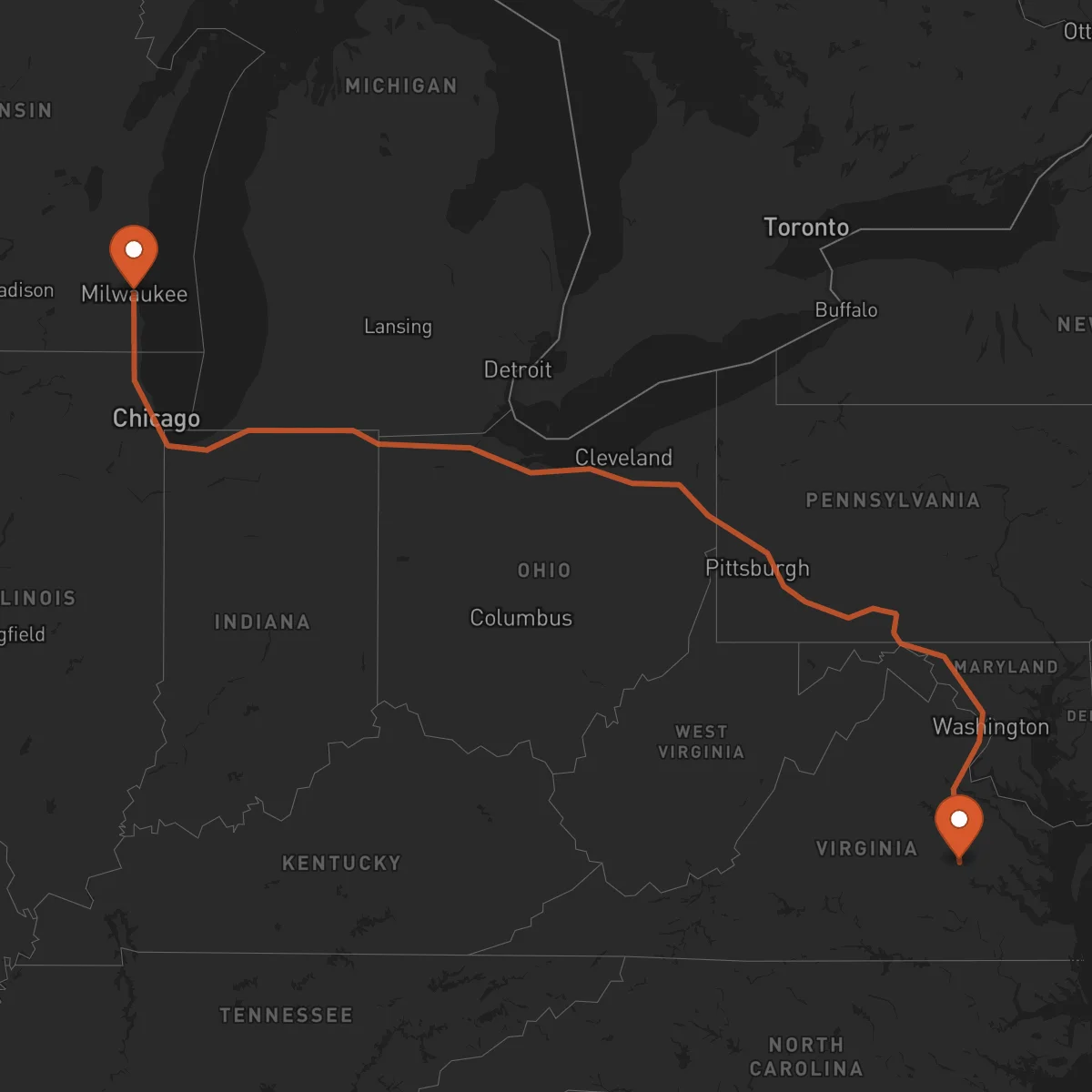
Milwaukee to Richmond
Richmond → MilwaukeeFTL freight transportation service between Milwaukee and Richmond. Reliable logistics solutions for your business.
Route Description
Everything you need to know about the corridor Milwaukee - Richmond
The logistics corridor between Milwaukee, Wisconsin and Richmond, Virginia represents a vital freight transportation route connecting the industrial Midwest with the Mid-Atlantic region. This 1077 km corridor traverses diverse economic zones, linking manufacturing centers in the Great Lakes region with distribution hubs and ports along the East Coast. The route strategically connects major economic corridors including the I-94 and I-64 interstate systems, facilitating efficient freight movement across eight states.
The corridor serves as a critical link for industries requiring reliable full truckload transportation between these two major metropolitan areas. Milwaukee's manufacturing base, particularly in machinery, metal fabrication, and food processing, generates substantial freight volumes moving eastward toward Richmond's diverse industrial sector. Richmond, as a major logistics hub with its proximity to the Port of Virginia and central East Coast location, serves as both a destination and a transshipment point for goods moving throughout the southeastern United States.
Control Terrestre specializes in facilitating seamless freight operations along this corridor through our network of certified transportation providers. We understand the unique requirements of full truckload shipments between these markets, including the need for temperature-controlled transport for food products, secure handling for industrial equipment, and specialized equipment for oversized cargo. Our expertise in navigating the regulatory requirements across multiple state jurisdictions ensures your freight moves efficiently and compliantly from origin to destination.
Services for this Route
Available services for the corridor Milwaukee - Richmond
 Origin
Milwaukee
Milwaukee, Wisconsin serves as a strategic logistics hub in the Great Lakes region, positioned advantageously for freight distribution throughout the Midwest. The city's location on Lake Michigan provides multimodal transportation options, while its proximity to major manufacturing centers in Wisconsin, Illinois, and Minnesota makes it an ideal origin point for full truckload shipments. Milwaukee's transportation infrastructure includes direct access to I-94, connecting westward to Minneapolis and eastward toward Chicago and beyond, creating efficient routes for long-haul freight movements.
The economic landscape of Milwaukee is dominated by advanced manufacturing, with strong presence in machinery production, precision metal fabrication, and food processing industries. Major employers in the region include companies in industrial equipment manufacturing, brewing and beverage production, and medical device manufacturing. These industries generate consistent demand for full truckload services, particularly for heavy equipment, raw materials, and finished goods requiring dedicated transportation capacity. The city's industrial parks and manufacturing districts are well-equipped with loading facilities designed for efficient truck loading and unloading operations.
 Destination
Richmond
Richmond, Virginia occupies a strategic position as a logistics gateway to the Mid-Atlantic and Southeast regions of the United States. Located at the fall line of the James River, Richmond has evolved into a major distribution center with excellent connectivity to the Port of Virginia and the broader East Coast market. The city's location at the intersection of I-64 and I-95 provides direct access to major freight corridors serving Washington D.C., the Carolinas, and the Northeast, making it an ideal destination for full truckload shipments originating from the Midwest.
The Richmond metropolitan area features a diverse industrial base including advanced manufacturing, food processing, and distribution centers serving the retail and e-commerce sectors. The region's logistics infrastructure includes multiple intermodal facilities, warehousing complexes, and proximity to major ports, creating a robust environment for freight movement. Richmond's economic development initiatives have attracted numerous distribution centers and fulfillment operations, generating consistent demand for reliable full truckload transportation services. The area's transportation network is designed to handle high volumes of freight traffic efficiently, with dedicated truck routes and modern distribution facilities equipped to manage large-scale logistics operations.










