Milwaukee to Cheyenne
Cheyenne → MilwaukeeFTL freight transportation service between Milwaukee and Cheyenne. Reliable logistics solutions for your business.
Route Description
Everything you need to know about the corridor Milwaukee - Cheyenne
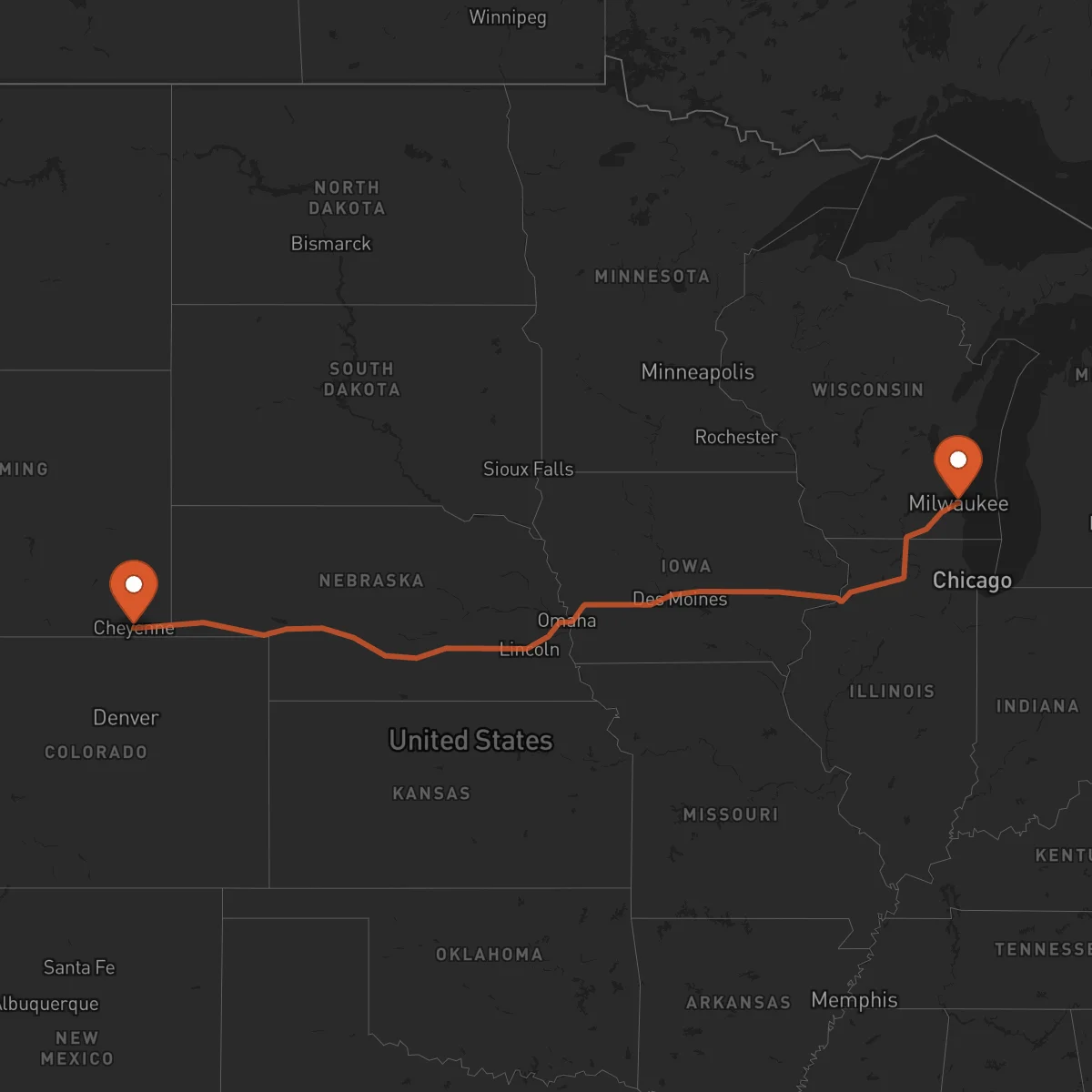
The logistics corridor between Milwaukee, Wisconsin, and Cheyenne, Wyoming, represents a vital domestic transportation route spanning approximately 1,409 kilometers across the American Midwest. This corridor connects the industrial heartland of the Great Lakes region with the strategic Rocky Mountain hub, facilitating the movement of goods between two economically significant regions. The route traverses diverse landscapes and crosses multiple state lines, making it a critical artery for interstate commerce.
The corridor serves as a crucial link between Milwaukee's manufacturing and distribution centers and Cheyenne's role as a regional logistics hub for Wyoming and surrounding states. This route supports the transportation of industrial equipment, automotive parts, agricultural products, and manufactured goods, playing a significant role in the supply chain networks of both regions. The corridor's strategic importance is enhanced by its connection to major population centers and industrial zones along the way.
Control Terrestre specializes in optimizing freight transportation along this corridor, offering dedicated full truckload (FTL) services that ensure efficient and reliable cargo movement. Our experienced network of carriers provides consistent capacity and specialized equipment to handle diverse freight requirements, from standard dry van shipments to temperature-controlled goods. We understand the unique challenges of this route, including varying terrain and weather conditions, and implement proactive measures to maintain schedule integrity and cargo safety throughout the journey.
Services for this Route
Available services for the corridor Milwaukee - Cheyenne
 Origin
Milwaukee
Milwaukee, Wisconsin, serves as a strategic logistics hub in the Great Lakes region, benefiting from its location on the western shore of Lake Michigan. The city boasts a robust transportation infrastructure including the Port of Milwaukee, General Mitchell International Airport, and extensive highway networks (I-94, I-43, I-894) that connect to major Midwestern markets. Milwaukee's industrial base includes advanced manufacturing, food processing, brewing, and medical equipment production, creating consistent freight movement requirements. The city's proximity to Chicago and other major manufacturing centers enhances its role as a distribution point for regional and national supply chains.
 Destination
Cheyenne
Cheyenne, Wyoming, functions as a critical logistics gateway to the Rocky Mountain region, leveraging its strategic location at the intersection of major transportation routes. The city is served by I-25 and I-80, two of the nation's most important freight corridors, along with the Union Pacific rail line and Cheyenne Regional Airport. Cheyenne's economic landscape includes government services, energy production, and distribution centers that support the broader Wyoming economy. The city's role as the state capital and its proximity to Denver enhance its importance as a regional distribution center for goods moving throughout the mountain states and beyond.










