Memphis to Montreal
Montreal → MemphisFTL freight transportation service between Memphis and Montreal. Reliable logistics solutions for your business.
Route Description
Everything you need to know about the corridor Memphis - Montreal
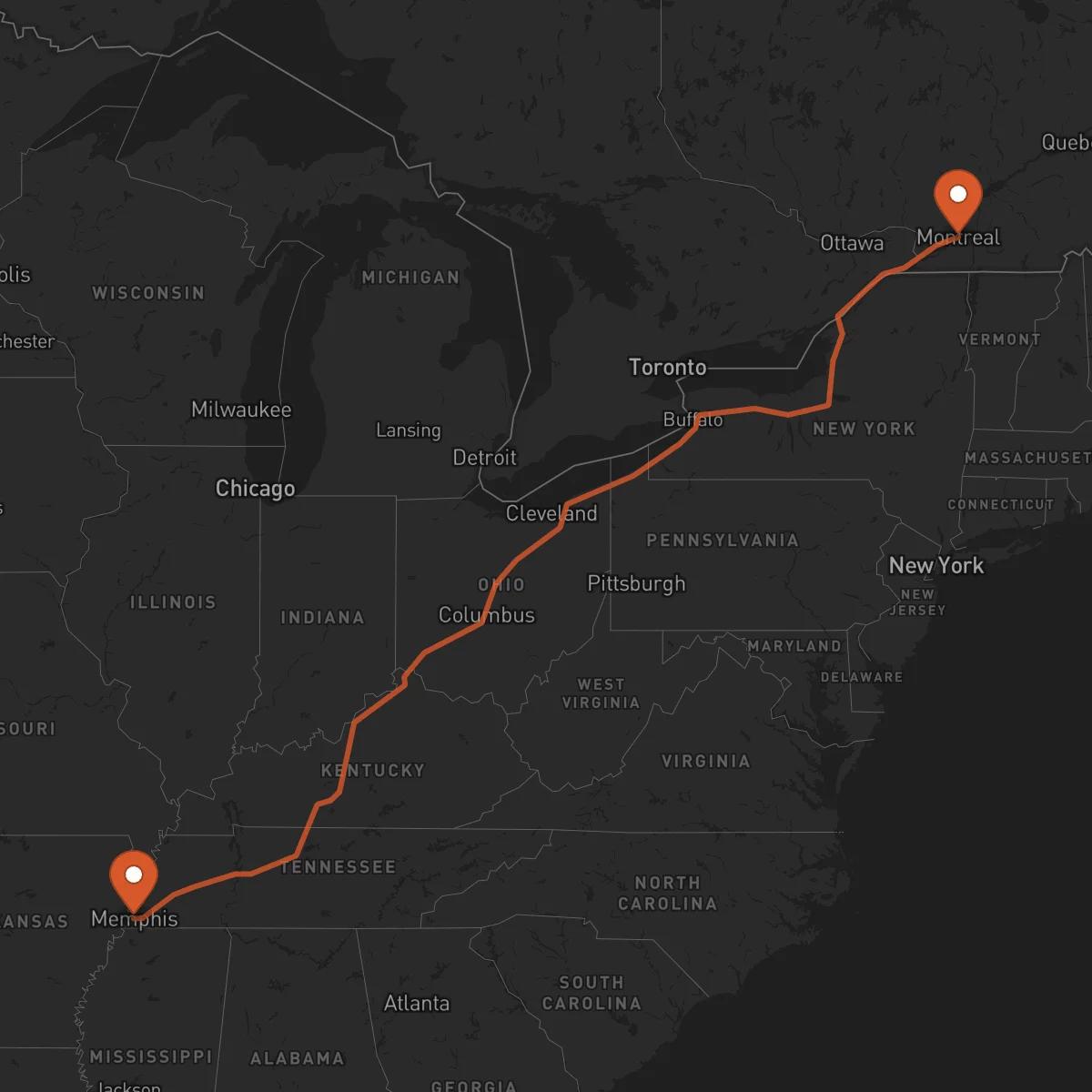
The logistics corridor between Memphis, Tennessee, and Montreal, Quebec, represents a vital north-south trade route connecting the central United States with Canada's largest port city. This 1,804 km cross-border corridor facilitates the movement of goods between major industrial and commercial hubs, supporting the economic integration of the North American supply chain. The route traverses diverse landscapes and crosses multiple state and provincial borders, requiring expertise in cross-border logistics and regulatory compliance.
The corridor's economic significance is underscored by the complementary industrial strengths of both regions. Memphis serves as a major logistics and distribution center, anchored by FedEx's global headquarters and extensive intermodal facilities. Montreal, as Canada's second-largest city and a key Atlantic gateway, hosts a diverse industrial base including aerospace, pharmaceuticals, and advanced manufacturing. The corridor connects these economic powerhouses, enabling the seamless flow of automotive parts, electronics, consumer goods, and industrial equipment.
Key transportation infrastructure includes major highways such as I-55 North to I-57 North, connecting to I-94 East, and eventually Autoroute 20 East into Montreal. The corridor benefits from well-developed intermodal facilities and truck stops along the route. Cross-border operations typically occur at major ports of entry like the Thousand Islands Bridge or Lacolle, requiring expertise in customs clearance and documentation. Control Terrestre's extensive network of certified carriers and cross-border experience ensures efficient, compliant transportation across this critical North American trade corridor.
Services for this Route
Available services for the corridor Memphis - Montreal
 Origin
Memphis
Memphis, Tennessee, stands as a strategic logistics hub in the southeastern United States, leveraging its central location and robust transportation infrastructure. The city's position at the crossroads of major interstates (I-40, I-55, and I-69) and its proximity to the Mississippi River create a multimodal logistics ecosystem that serves as a distribution nucleus for the region. Memphis International Airport, home to FedEx's global superhub, processes millions of packages daily, while the city's inland port facilities facilitate river barge transportation.
The local economy thrives on logistics, healthcare, and manufacturing sectors. Beyond FedEx, major employers include International Paper, AutoZone, and St. Jude Children's Research Hospital. The Memphis area's industrial parks and warehouse facilities support a diverse range of activities, from automotive parts distribution to e-commerce fulfillment. The city's affordable cost of living and business-friendly environment have attracted numerous companies seeking strategic distribution points for their North American operations.
 Destination
Montreal, Quebec, serves as Canada's leading logistics and industrial center, strategically positioned at the confluence of the Saint Lawrence River and major transportation networks. As the largest city in Canada's second-most populous province, Montreal functions as a critical Atlantic gateway, with the Port of Montreal handling over 26 million tons of cargo annually. The city's extensive transportation infrastructure includes Pierre Elliott Trudeau International Airport, a comprehensive public transit system, and direct highway connections to major North American markets.
The Montreal metropolitan area hosts a diverse industrial base, with particular strengths in aerospace (Bombardier, Pratt & Whitney Canada), pharmaceuticals, information technology, and advanced manufacturing. The city's research institutions and universities foster innovation in these sectors, while its skilled bilingual workforce supports international trade. Montreal's role as a cultural and economic bridge between North America and Europe enhances its importance in global supply chains, making it a key destination for goods moving between the United States and Canadian markets.










