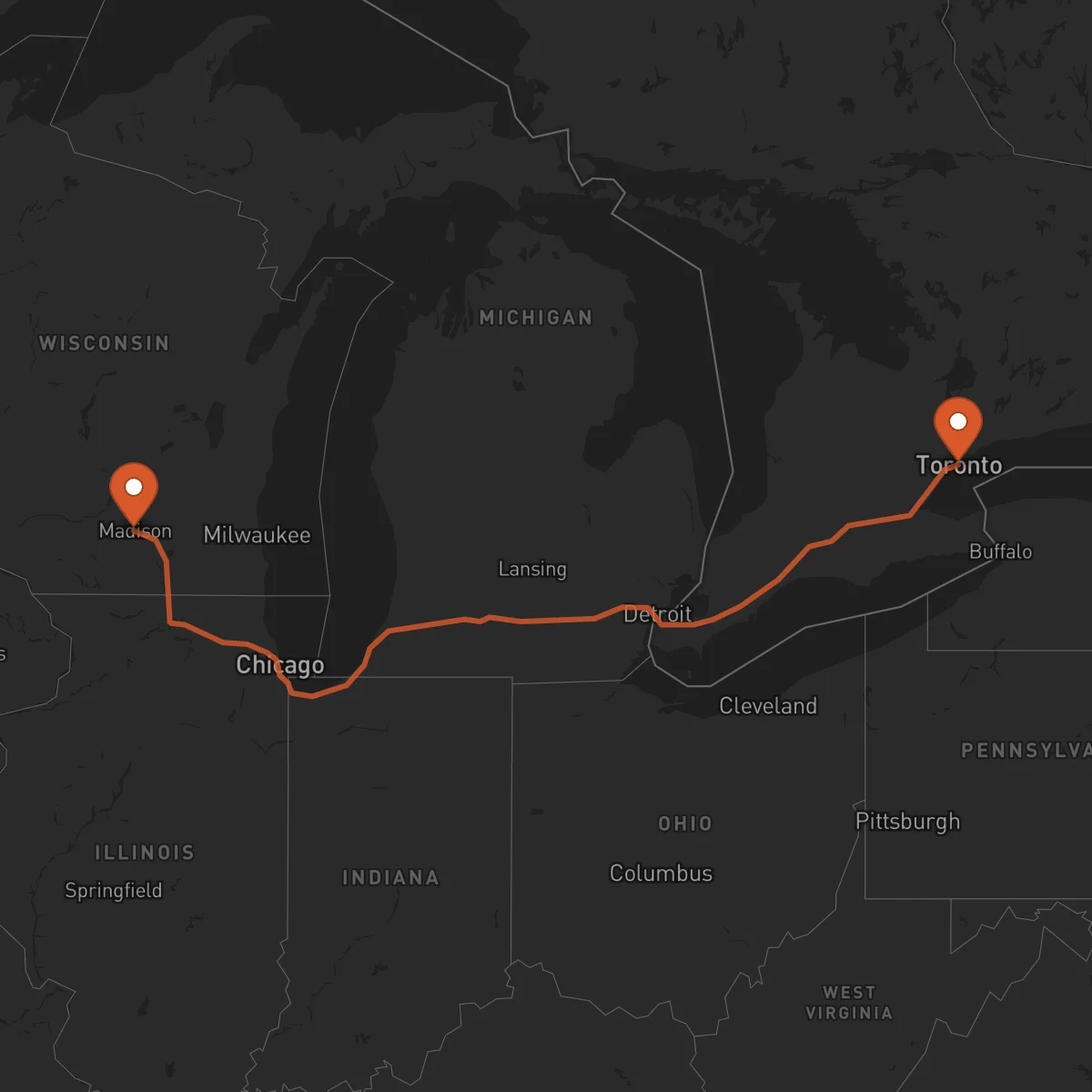
Madison to Toronto
Toronto → MadisonFTL freight transportation service between Madison and Toronto. Reliable logistics solutions for your business.
Route Description
Everything you need to know about the corridor Madison - Toronto
The logistics corridor between Madison, Wisconsin and Toronto, Ontario represents a vital cross-border connection between two major economic centers in North America. This strategic route spans approximately 811 kilometers and links the industrial heartland of the Midwest United States with Canada's largest financial and commercial hub. The corridor serves as a crucial artery for trade, connecting manufacturing centers in Wisconsin with distribution networks throughout Ontario and beyond.
The economic significance of this corridor cannot be overstated. Madison serves as a key logistics hub for Wisconsin's manufacturing sector, while Toronto functions as Canada's primary gateway for international trade and commerce. The route facilitates the movement of diverse cargo types, from automotive parts and agricultural products to industrial equipment and consumer goods. Major industries utilizing this corridor include manufacturing, automotive, technology, and food processing sectors on both sides of the border.
Transportation infrastructure along this corridor includes major highways such as I-90/I-94 from Madison to the Detroit-Windsor crossing, followed by Highway 401 through Ontario. The route offers multiple border crossing options, with the Detroit-Windsor crossing being the most prominent. Control Terrestre leverages this infrastructure to provide efficient full truckload (FTL) services, ensuring seamless cross-border operations through our certified transportation partners who maintain C-TPAT and FAST certifications for expedited customs clearance.
Services for this Route
Available services for the corridor Madison - Toronto
 Origin
Madison
Madison, Wisconsin serves as a strategic logistics hub in the American Midwest, offering excellent connectivity to major transportation networks. Located in south-central Wisconsin, Madison provides access to key highways including I-39, I-90, and I-94, facilitating efficient distribution throughout the region. The city's central location within Wisconsin makes it an ideal origin point for freight transportation to both eastern and western destinations.
The region's economy is characterized by diverse manufacturing sectors, including machinery, food processing, and advanced manufacturing. Madison's proximity to major agricultural areas also makes it a key point for food and agricultural product distribution. The city benefits from multiple intermodal facilities and a well-developed transportation infrastructure, including access to rail networks and nearby airports, making it an optimal starting point for cross-border freight movements.
 Destination
Toronto, Ontario stands as Canada's premier logistics and commercial center, offering unparalleled access to North American and international markets. As Canada's largest city, Toronto provides strategic access to the Greater Toronto Area (GTA), which serves as a major distribution hub for the entire country. The city's location on Lake Ontario and its extensive transportation infrastructure make it a critical gateway for international trade.
The Toronto region boasts a diverse industrial base, including automotive manufacturing, technology, financial services, and consumer goods production. The city's transportation infrastructure includes major highways such as the 401, which is North America's busiest highway, extensive rail networks, and the Port of Toronto for maritime shipping. Toronto's Pearson International Airport, Canada's largest and busiest airport, provides additional air cargo capabilities. This comprehensive infrastructure network makes Toronto an ideal destination for full truckload freight services, supporting efficient distribution throughout Ontario and beyond.










