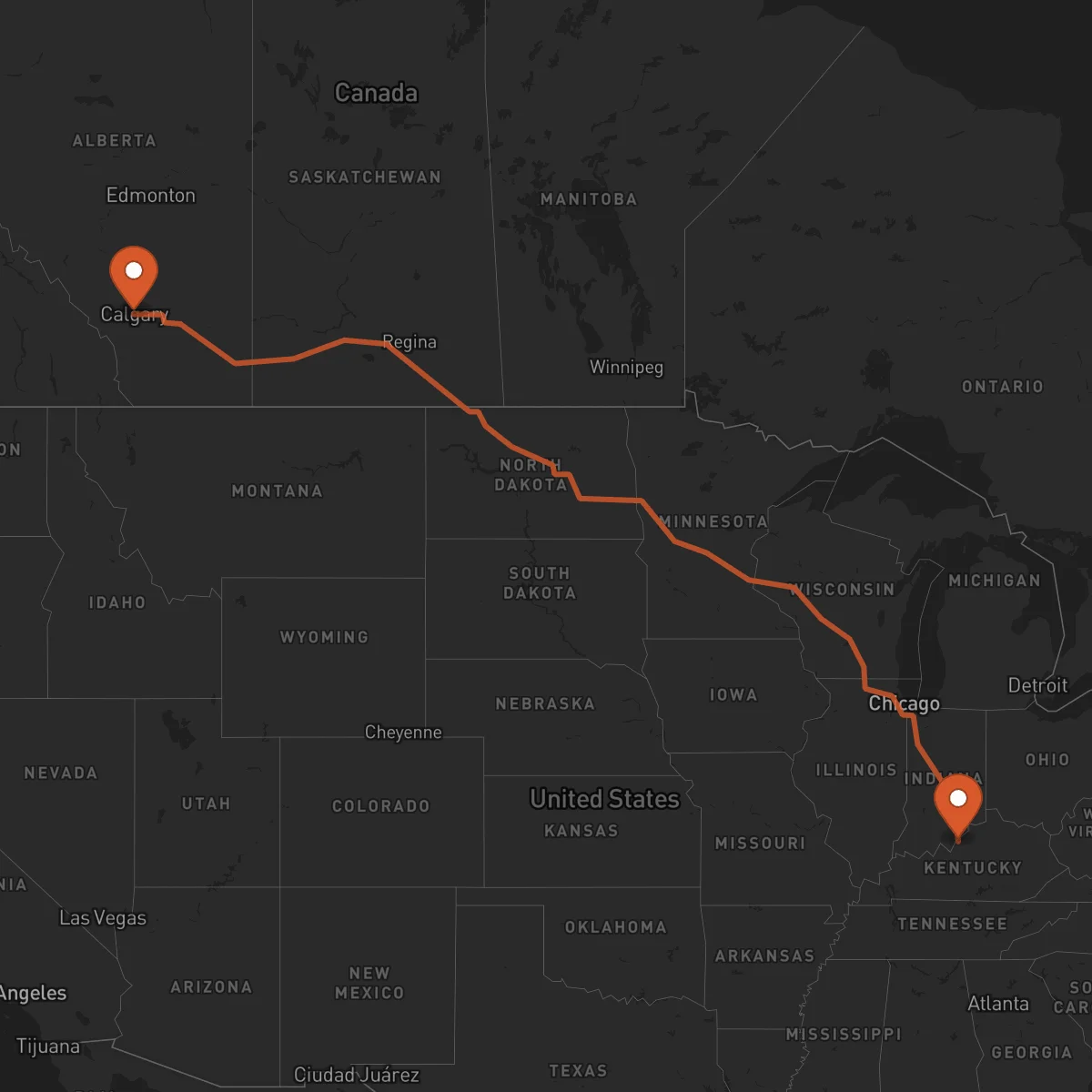
Louisville to Calgary
Calgary → LouisvilleFTL freight transportation service between Louisville and Calgary. Reliable logistics solutions for your business.
Route Description
Everything you need to know about the corridor Louisville - Calgary
The Louisville-Calgary corridor connects two major North American logistics hubs across a distance of approximately 2,628 kilometers. This cross-border route traverses the United States and Canada, linking Kentucky's industrial heartland with Alberta's energy and technology center. The corridor serves as a vital artery for trade between the central United States and western Canada, facilitating the movement of goods through key economic regions including the Midwest and the Canadian Prairies.
The economic significance of this corridor is substantial, connecting Louisville's diverse manufacturing base with Calgary's energy sector and growing tech industry. Major industries utilizing this route include automotive parts, pharmaceuticals, agricultural products, and energy equipment. The corridor passes through major transportation hubs such as Indianapolis, Chicago, and Winnipeg, providing access to extensive distribution networks and manufacturing centers along the way.
Transportation infrastructure along the Louisville-Calgary corridor primarily utilizes I-65, I-90, and the Trans-Canada Highway. The route includes several key border crossings, with the most common being at Sweetgrass, Montana/Coutts, Alberta, which offers efficient processing for commercial vehicles. Control Terrestre facilitates seamless operations on this corridor through our network of certified carriers, expertise in cross-border documentation, and specialized services for temperature-controlled and oversized shipments.
Services for this Route
Available services for the corridor Louisville - Calgary
 Origin
Louisville
Louisville, Kentucky serves as a strategic logistics hub in the eastern United States, positioned along the Ohio River and at the crossroads of major interstate highways. The city's central location provides excellent access to major markets within a day's drive, including Chicago, Atlanta, and St. Louis. Louisville's economy is anchored by manufacturing, healthcare, and logistics sectors, with the presence of major companies like UPS, which operates its worldwide air hub at Louisville International Airport.
The city boasts extensive transportation infrastructure, including three interstate highways (I-64, I-65, and I-71) that converge in Louisville, facilitating efficient ground transportation. The Port of Louisville provides river access for barge shipping, while the airport's cargo facilities handle millions of tons of freight annually. These multimodal capabilities make Louisville an ideal origin point for cross-border freight movements to Canada and beyond.
 Destination
Calgary, Alberta stands as a major logistics and economic center in western Canada, strategically located at the foothills of the Rocky Mountains. The city's position provides direct access to the Asia-Pacific market via the Port of Vancouver and serves as a gateway to Canada's northern territories. Calgary's economy is traditionally driven by the energy sector, particularly oil and gas, but has diversified to include technology, finance, and tourism industries.
The city offers robust transportation infrastructure, including Calgary International Airport with significant cargo handling capacity and extensive highway networks connecting to major Canadian and U.S. cities. The city's proximity to the Canadian Rockies also makes it a key distribution point for both industrial and consumer goods moving to and from western Canada. Calgary's logistics ecosystem is supported by numerous warehousing and distribution centers, making it an efficient destination for cross-border freight operations.










