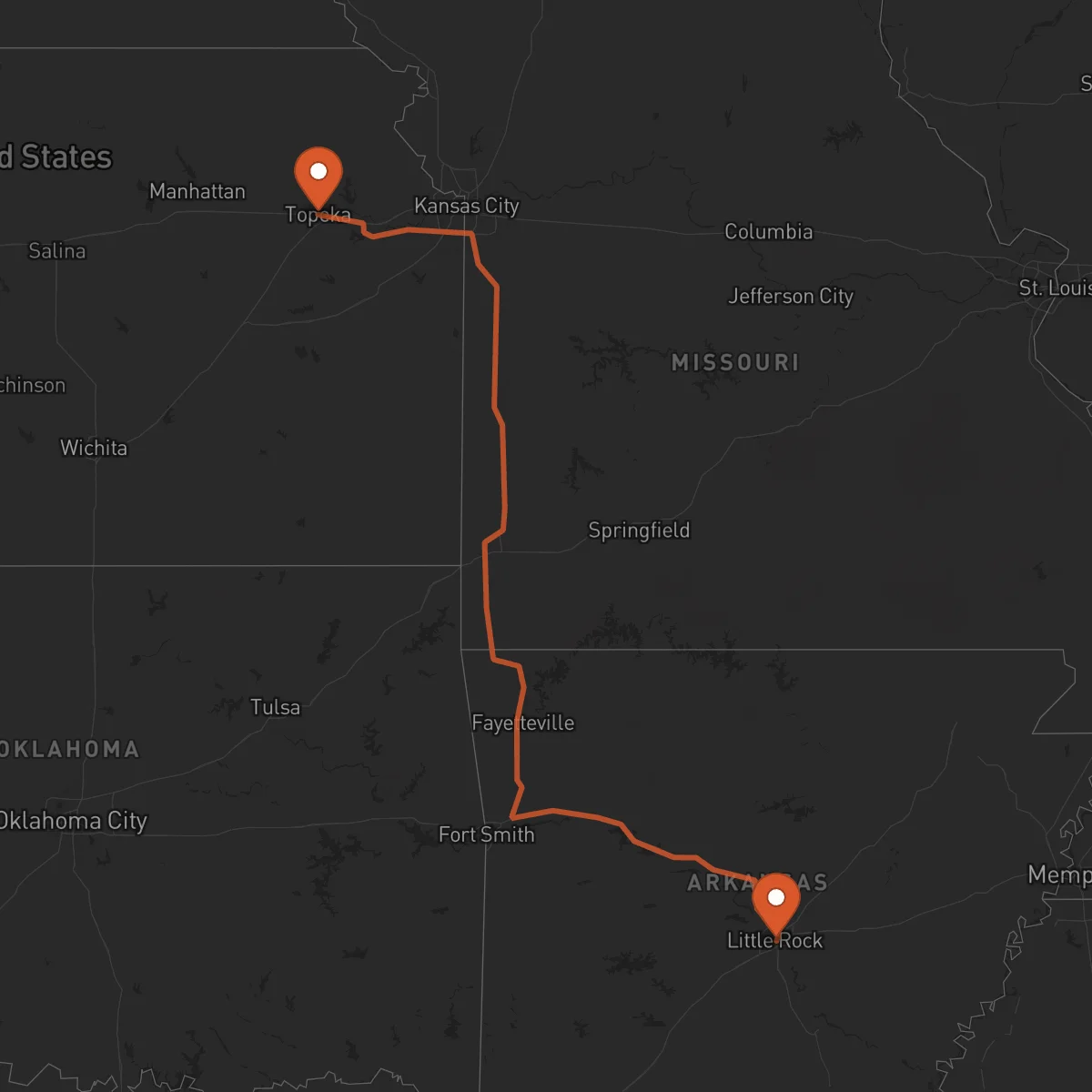
Little Rock to Topeka
Topeka → Little RockFTL freight transportation service between Little Rock and Topeka. Reliable logistics solutions for your business.
Route Description
Everything you need to know about the corridor Little Rock - Topeka
The logistics corridor connecting Little Rock, Arkansas, to Topeka, Kansas, represents a vital transportation link in the central United States, spanning approximately 566 kilometers. This route traverses key states in the American Midwest, facilitating the movement of goods between the southern and northern regions of the country. The corridor's strategic importance lies in its ability to connect major industrial and commercial centers, enabling efficient distribution of products across a wide geographic area.
The economic landscape along this corridor is diverse and robust, with Little Rock serving as a hub for healthcare, aerospace, and retail industries, while Topeka functions as a center for government services, education, and manufacturing. The route passes through several states with strong agricultural, energy, and manufacturing sectors, making it a crucial artery for various types of freight. Industries such as automotive parts, food and beverage, pharmaceuticals, and consumer goods frequently utilize this corridor for their distribution needs.
Transportation infrastructure along this route is well-developed, with Interstate 40 and Interstate 70 serving as the primary highways. These major interstates provide reliable and efficient transportation options, with multiple lanes and modern facilities to support the movement of commercial vehicles. The corridor also benefits from numerous rest areas, truck stops, and maintenance facilities strategically located along the route, ensuring smooth operations for freight carriers.
Control Terrestre leverages this established infrastructure to provide seamless FTL (Full Truckload) transportation services between Little Rock and Topeka. Our experienced network of carriers and strategic partnerships enable us to offer reliable, timely, and cost-effective solutions for businesses requiring full truckload services on this corridor. We understand the unique challenges of this route and have optimized our operations to ensure maximum efficiency and customer satisfaction.
Services for this Route
Available services for the corridor Little Rock - Topeka
 Origin
Little Rock
Little Rock, the capital city of Arkansas, serves as a strategic logistics hub in the southern United States. Its location at the intersection of major transportation routes, including Interstates 30 and 40, provides excellent connectivity to regional and national markets. The city's economic landscape is diverse, with strong sectors in healthcare, aerospace, and retail. Little Rock is home to several Fortune 500 companies and has a growing technology sector, contributing to its importance as a commercial center. The Port of Little Rock, located on the Arkansas River, further enhances the city's logistics capabilities by providing access to barge transportation and connecting to the Mississippi River system. The city's airport also offers air cargo services, adding another dimension to its multimodal transportation infrastructure.
 Destination
Topeka
Topeka, the capital city of Kansas, is strategically positioned in the heart of the American Midwest, making it a crucial point for logistics and distribution. The city's location at the intersection of Interstate 70 and U.S. Route 75 provides excellent connectivity to major markets in the region. Topeka's economy is diverse, with significant contributions from government services, education, and manufacturing sectors. The city is home to several large employers in healthcare, technology, and financial services, driving demand for efficient freight transportation. Topeka's logistics infrastructure includes a well-developed highway system, rail connections, and a regional airport with cargo capabilities. The city's central location makes it an ideal distribution point for companies looking to serve the Midwest and beyond, further emphasizing its importance in the national logistics network.










