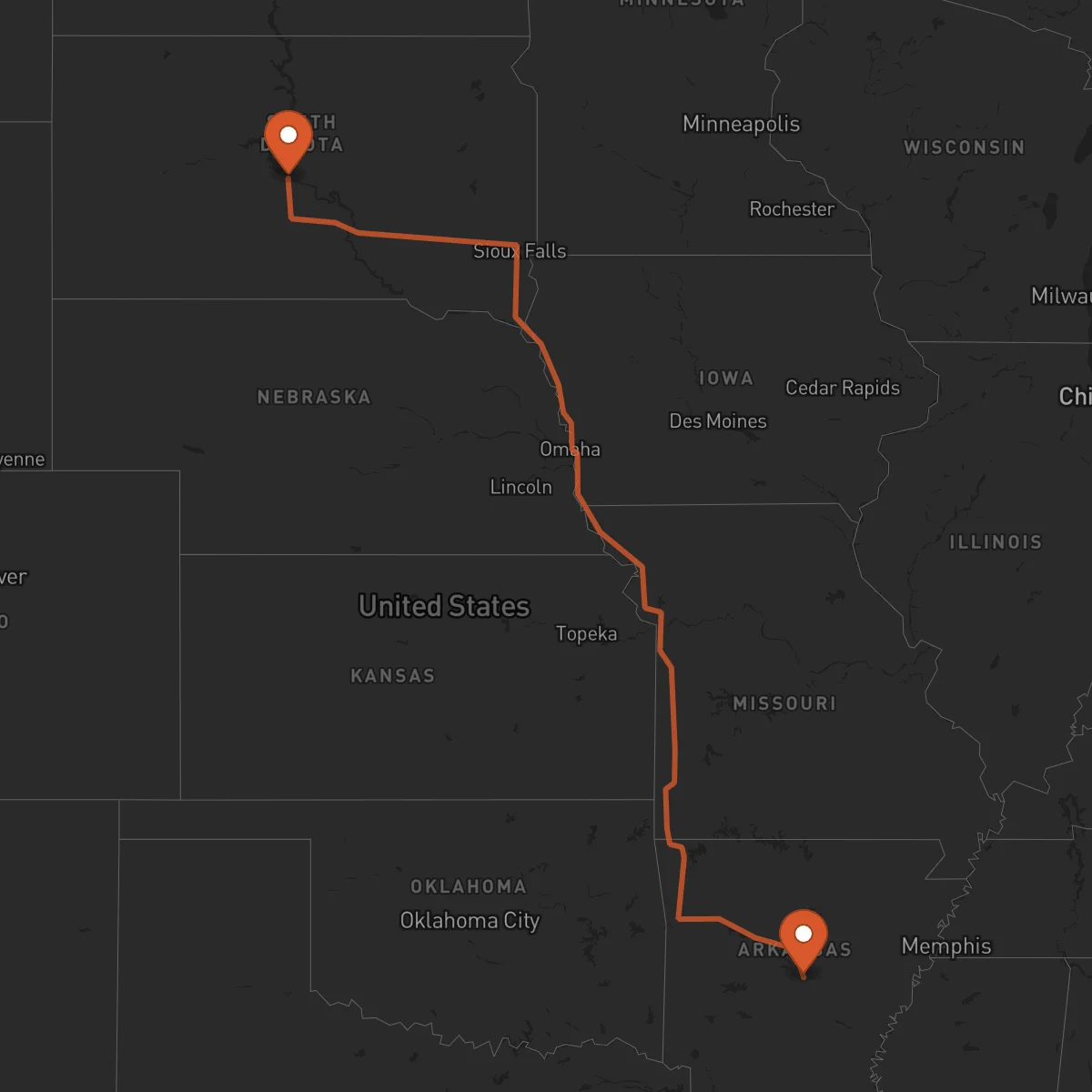
Little Rock to Pierre
Pierre → Little RockFTL freight transportation service between Little Rock and Pierre. Reliable logistics solutions for your business.
Route Description
Everything you need to know about the corridor Little Rock - Pierre
The freight transportation corridor between Little Rock, Arkansas, and Pierre, South Dakota, represents a vital link in the central United States logistics network. This north-south route spans approximately 1273 kilometers, connecting the industrial heartland of Arkansas with the governmental and agricultural center of South Dakota. The corridor traverses diverse landscapes and economic regions, making it essential for businesses that require reliable full truckload (FTL) transportation services across multiple states.
The region along this corridor is characterized by a mix of manufacturing, agricultural, and energy-related industries. Arkansas serves as a significant manufacturing hub, particularly in the aerospace, automotive, and food processing sectors, while South Dakota's economy is anchored by agriculture, government services, and emerging technology industries. This economic diversity creates substantial freight movement in both directions, with businesses requiring consistent and efficient transportation solutions to maintain their supply chains.
Key transportation infrastructure along this corridor includes major interstate highways such as I-40 and I-29, which provide direct access between the two cities. These well-maintained routes ensure smooth transit for heavy freight vehicles, minimizing delays and optimizing delivery times. The corridor also benefits from numerous rest stops, truck facilities, and maintenance centers strategically located along the way, supporting the needs of commercial transportation.
Control Terrestre specializes in facilitating seamless FTL operations along this corridor, offering dedicated transportation solutions that cater to the specific needs of businesses moving freight between Little Rock and Pierre. Our extensive network of certified carriers and our commitment to safety and reliability ensure that your cargo arrives on time and in perfect condition, regardless of the season or weather conditions.
Services for this Route
Available services for the corridor Little Rock - Pierre
 Origin
Little Rock
Little Rock, the capital and largest city of Arkansas, serves as a strategic logistics hub in the southeastern United States. Located along the Arkansas River, the city provides excellent access to major transportation routes, including I-30 and I-40, connecting it to regional and national markets. Little Rock's central location makes it an ideal origin point for freight distribution throughout the Midwest and South.
The city's economy is diverse, with strong presence in government services, healthcare, education, and manufacturing. Key industries include aerospace (with companies like Dassault Falcon Jet), automotive parts manufacturing, and food processing. The Port of Little Rock, an inland port on the McClellan-Kerr Arkansas River Navigation System, provides additional multimodal transportation options, enhancing the city's logistics capabilities. The presence of Little Rock National Airport further expands freight forwarding possibilities for time-sensitive shipments.
 Destination
Pierre
Pierre, the capital city of South Dakota, occupies a unique strategic position along the Missouri River in the central part of the state. While smaller than other regional cities, Pierre's role as the state capital and its location at the intersection of major transportation routes make it an important logistics node. The city is accessible via US Highway 83 and US Highway 14, providing reliable connections to the broader regional transportation network.
The local economy is anchored by government services, healthcare, and agriculture-related industries. Pierre serves as a distribution center for agricultural products from the surrounding rural areas, including corn, soybeans, and livestock. The city's proximity to major agricultural regions creates consistent freight movement, particularly for food products and agricultural equipment. The Missouri River also provides potential for multimodal transportation options, though road freight remains the primary mode for most commercial shipments.










