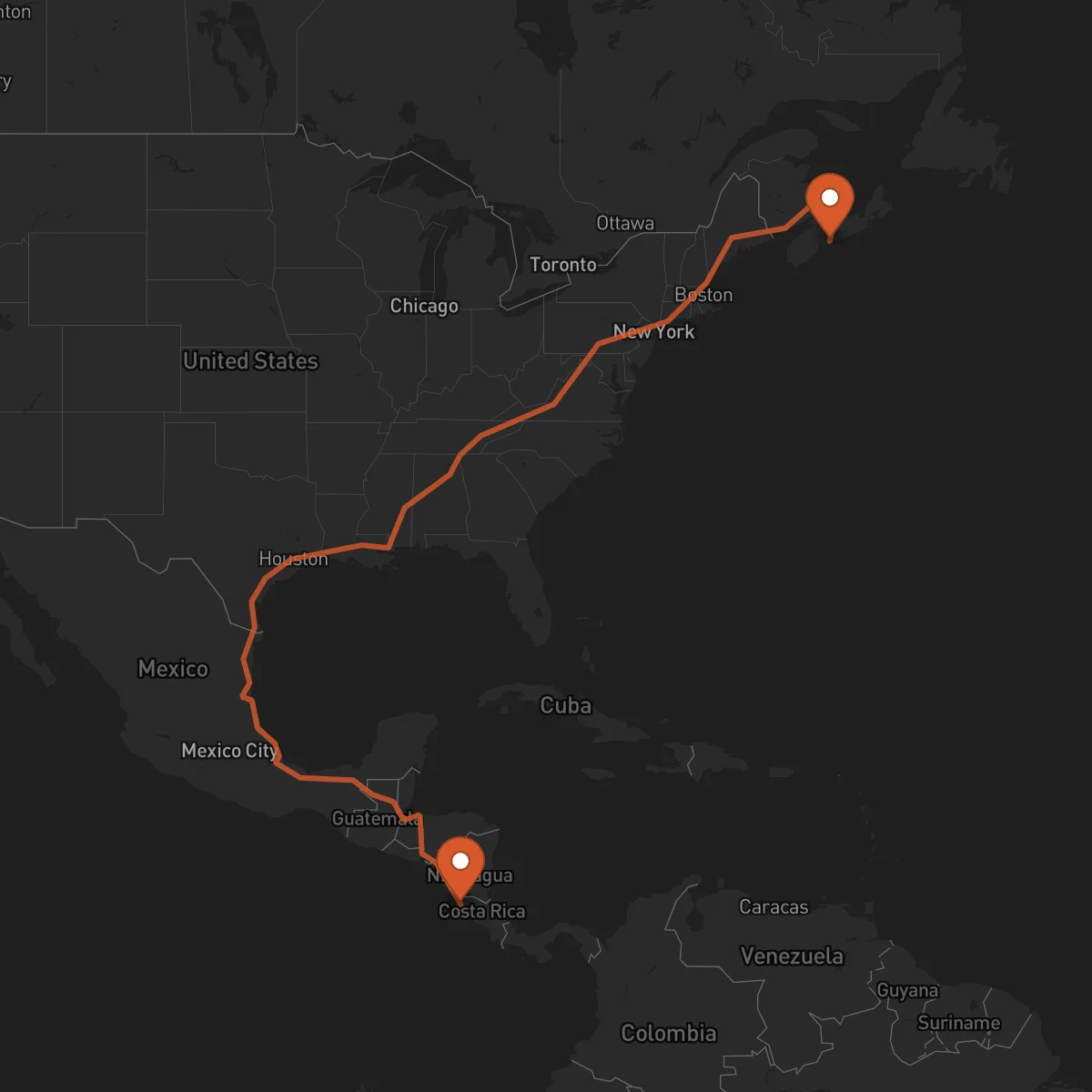
Liberia to Halifax
Halifax → LiberiaFTL freight transportation service between Liberia and Halifax. Reliable logistics solutions for your business.
Route Description
Everything you need to know about the corridor Liberia - Halifax
This cross-border corridor connects the Pacific coast of Costa Rica in Liberia to the Atlantic coast of Canada in Halifax, spanning approximately 4321 kilometers. It serves as a vital link for trade between Central America and North America, facilitating the movement of goods across two major maritime hubs. The strategic importance of this route lies in its ability to connect agricultural and industrial centers of Central America with the consuming markets and ports of North America, offering a direct path for time-sensitive cargo.
The economic context of the region is driven by agriculture, manufacturing, and growing industrial sectors, particularly in Costa Rica and Nicaragua. Key industries utilizing this corridor include agribusiness, electronics, automotive parts, and general manufacturing. The primary transportation infrastructure relies on the Pan-American Highway system, transitioning through major domestic routes to reach the port facilities. Border crossings require careful attention to customs procedures, where documentation and compliance are critical for smooth transit.
Control Terrestre facilitates operations on this corridor by leveraging our network of certified providers, equipped for full truckload (FTL) and specialized cargo needs. We handle the complexities of cross-border freight, ensuring that shipments meet the necessary regulatory requirements. Our expertise in refrigerated, hazardous, and oversized cargo ensures that diverse freight requirements are met with professionalism and efficiency, making us a reliable partner for this international route.
Services for this Route
Available services for the corridor Liberia - Halifax
 Origin
Liberia
Liberia, located in Guanacaste, Costa Rica, serves as a crucial strategic hub for logistics due to its proximity to major ports and its role in regional trade. The city's position along the Central American isthmus makes it an ideal starting point for freight moving northward. Key economic sectors here include tourism, agriculture, and manufacturing, driving consistent demand for robust transportation solutions. The available infrastructure includes direct access to the Pan-American Highway and nearby air cargo facilities, enhancing its connectivity. This allows for efficient consolidation and dispatch of FTL loads, providing a solid foundation for exporters seeking reliable routes to northern markets.
 Destination
Halifax
Halifax, the capital of Nova Scotia, is a major Atlantic port and a key logistical destination in Eastern Canada. Its strategic location on the coast makes it a primary entry point for international trade and a vital economic center for the region. The local economy is heavily supported by sectors such as shipping, offshore oil and gas, information technology, and public administration. The city is well-equipped with modern port facilities and an extensive network of highways and rail links. This infrastructure supports the efficient distribution of incoming freight, allowing Control Terrestre to ensure that specialized cargo is received and prepared for final delivery with precision.










