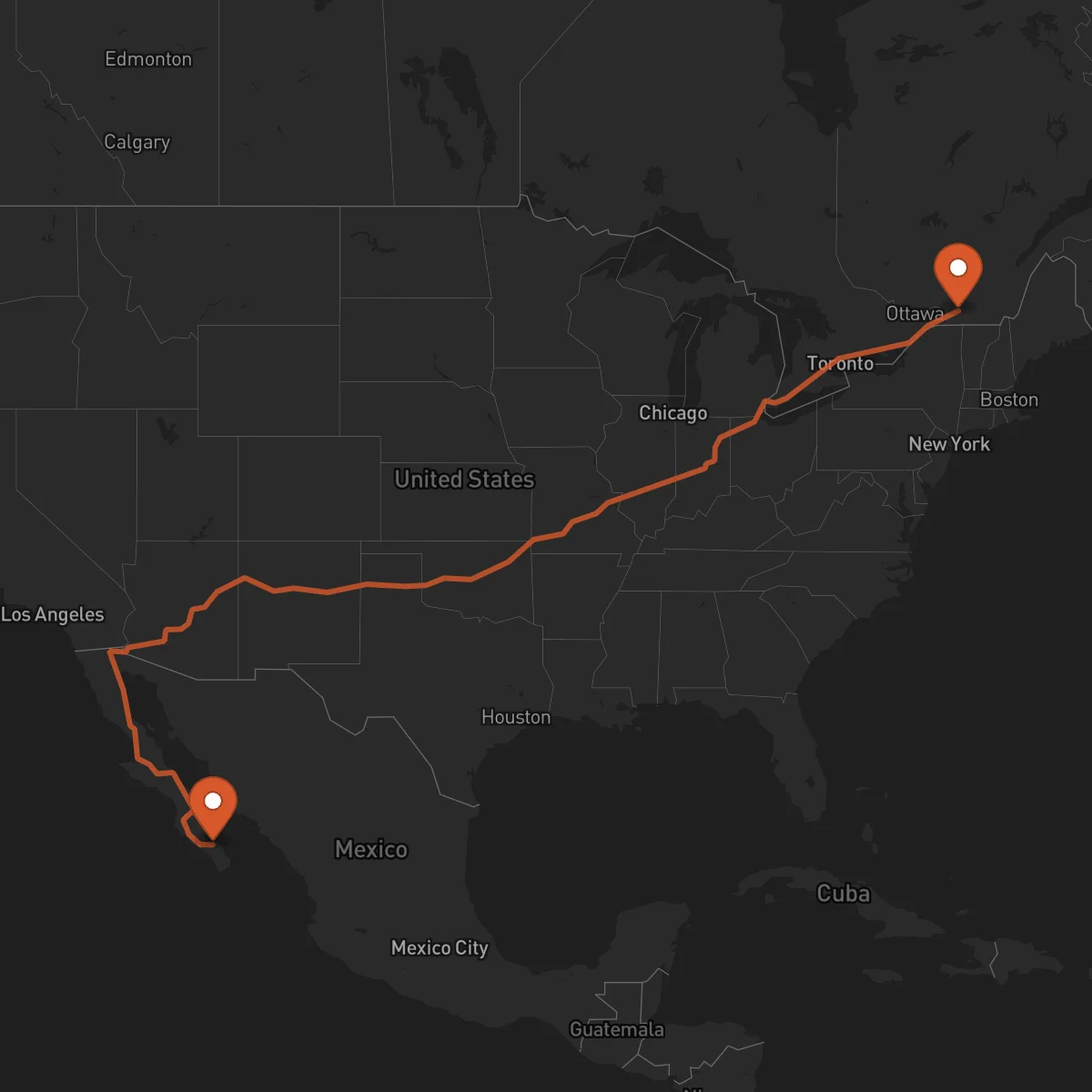
La Paz to Montreal
Montreal → La PazFTL freight transportation service between La Paz and Montreal. Reliable logistics solutions for your business.
Route Description
Everything you need to know about the corridor La Paz - Montreal
The logistics corridor between La Paz, Baja California Sur, and Montreal, Quebec, represents a vital cross-border connection spanning approximately 4,055 kilometers. This corridor links Mexico's strategic Pacific port with one of Canada's most important industrial and commercial hubs, facilitating the movement of goods across three countries. The route traverses diverse terrain and crosses multiple international borders, making it essential for industries requiring seamless freight transportation between North American markets.
The economic significance of this corridor is substantial, connecting Mexico's growing manufacturing and export sectors with Canada's advanced industrial base. Key industries utilizing this route include automotive manufacturing, electronics, agricultural products, and consumer goods. The corridor supports just-in-time inventory systems and supply chain optimization for companies operating across North America.
Major transportation infrastructure along this route includes Mexico's Federal Highway 1 and 5, connecting to the United States through California and continuing north via Interstate 15, Interstate 80, and Interstate 94. The corridor crosses the U.S.-Canada border at various points, with efficient customs processing being crucial for maintaining supply chain velocity. Control Terrestre facilitates operations on this corridor through our extensive network of certified carriers, ensuring compliance with all cross-border regulations and providing real-time tracking capabilities for our clients' shipments.
Services for this Route
Available services for the corridor La Paz - Montreal
 Origin
La Paz
La Paz, located on the eastern coast of Baja California Sur, serves as a strategic logistics hub for Mexico's Pacific trade. The city benefits from its proximity to major ports and its position as a gateway to the Baja California peninsula. La Paz's economy is driven by tourism, fishing, mining, and growing manufacturing sectors, with increasing industrial development supporting export activities. The region's transportation infrastructure includes access to the Port of Pichilingue, Federal Highway 1 connecting to the north, and an international airport facilitating multimodal logistics solutions.
 Destination
Montreal, Quebec, stands as one of Canada's most important logistics and industrial centers, strategically positioned along the St. Lawrence River. The city serves as a major gateway for international trade, with its extensive port facilities, international airport, and comprehensive rail and road networks. Montreal's economy is diverse, with strong presence in aerospace, pharmaceuticals, technology, and manufacturing industries. The metropolitan area's transportation infrastructure includes the Port of Montreal, Pierre Elliott Trudeau International Airport, extensive highway systems, and rail connections to both U.S. and Canadian markets, making it an ideal distribution hub for North American operations.










