Jackson to Hartford
Hartford → JacksonFTL freight transportation service between Jackson and Hartford. Reliable logistics solutions for your business.
Route Description
Everything you need to know about the corridor Jackson - Hartford
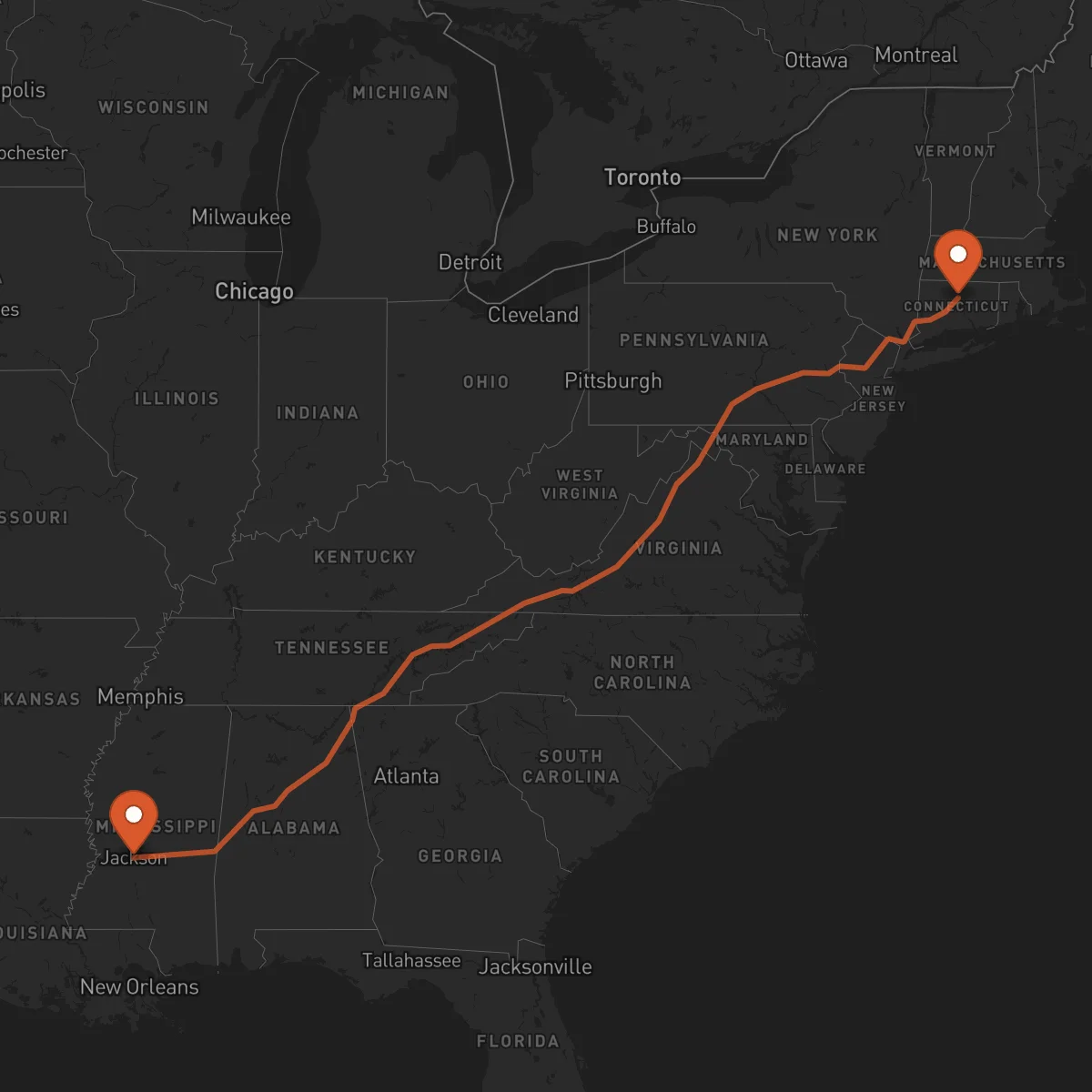
The logistics corridor connecting Jackson, Mississippi, to Hartford, Connecticut, represents a vital transportation route spanning approximately 1,871 kilometers across the eastern United States. This domestic corridor traverses diverse geographic regions and connects two significant economic centers, facilitating the movement of goods between the Southeast and Northeast regions of the country. The route serves as a critical link in the national supply chain, supporting interstate commerce and industrial distribution networks that are essential to the American economy.
The corridor passes through multiple states and crosses several major economic regions, making it strategically important for freight transportation. It connects the industrial and agricultural heartland of the South with the manufacturing and commercial centers of the Northeast. This north-south axis complements the more common east-west transportation patterns, providing shippers with flexible routing options and helping to balance freight flows across the national transportation network.
Key industries utilizing this corridor include automotive manufacturing, agricultural products, industrial equipment, and consumer goods. The route supports just-in-time delivery systems for manufacturing facilities, distribution centers, and retail operations. Control Terrestre provides dedicated full truckload (FTL) services along this corridor, ensuring reliable transportation of high-value or time-sensitive cargo. Our experienced carrier network and advanced logistics technology enable us to optimize routes, manage capacity, and provide real-time tracking for shipments moving between Jackson and Hartford.
Services for this Route
Available services for the corridor Jackson - Hartford
 Origin
Jackson
Jackson, Mississippi, serves as a strategic logistics hub in the southeastern United States, offering excellent connectivity to major transportation networks. The city's location provides access to Interstate 55, a north-south corridor that connects to major markets in the Midwest and Gulf Coast regions. Jackson's transportation infrastructure includes the Jackson-Medgar Wiley Evers International Airport, extensive rail connections through Canadian National Railway, and the Port of Jackson on the Pearl River, creating a multimodal logistics environment that supports efficient freight movement.
The region's economy is diverse, with strong presence in automotive manufacturing, including Nissan's assembly plant, healthcare and medical research facilities, government services, and agricultural processing. These industries generate substantial freight volumes requiring reliable transportation services. Jackson's central location within Mississippi and its position along major freight corridors make it an ideal origin point for shipments destined for the Northeast, including Hartford and surrounding areas.
 Destination
Hartford
Hartford, Connecticut, stands as a strategic logistics center in the northeastern United States, positioned within the Boston-New York-Washington economic corridor. The city's location provides access to Interstate 91 and proximity to major highways including I-84 and I-90, facilitating efficient connections to major Northeast markets. Bradley International Airport, located nearby in Windsor Locks, offers air cargo services, while the Connecticut River provides historical waterway access, though primarily used for recreational purposes today.
The Hartford metropolitan area is characterized by strong insurance and financial services industries, advanced manufacturing, healthcare, and education sectors. The region's proximity to major Northeast markets and its well-developed transportation infrastructure make it an important destination for freight shipments from across the country. Hartford's economic diversity and its role as a regional business center create consistent demand for reliable freight transportation services, particularly for specialized cargo and time-sensitive deliveries from manufacturing and distribution facilities.










