Hartford to Pierre
Pierre → HartfordFTL freight transportation service between Hartford and Pierre. Reliable logistics solutions for your business.
Route Description
Everything you need to know about the corridor Hartford - Pierre
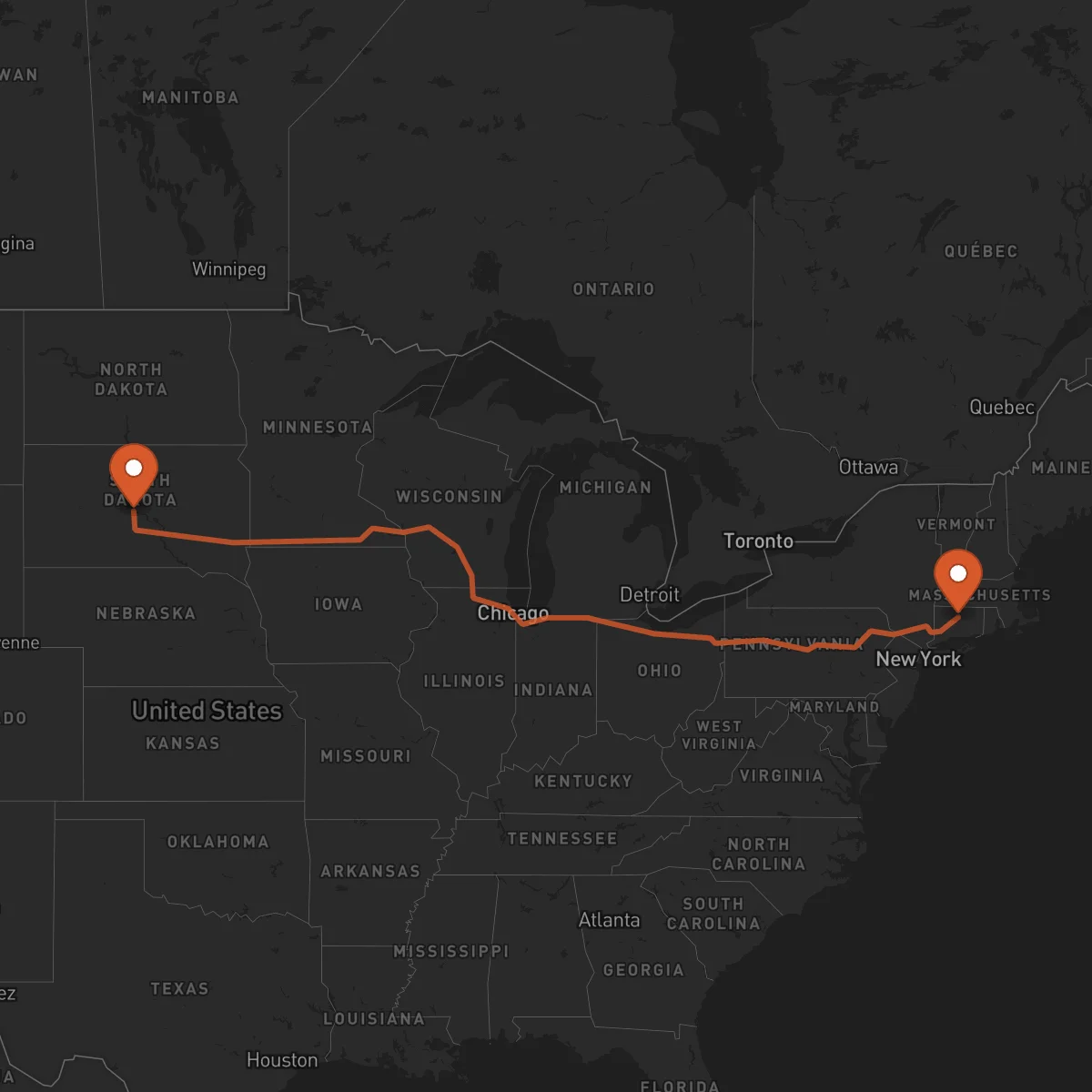
The Hartford to Pierre corridor connects the vibrant industrial hub of Connecticut with the strategic capital of South Dakota, spanning approximately 2,256 kilometers across the American heartland. This domestic route traverses key economic regions, linking the Northeast's manufacturing and financial centers with the agricultural and energy-rich Midwest. The corridor serves as a vital artery for commerce, facilitating the movement of goods between two distinct economic ecosystems.
The region's economic significance stems from Hartford's position as a center for insurance, healthcare, and advanced manufacturing, complemented by Pierre's role in government services, agriculture, and energy production. This complementary economic structure creates consistent freight demand, with manufacturers, distributors, and agricultural producers relying on efficient transportation to maintain their supply chains. The corridor particularly benefits from the diverse industrial base, including aerospace components, medical equipment, and agricultural machinery moving between these markets.
Transportation infrastructure along this route includes major interstate highways such as I-90, I-80, and I-84, providing reliable access through key states including New York, Pennsylvania, Ohio, Indiana, Illinois, Wisconsin, and Minnesota. These well-maintained highways ensure consistent transit times and support various equipment types, from standard dry vans to specialized freight. Control Terrestre leverages this robust infrastructure through our network of certified carriers, offering dedicated full truckload services that ensure your cargo moves efficiently from origin to destination without intermediate handling or delays.
Services for this Route
Available services for the corridor Hartford - Pierre
 Origin
Hartford
Hartford, Connecticut serves as a strategic logistics hub in the Northeast, benefiting from its proximity to major metropolitan areas like New York City and Boston while maintaining competitive operational costs. The city's location provides excellent access to the Port of New York and New Jersey, one of North America's busiest ports, facilitating seamless integration between ocean and land transportation. Hartford's well-developed infrastructure includes Bradley International Airport for air freight connections and an extensive network of highways, including I-91 and I-84, ensuring efficient distribution throughout the region.
The economic landscape of Hartford centers around insurance, healthcare, and advanced manufacturing sectors. The city hosts numerous Fortune 500 insurance companies and serves as a financial services hub, creating consistent demand for specialized freight transportation. Additionally, Hartford's manufacturing base produces aerospace components, medical devices, and precision equipment, requiring reliable full truckload services for time-sensitive and high-value shipments. The region's skilled workforce and technological infrastructure make it an ideal origin point for complex supply chain operations.
 Destination
Pierre
Pierre, South Dakota represents a strategic logistics destination in the American Midwest, serving as the state capital and a central distribution point for the Northern Plains region. Located along the Missouri River, Pierre provides unique access to both river and land transportation networks, complementing its highway infrastructure. The city's position in central South Dakota makes it an ideal hub for distributing goods throughout the region, with major highways like US-14 and US-83 providing reliable connections to surrounding states.
The local economy centers around government services, agriculture, and energy production, creating diverse freight transportation needs. Pierre's role as the state capital ensures consistent demand for office supplies, technology equipment, and specialized government freight. The surrounding agricultural region produces significant quantities of grains, livestock, and agricultural machinery, while the area's energy sector, including wind and traditional power generation, requires specialized equipment transportation. These industries create steady demand for full truckload services, particularly for oversized and specialized cargo moving to and from the region.










