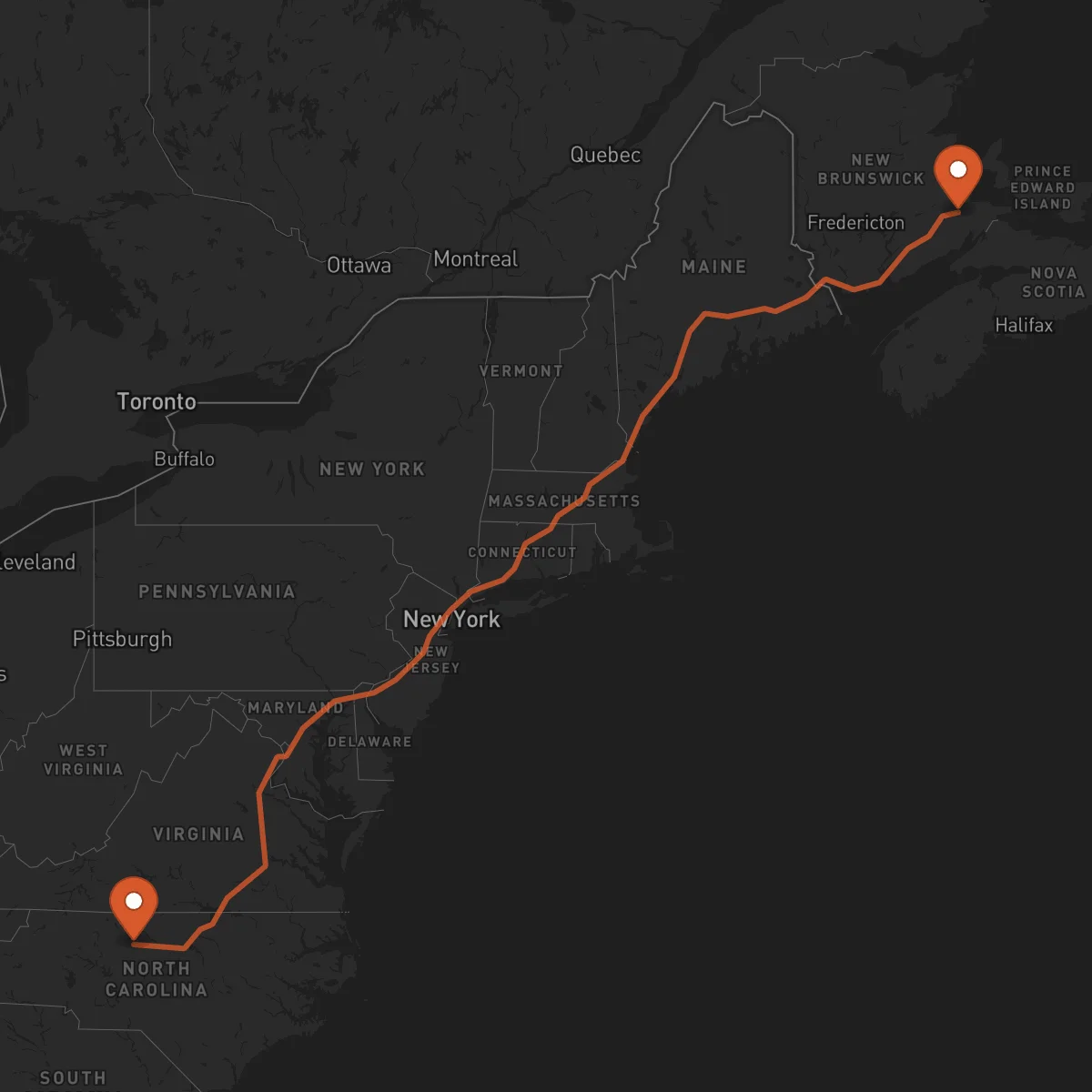
Greensboro to Moncton
Moncton → GreensboroFTL freight transportation service between Greensboro and Moncton. Reliable logistics solutions for your business.
Route Description
Everything you need to know about the corridor Greensboro - Moncton
The Greensboro-Moncton corridor represents a vital cross-border logistics route connecting the industrial heartland of North Carolina with the Atlantic maritime hub of New Brunswick. This 1675 km transportation artery facilitates the movement of goods between the United States and Canada, serving as a critical link in the North American supply chain. The route traverses diverse economic regions, connecting manufacturing centers with distribution networks and international trade gateways.
The corridor's significance stems from its connection between Greensboro's manufacturing and logistics ecosystem and Moncton's strategic position as Atlantic Canada's transportation and distribution center. This route enables efficient movement of industrial goods, consumer products, and raw materials between major economic zones. The journey crosses through multiple states and provinces, requiring expertise in cross-border logistics, customs compliance, and regulatory requirements for both nations.
Transportation infrastructure along this corridor includes major interstate highways such as I-85 and I-95 in the United States, transitioning to Canadian routes including the Trans-Canada Highway. The route benefits from multiple border crossing options, with efficient processing at key ports of entry. Control Terrestre's expertise in managing cross-border operations ensures seamless transit through customs procedures, documentation requirements, and regulatory compliance for both US and Canadian jurisdictions.
Services for this Route
Available services for the corridor Greensboro - Moncton
 Origin
Greensboro
Greensboro, North Carolina serves as a strategic logistics hub in the southeastern United States, positioned at the intersection of major transportation networks. The city's location provides excellent access to the Research Triangle, Piedmont Triad region, and major ports along the East Coast. Greensboro's robust transportation infrastructure includes extensive highway connections, rail networks, and proximity to Piedmont Triad International Airport, making it an ideal origin point for freight distribution.
The region's economy is characterized by diverse manufacturing sectors including textiles, furniture, electronics, and automotive components. Greensboro's industrial base produces a wide range of goods requiring efficient transportation solutions. The presence of numerous distribution centers, warehouses, and manufacturing facilities creates substantial freight movement, establishing Greensboro as a key logistics node for both regional and international shipping.
 Destination
Moncton
Moncton, New Brunswick represents a crucial logistics gateway for Atlantic Canada, strategically positioned to serve the Maritime provinces. The city's location at the geographic center of the Maritimes provides optimal access to major population centers in New Brunswick, Nova Scotia, and Prince Edward Island. Moncton's transportation infrastructure includes comprehensive highway networks, rail connections, and the Greater Moncton Roméo LeBlanc International Airport, supporting efficient freight distribution throughout the region.
The local economy benefits from Moncton's role as a distribution and logistics center, with strong sectors in manufacturing, retail distribution, and international trade. The city's port facilities and proximity to the Port of Halifax enhance its capabilities for handling import-export operations. Moncton's position as Atlantic Canada's logistics hub makes it an essential destination for freight movement, particularly for goods destined for the Maritime provinces and beyond.










