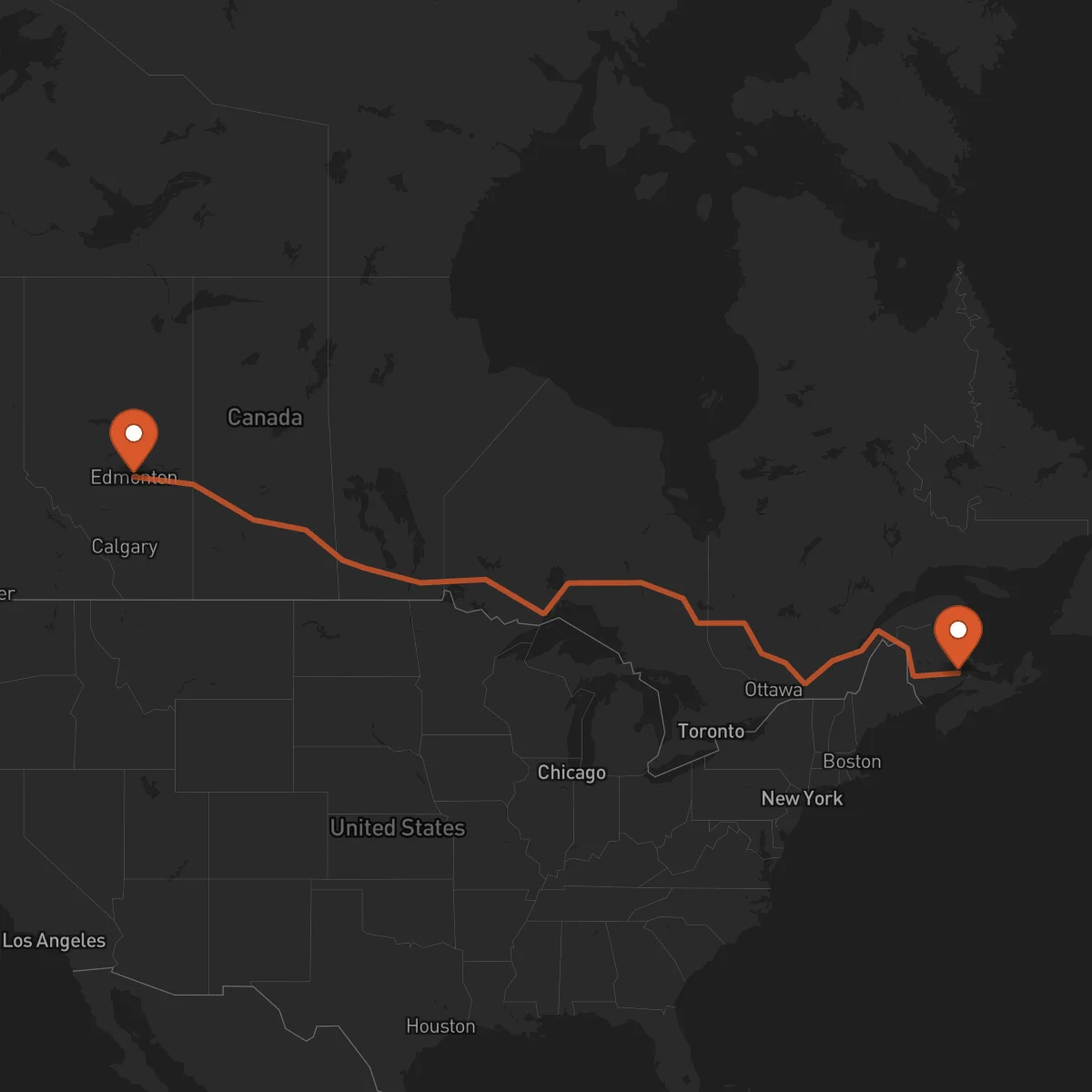
Edmonton to Moncton
Moncton → EdmontonFTL freight transportation service between Edmonton and Moncton. Reliable logistics solutions for your business.
Route Description
Everything you need to know about the corridor Edmonton - Moncton
The Edmonton to Moncton corridor represents one of Canada's most critical east-west freight transportation routes, spanning approximately 3,518 kilometers across six provinces. This strategic connection links Alberta's energy and industrial heartland with Atlantic Canada's maritime ports and manufacturing centers, creating an essential supply chain artery for the nation's economy.
The corridor traverses diverse economic regions, from Edmonton's oil sands and petrochemical industries through Saskatchewan's agricultural heartland, Manitoba's manufacturing base, and Ontario's automotive sector, before reaching New Brunswick's forestry and seafood industries. This multi-provincial route supports the movement of industrial equipment, agricultural products, manufactured goods, and energy resources that drive Canada's interprovincial trade.
Control Terrestre provides dedicated full truckload (FTL) services along this corridor using our extensive network of certified carriers. Our operations ensure consistent capacity and reliable service across the entire route, with specialized equipment available for temperature-sensitive cargo, oversized shipments, and hazardous materials. Our C-TPAT and FAST certified partners facilitate smooth border operations and customs clearance throughout the journey.
We understand the unique challenges of this long-haul corridor, including varying provincial regulations, weather conditions, and infrastructure requirements. Our logistics experts coordinate every aspect of the shipment, providing real-time tracking and dedicated support to ensure your cargo moves efficiently from Edmonton to Moncton, maintaining the integrity of your supply chain across Canada's vast geography.
Services for this Route
Available services for the corridor Edmonton - Moncton
 Origin
Edmonton serves as Alberta's primary logistics hub, strategically positioned at the crossroads of major transportation networks. Located in the heart of Canada's energy sector, Edmonton provides direct access to the oil sands, petrochemical facilities, and industrial manufacturing centers of northern Alberta. The city's Yellowhead Highway (Highway 16) connects directly to national freight corridors, while Edmonton International Airport and major rail terminals support multimodal transportation options.
The region's economy is driven by energy production, petrochemical processing, manufacturing, and technology sectors. Edmonton's industrial parks and warehouse facilities offer extensive storage and distribution capabilities, while the city's proximity to major oil and gas operations creates consistent demand for specialized freight services. The city's infrastructure includes modern highways, dedicated freight corridors, and a robust network of logistics providers capable of handling everything from standard palletized freight to oversized industrial equipment.
 Destination
Moncton
Moncton functions as Atlantic Canada's primary logistics gateway, offering strategic access to New Brunswick's forestry, seafood, and manufacturing industries. Located in the Maritimes, Moncton provides crucial connections to Atlantic ports and serves as a distribution center for goods moving throughout the region. The city's transportation infrastructure includes the Trans-Canada Highway, rail connections, and the Greater Moncton Roméo LeBlanc International Airport.
The region's economy encompasses forestry products, seafood processing, agricultural goods, and light manufacturing. Moncton's warehouse districts and industrial parks support regional distribution networks, while the city's position near major Atlantic ports facilitates international trade. The area's infrastructure is designed to handle diverse freight types, from refrigerated seafood shipments to industrial equipment, making it an essential endpoint for cross-Canada freight movements.










