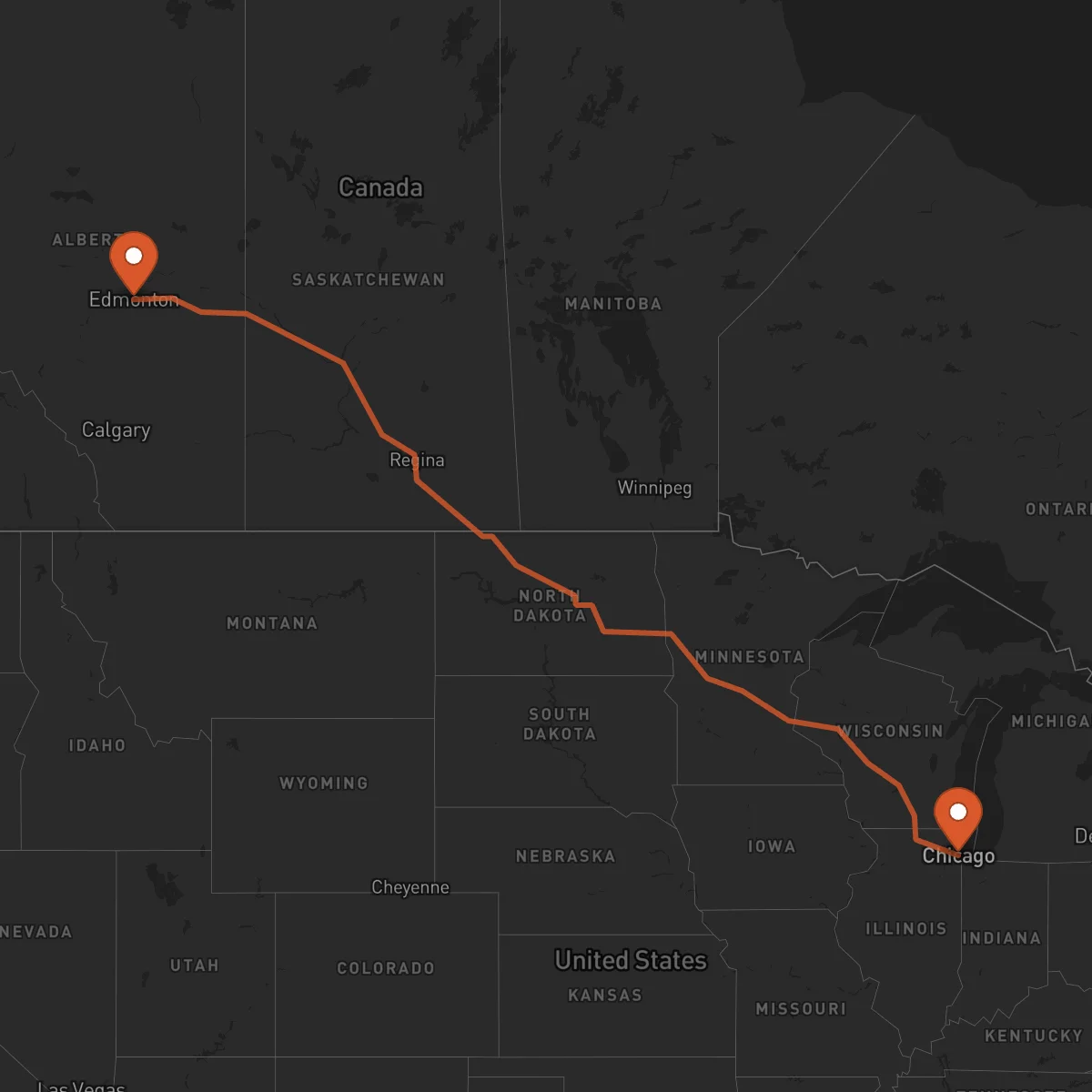
Edmonton to Chicago
Chicago → EdmontonFTL freight transportation service between Edmonton and Chicago. Reliable logistics solutions for your business.
Route Description
Everything you need to know about the corridor Edmonton - Chicago
The Edmonton-Chicago corridor represents a vital cross-border freight transportation link connecting Canada's western energy hub with the United States' major transportation and industrial center. This 2,309 km route traverses diverse landscapes and crosses the international border at key points, facilitating the movement of goods between Alberta and Illinois. The corridor's strategic importance stems from Edmonton's role as a major oil and gas production center and Chicago's position as a continental logistics hub.
The economic significance of this corridor is substantial, supporting industries ranging from energy and manufacturing to agriculture and retail. Edmonton's proximity to the Alberta oil sands and Chicago's extensive manufacturing base create a natural flow of industrial equipment, raw materials, and finished goods. The corridor also serves the agricultural sector, with products moving in both directions to support food processing and distribution networks.
Major transportation infrastructure along this route includes the Trans-Canada Highway system and Interstate highways in the United States. Key border crossings such as the Pembina-Emerson crossing provide efficient customs clearance for freight shipments. Control Terrestre facilitates seamless operations on this corridor by leveraging our C-TPAT and FAST certified carriers, ensuring expedited border processing and reliable cross-border transportation solutions for our clients.
Services for this Route
Available services for the corridor Edmonton - Chicago
 Origin
Edmonton, Alberta serves as a strategic logistics hub in Western Canada, offering exceptional connectivity for freight transportation. Located on the North Saskatchewan River, Edmonton provides access to major transportation networks including highways, rail lines, and air cargo facilities. The city's Yellowhead Highway (Highway 16) serves as a primary east-west corridor connecting to the rest of Canada and into the United States.
The region's economy is anchored by the energy sector, with Edmonton serving as a service and supply center for the Alberta oil sands. Major industries include oil and gas extraction, petrochemical refining, manufacturing, and technology. The city's industrial base creates substantial freight transportation demand for heavy equipment, machinery, and specialized cargo. Edmonton's International Airport and major rail yards further enhance its logistics capabilities, making it an ideal origin point for cross-border shipments to the United States.
 Destination
Chicago
Chicago, Illinois stands as one of North America's premier logistics and transportation hubs, offering unparalleled connectivity and infrastructure for freight movement. The city's strategic location at the crossroads of major interstate highways, rail networks, and waterway systems makes it an ideal destination for cross-border shipments from Canada. Chicago's extensive intermodal facilities and warehousing infrastructure support efficient cargo handling and distribution.
The Chicago metropolitan area hosts diverse industries including manufacturing, food processing, pharmaceuticals, and retail distribution. The region's economic strength drives substantial freight transportation demand, particularly for time-sensitive and high-value goods. Chicago's O'Hare International Airport ranks among the world's busiest cargo airports, while the city's extensive rail yards and port facilities on Lake Michigan provide multiple transportation options. This comprehensive infrastructure network ensures reliable delivery and distribution capabilities for freight arriving from cross-border corridors like Edmonton.










