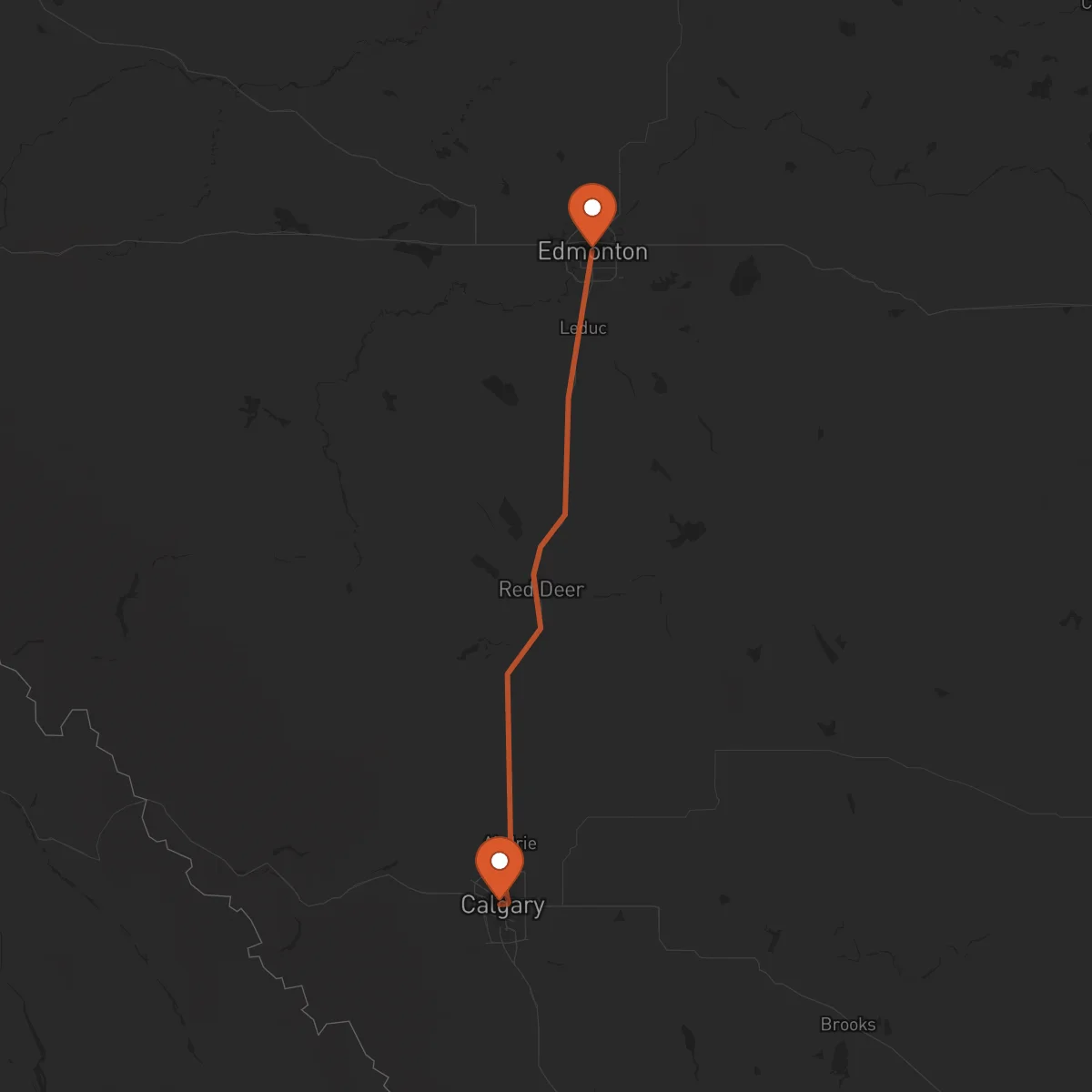
Edmonton to Calgary
Calgary → EdmontonFTL freight transportation service between Edmonton and Calgary. Reliable logistics solutions for your business.
Route Description
Everything you need to know about the corridor Edmonton - Calgary
The Edmonton to Calgary corridor represents one of Canada's most vital domestic freight transportation routes, connecting Alberta's two largest cities across a distance of approximately 281 kilometers. This strategic corridor serves as the backbone of Alberta's economy, linking Edmonton's industrial and governmental center with Calgary's energy and financial hub. The route primarily follows the Queen Elizabeth II Highway (Highway 2), a modern four-lane divided highway that ensures reliable and efficient freight movement throughout the year.
The corridor's importance stems from the complementary economic strengths of both cities. Edmonton serves as Alberta's northern economic engine, with significant government operations, manufacturing, and distribution centers, while Calgary stands as the energy capital of Canada, hosting major oil and gas companies, financial institutions, and corporate headquarters. This creates a constant flow of goods, equipment, and materials between the two cities, supporting industries ranging from energy and construction to technology and professional services.
Control Terrestre specializes in full truckload (FTL) transportation along this corridor, offering dedicated services that ensure your cargo moves efficiently between Edmonton and Calgary. Our strategic partnerships with certified carriers provide access to the right equipment for your specific needs, whether you require dry van, refrigerated, or specialized transport. With our commitment to safety, reliability, and customer service, we ensure your freight arrives on time and in perfect condition, supporting your business operations in both cities.
Services for this Route
Available services for the corridor Edmonton - Calgary
 Origin
Edmonton, Alberta's capital city, serves as a strategic logistics hub for Western Canada. Located in the geographic center of Alberta, Edmonton provides excellent access to northern markets and serves as a gateway to the Northwest Territories and Yukon. The city's Yellowhead Corridor connects it to major transportation networks, making it an ideal origin point for freight distribution across Western Canada.
The city's economy is diverse, with strong presence in government services, education, healthcare, and manufacturing. Edmonton is home to the largest urban park in North America, the North Saskatchewan River Valley, and boasts a robust industrial sector including oil and gas equipment manufacturing, construction materials, and agricultural products. The city's major industrial areas, such as the Edmonton International Airport area and the Edmonton Research Park, provide excellent infrastructure for logistics operations, with numerous warehouses, distribution centers, and transportation facilities supporting efficient freight movement.
 Destination
Calgary, located at the confluence of the Bow and Elbow rivers, stands as Alberta's economic powerhouse and a major logistics center in Western Canada. The city's strategic location at the foothills of the Rocky Mountains provides excellent access to both eastern and western markets, making it a crucial node in Canada's transportation network. Calgary's modern infrastructure includes extensive highway systems, rail connections, and proximity to the Calgary International Airport, facilitating efficient freight movement in all directions.
The city's economy is dominated by the energy sector, with numerous oil and gas companies headquartered here, along with significant financial services, technology, and manufacturing industries. Calgary's industrial areas, such as the Foothills Industrial Park and the Calgary International Airport Business Park, offer modern warehousing and distribution facilities. The city's strong economic base creates consistent demand for freight transportation services, particularly for specialized equipment needed in the energy sector, including oversized loads and hazardous materials handling.










