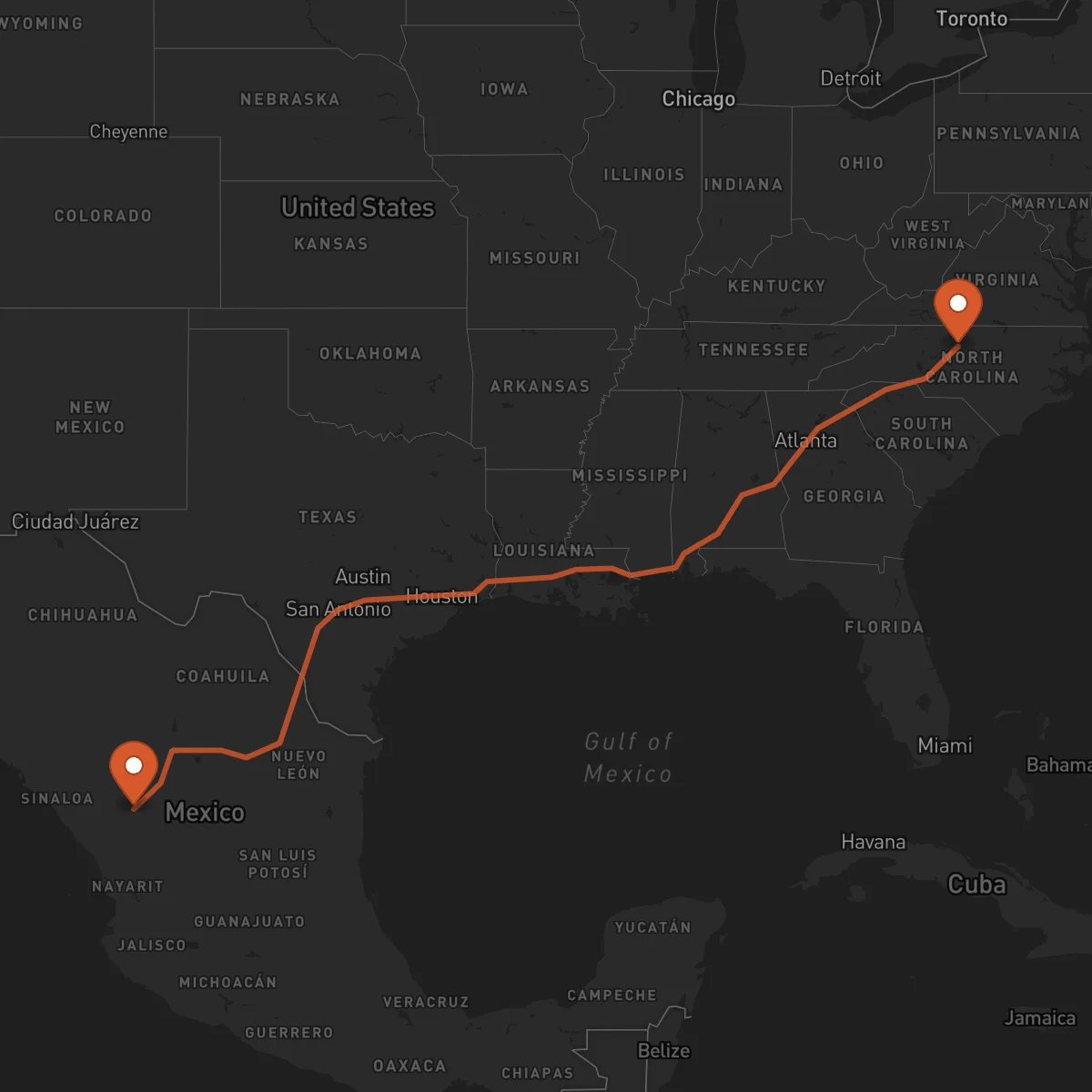
Durango to Greensboro
Greensboro → DurangoFTL freight transportation service between Durango and Greensboro. Reliable logistics solutions for your business.
Route Description
Everything you need to know about the corridor Durango - Greensboro
The logistics corridor between Durango, Mexico and Greensboro, North Carolina represents a vital cross-border connection spanning approximately 2,731 kilometers. This strategic route links Mexico's industrial heartland with one of the United States' most dynamic logistics hubs, facilitating the seamless movement of goods between North America's two largest economies.
The corridor traverses diverse terrain and crosses key economic regions, connecting manufacturing centers in northern Mexico with the robust distribution networks of the southeastern United States. Control Terrestre's expertise in cross-border operations ensures smooth transitions through customs and compliance with all regulatory requirements, minimizing delays and optimizing transit times for our clients.
This route serves critical industries including automotive manufacturing, electronics, aerospace components, and agricultural products. The Durango region is known for its industrial parks and maquiladora operations, while Greensboro has emerged as a major distribution center with its proximity to the Port of Virginia and extensive rail connections. The corridor primarily utilizes Mexico's Federal Highway 45 and connects to major U.S. interstates including I-40 and I-85, providing reliable access to the East Coast market.
Control Terrestre's dedicated fleet and specialized equipment ensure that cargo moves efficiently through this corridor, whether it's time-sensitive manufacturing components or temperature-controlled goods. Our cross-border expertise, combined with our certified transportation partners, provides the reliability and security that businesses demand when shipping between Mexico and the United States.
Services for this Route
Available services for the corridor Durango - Greensboro
 Origin
Durango, located in northern Mexico, serves as a strategic logistics hub with excellent connectivity to major industrial centers. The city benefits from its position along Federal Highway 45, a critical north-south corridor that links Mexico's central and northern regions. Durango's industrial parks host a diverse range of manufacturing operations, particularly in automotive, aerospace, and electronics sectors, making it a key origin point for cross-border freight.
The region's transportation infrastructure includes the Durango International Airport, which supports air cargo operations, and well-maintained highway networks that connect to border crossings at Ciudad Juárez and Nuevo Laredo. Durango's industrial base has grown significantly, with numerous maquiladora facilities producing components for export to the United States and Canada. The city's logistics ecosystem includes warehousing, distribution centers, and specialized freight services that cater to the needs of international shippers.
 Destination
Greensboro
Greensboro, North Carolina, stands as a premier logistics and distribution center in the southeastern United States. The city's strategic location provides access to over 60% of the U.S. population within a one-day drive, making it an ideal destination for cross-border freight from Mexico. Greensboro's extensive transportation infrastructure includes major highways such as I-40, I-85, and I-73, along with the nearby Piedmont Triad International Airport and intermodal rail facilities.
The region has developed a strong presence in advanced manufacturing, logistics services, and distribution operations. Greensboro is home to numerous warehouses, fulfillment centers, and logistics companies that serve the East Coast market. The city's proximity to the Port of Virginia and its integration with the Southeast's extensive rail network make it a critical node in North America's supply chain. Greensboro's business-friendly environment and skilled workforce have attracted companies from various sectors, including automotive, textiles, and technology, all of which benefit from efficient cross-border transportation services.










