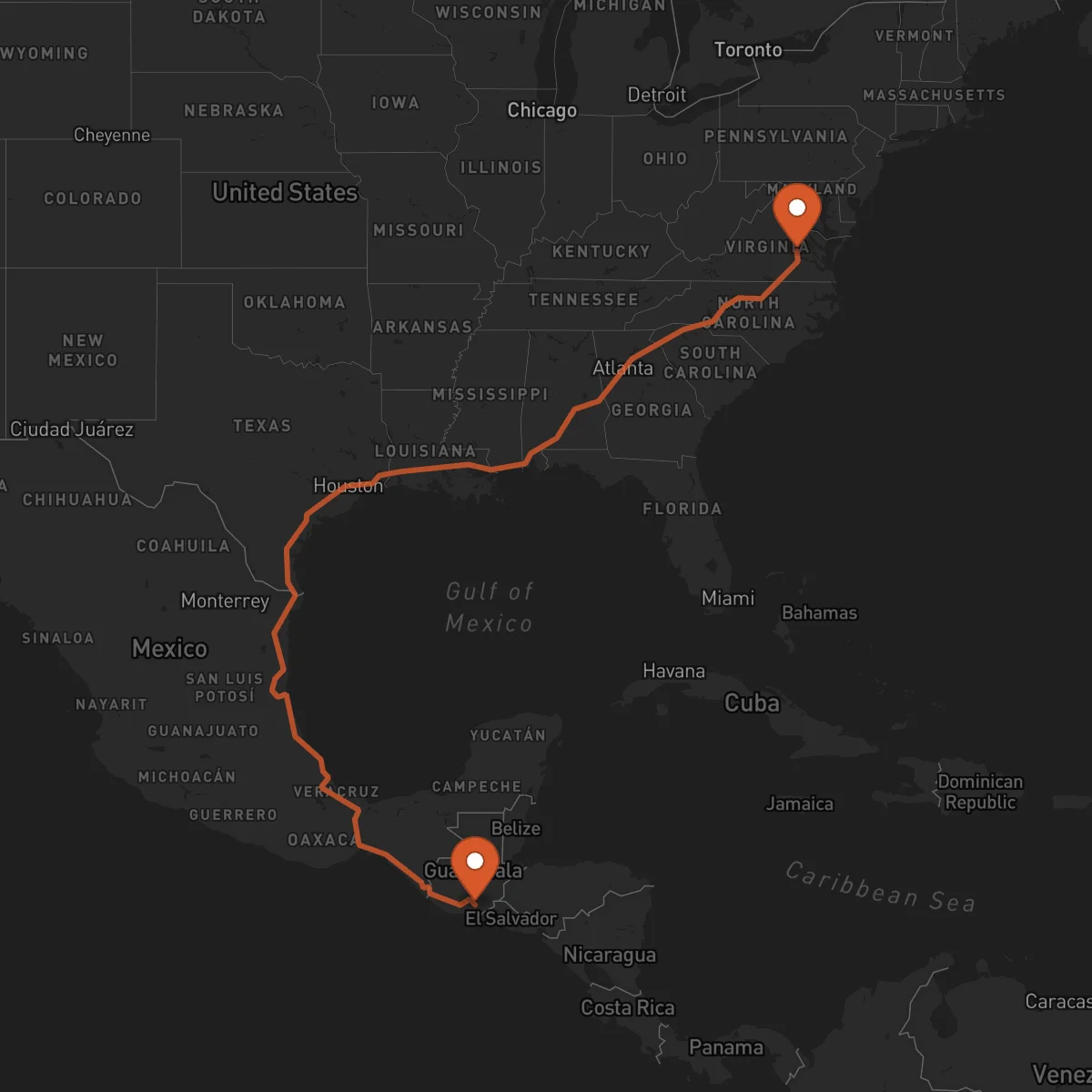
Cuilapa to Richmond
Richmond → CuilapaFTL freight transportation service between Cuilapa and Richmond. Reliable logistics solutions for your business.
Route Description
Everything you need to know about the corridor Cuilapa - Richmond
The Cuilapa to Richmond corridor is a vital cross-border route linking Guatemala to the US East Coast, enabling efficient trade and supply chain optimization. Strategically, it connects Central American production hubs with key American markets, supporting economic growth on both ends. Economically, Guatemala relies on exports such as agricultural products (coffee, bananas, textiles) and raw materials, while Richmond, Virginia, serves as a distribution and manufacturing center for goods like machinery, consumer products, and chemicals. Main industries utilizing this corridor include agriculture, food and beverage, retail, and industrial manufacturing, which depend on reliable full truckload (FTL) services for timely movement. The transportation infrastructure involves Guatemalan highways like CA-9 to the Mexican border at Tecún Umán, followed by Mexican routes (e.g., Mexico 190, 190D, 150D) to US crossings such as Laredo or Brownsville, then US interstates (I-35, I-10, I-95) covering approximately 2882 km to Richmond. Relevant border crossings require strict customs compliance with USMCA regulations, and Control Terrestre's provider network holds certifications like C-TPAT, FAST, and BASC to facilitate smoother clearance. We enhance operations through our alliance of experienced carriers, offering tailored FTL solutions—including dedicated, expedited, and specialized options—while managing documentation and transit efficiently, all from a human and sustainable approach.
Services for this Route
Available services for the corridor Cuilapa - Richmond
 Origin
Cuilapa
Cuilapa, the capital of Santa Rosa department in Guatemala, holds strategic importance as a logistical hub in the eastern region. Surrounded by fertile agricultural lands, it serves as a key production center for crops like coffee, sugarcane, fruits, and vegetables, driving significant export activity. The local economy is predominantly agricultural, with supplemental sectors in livestock and light manufacturing, creating consistent demand for freight transport to ports and borders. Transportation infrastructure is anchored by the CA-9 highway, which connects Cuilapa north to Guatemala City and south to Puerto San José on the Pacific coast, and via CA-1 to the Mexican border at Tecún Umán. While road conditions can vary, this network supports truck movement for cross-border shipments, positioning Cuilapa as a critical origin point for goods destined for North America.
 Destination
Richmond
Richmond, Virginia, is a strategic East Coast logistics gateway with direct access to the Port of Virginia, one of the largest and deepest ports on the US East Coast. Its location on the I-95 corridor provides seamless connectivity to major markets from the Northeast to the Southeast, enhancing its role in distribution and supply chains. Economically, Richmond boasts a diverse industrial base, including manufacturing (chemicals, plastics, food processing), finance, government, and logistics services, with key sectors like tobacco and agriculture contributing to freight demand. The transportation infrastructure is robust, featuring highways I-95, I-64, and I-295 for road transit, complemented by nearby port facilities and rail networks. This makes Richmond an ideal destination for FTL shipments from Latin America, supporting efficient import and export operations within a well-integrated logistics ecosystem.










