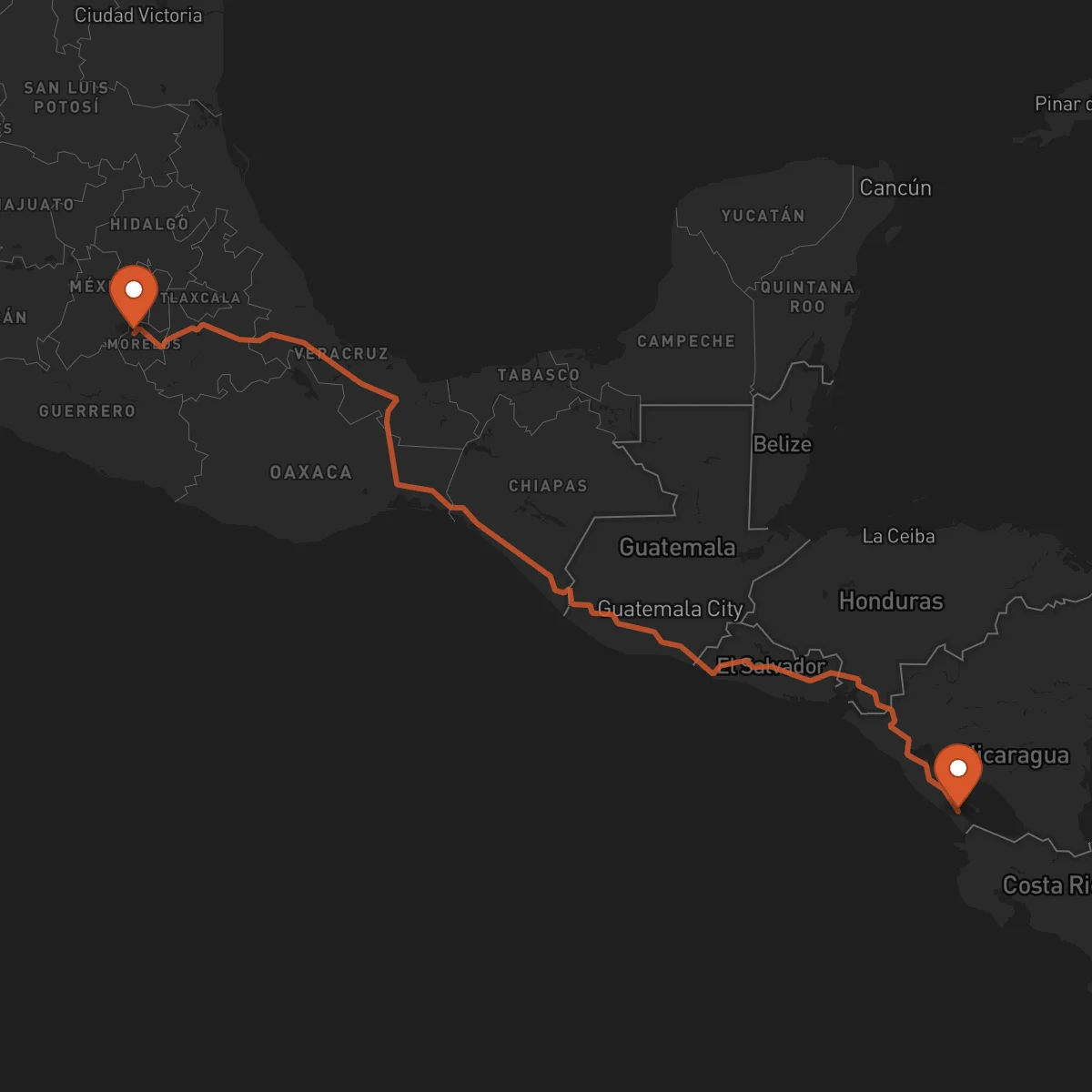
Cuernavaca to Rivas
Rivas → CuernavacaFTL freight transportation service between Cuernavaca and Rivas. Reliable logistics solutions for your business.
Route Description
Everything you need to know about the corridor Cuernavaca - Rivas
This cross-border corridor connects Cuernavaca, Morelos, México to Rivas, Nicaragua, spanning approximately 1,660 kilometers. It serves as a vital commercial artery linking central Mexico to Central America, facilitating the movement of goods between major economic zones and enabling market expansion for businesses engaged in international trade.
The region along this route features a diverse economic and industrial landscape. In Mexico, it supports manufacturing and industrial activities, while Central American destinations are driven by agriculture, textiles, and growing commercial hubs. This corridor is essential for companies participating in regional supply chains, allowing for the efficient flow of materials and finished products across borders.
Transportation infrastructure primarily utilizes established national highways that connect to key routes leading into Central America. Border crossings require careful attention to customs procedures, where documentation and compliance are critical. Control Terrestre leverages its network of certified providers, who hold credentials such as C-TPAT and Responsible Care, to manage these complexities. We coordinate full truckload (FTL) services, including specialized cargo needs, ensuring that shipments move seamlessly through this corridor with adherence to regulatory requirements.
Control Terrestre facilitates operations by offering dedicated and expedited freight solutions across this route. Our capabilities in handling hazardous materials and oversized cargo, combined with our intermodal and refrigerated options, provide flexibility. We manage the documentation and carrier selection to optimize the logistics flow between these two strategic points.
Services for this Route
Available services for the corridor Cuernavaca - Rivas
 Origin
Cuernavaca is strategically positioned as a logistics hub in central Mexico, offering efficient connectivity to Mexico City and other major distribution centers. Its location allows for streamlined access to both domestic and international routes, making it an ideal origin point for FTL shipments.
The city hosts a diverse economic landscape, with strong sectors in manufacturing, services, and commerce. This industrial base generates consistent freight traffic, supporting the need for reliable transportation solutions. Infrastructure in Cuernavaca is well-developed, with access to primary highways that integrate into the national transportation network.
Control Terrestre utilizes this infrastructure to initiate complex logistics operations. Our focus on specialized cargo and dedicated services ensures that shipments from Cuernavaca are prepared for long-distance transit. We coordinate seamlessly with our network of providers to maintain a high level of operational efficiency for exports and domestic transport.
 Destination
Rivas is a strategic coastal destination in Nicaragua, offering vital connectivity to Central American markets. Its location provides a gateway for trade, particularly for imports and regional distribution throughout Central America. The infrastructure supports the efficient handling of incoming shipments, making it a practical endpoint for logistics operations.
The economic sectors in Rivas are centered on agriculture, textiles, and growing commercial activities. This industrial base creates demand for specialized transportation solutions, including the handling of diverse cargo types. The availability of infrastructure ensures that goods can be received and further distributed effectively.
Control Terrestre coordinates the final leg of the journey by leveraging trusted carrier alliances. We ensure that shipments destined for Rivas are managed with the same level of care and compliance. Our capabilities in refrigerated and specialized cargo transport ensure that the destination is equipped to handle the specific needs of arriving FTL shipments.










