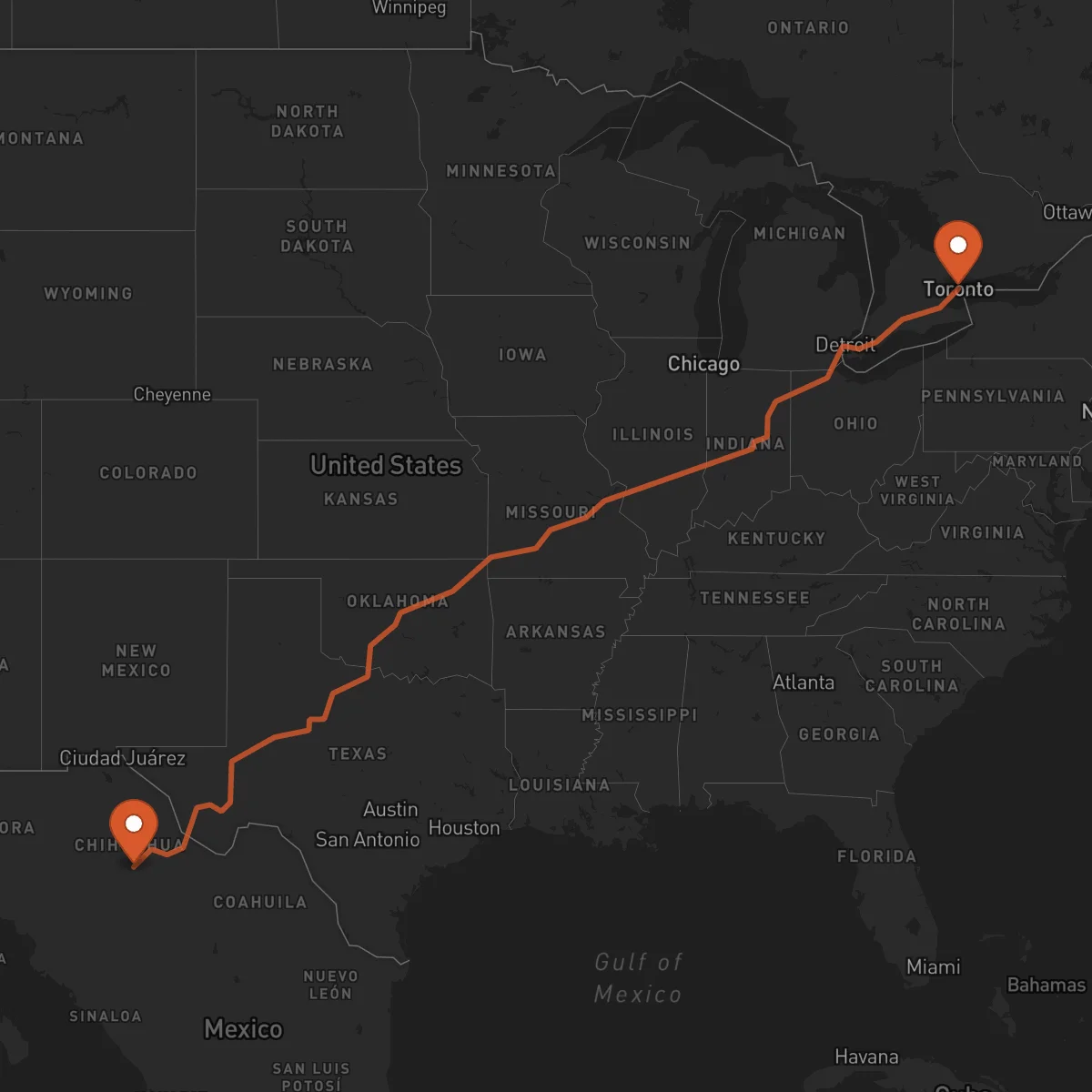
Chihuahua to Toronto
Toronto → ChihuahuaFTL freight transportation service between Chihuahua and Toronto. Reliable logistics solutions for your business.
Route Description
Everything you need to know about the corridor Chihuahua - Toronto
The logistics corridor connecting Chihuahua, Mexico to Toronto, Canada represents one of the most critical cross-border freight transportation routes in North America. This 2,898 km corridor links the industrial heart of northern Mexico with Canada's financial and manufacturing capital, facilitating the movement of high-value goods across three countries. The route traverses diverse terrain and crosses multiple state and provincial lines, requiring expert coordination and compliance with varying regulations.
The corridor serves as a vital artery for international trade, connecting Mexico's growing manufacturing sector with Canada's sophisticated industrial base. Major transportation infrastructure along this route includes Mexico's Federal Highway 45, the United States' interstate system, and Canada's 400-series highways. The corridor passes through key border crossings including Laredo/Nuevo Laredo and Detroit/Windsor, where efficient customs clearance is essential for maintaining supply chain velocity.
Control Terrestre provides comprehensive cross-border FTL services along this corridor, leveraging our strategic partnerships and certified transportation providers. Our expertise in handling the complex documentation requirements, customs procedures, and regulatory compliance ensures seamless freight movement from Chihuahua's maquiladoras to Toronto's distribution centers. We coordinate every aspect of the journey, from initial pickup to final delivery, providing our clients with reliable, temperature-controlled, and specialized transportation solutions that meet the demanding requirements of cross-border logistics.
Services for this Route
Available services for the corridor Chihuahua - Toronto
 Origin
Chihuahua serves as a strategic logistics hub in northern Mexico, offering exceptional connectivity to both domestic and international markets. The city's industrial sector is dominated by maquiladoras, automotive manufacturing, and electronics production, making it a critical origin point for high-value, time-sensitive freight. Chihuahua's transportation infrastructure includes modern highways connecting to the US border, a commercial airport, and rail connections that facilitate efficient cargo movement throughout the region.
 Destination
Toronto stands as Canada's premier logistics and economic center, strategically positioned to serve the country's most populous region. The city's advanced infrastructure includes Pearson International Airport, extensive highway networks, and major rail terminals that support its diverse industrial base. Toronto's economy is driven by advanced manufacturing, technology, financial services, and automotive industries, all requiring sophisticated logistics solutions to maintain competitive supply chains and just-in-time delivery systems.










