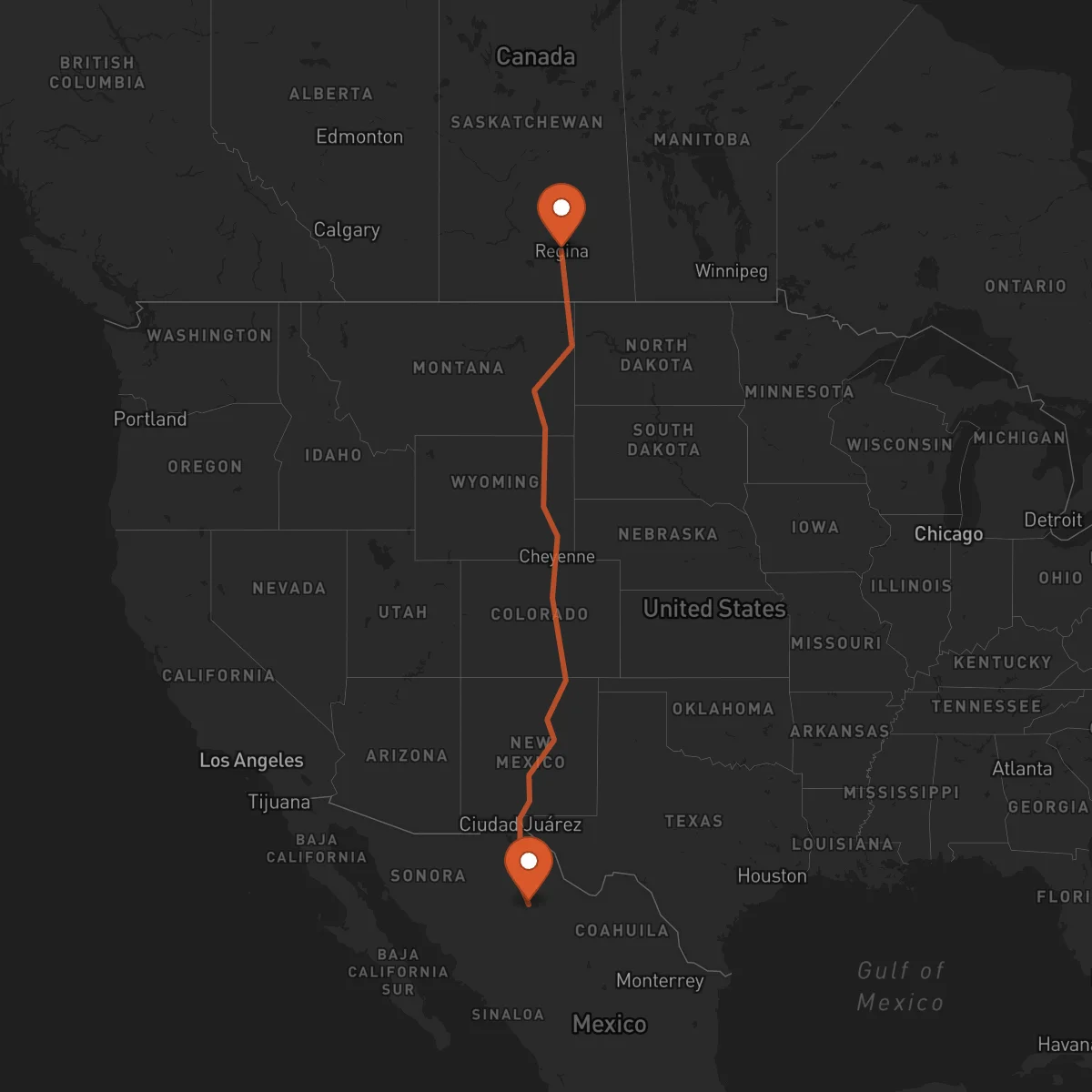
Chihuahua to Regina
Regina → ChihuahuaFTL freight transportation service between Chihuahua and Regina. Reliable logistics solutions for your business.
Route Description
Everything you need to know about the corridor Chihuahua - Regina
The logistics corridor between Chihuahua, Mexico and Regina, Canada represents a vital cross-border connection spanning approximately 2,427 kilometers through North America's industrial heartland. This route links Mexico's leading agricultural and manufacturing state with Saskatchewan's agricultural powerhouse, creating essential supply chain flows for both nations. The corridor traverses diverse terrain and climate zones, requiring specialized logistics expertise to ensure reliable freight transportation across international borders.
This corridor serves as a critical artery for industries including agricultural products, manufacturing components, mining equipment, and consumer goods. Chihuahua's industrial base exports finished goods northward, while Regina receives these products alongside agricultural exports from Saskatchewan's vast farming regions. The route supports just-in-time manufacturing schedules and seasonal agricultural movements that are crucial to both regional economies.
Key transportation infrastructure includes Mexico's Federal Highway 45, which connects to Interstate 35 in the United States, continuing through major logistics hubs like Kansas City before connecting to Canadian Highway 1. The primary border crossing at Ciudad Juárez facilitates efficient customs processing for commercial freight. Control Terrestre's expertise in cross-border operations ensures seamless documentation, compliance with C-TPAT and FAST program requirements, and coordinated customs clearance that minimizes delays and maintains supply chain integrity throughout this extensive corridor.
Services for this Route
Available services for the corridor Chihuahua - Regina
 Origin
Chihuahua stands as Mexico's largest state by area and a strategic logistics hub in northern Mexico. Its location bordering Texas and New Mexico provides direct access to major U.S. markets while maintaining strong connections throughout Mexico's central and western regions. The state's capital, also named Chihuahua, serves as a primary distribution center with excellent highway connectivity through Federal Highway 45 and rail links to major ports.
The region's economy thrives on diverse industries including aerospace manufacturing, automotive production, mining operations, and agricultural processing. Major companies have established operations in Chihuahua's industrial parks, creating substantial freight volumes requiring reliable transportation solutions. The state's agricultural sector produces significant quantities of apples, nuts, and dairy products that require specialized refrigerated transportation. Chihuahua's transportation infrastructure includes modern highways, intermodal facilities, and proximity to the Ciudad Juárez border crossing, making it an ideal origin point for cross-border freight movements to Canada and the United States.
 Destination
Regina
Regina, the capital city of Saskatchewan, serves as a strategic logistics hub in Canada's prairie provinces. Located in the heart of the Canadian agricultural belt, Regina provides excellent access to major transportation routes including the Trans-Canada Highway and extensive rail networks operated by Canadian Pacific and Canadian National railways. The city's central location in Saskatchewan makes it an ideal distribution point for goods throughout the province and neighboring regions.
The local economy centers on agriculture, mining, and energy sectors, with Saskatchewan being Canada's leading producer of wheat, canola, and potash. Regina's industrial base includes manufacturing facilities, food processing plants, and distribution centers that require consistent freight services. The city's infrastructure supports various transportation modes, with Regina International Airport and modern warehousing facilities complementing the road and rail networks. The region's seasonal agricultural cycles create demand for specialized transportation services, particularly for temperature-controlled shipments during harvest seasons and for heavy equipment movements supporting the mining and energy industries.










