Chicago to Wichita
Wichita → ChicagoFTL freight transportation service between Chicago and Wichita. Reliable logistics solutions for your business.
Route Description
Everything you need to know about the corridor Chicago - Wichita
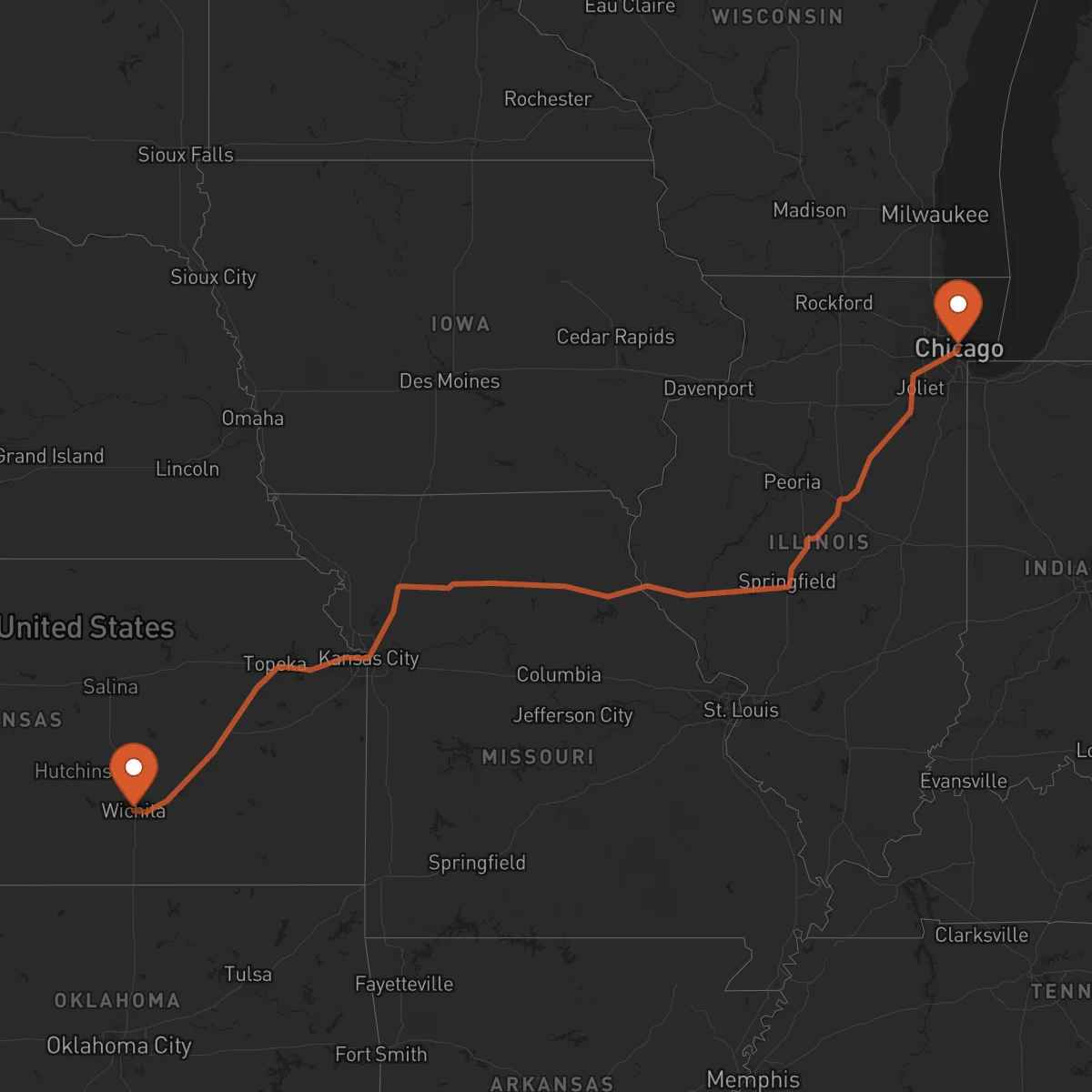
The Chicago-Wichita corridor represents a vital logistics route connecting the Midwest's largest transportation hub with one of Kansas's most important industrial centers. This 950 km route traverses the heart of America's agricultural and manufacturing regions, serving as a crucial link between major economic zones. The corridor benefits from Chicago's position as a continental logistics hub and Wichita's status as an aerospace and manufacturing powerhouse, creating significant freight traffic in both directions.
The economic relationship between these cities drives substantial freight movement along this route. Chicago's diverse economy, encompassing manufacturing, technology, and financial services, generates consistent outbound freight, while Wichita's specialized industries - particularly aerospace, defense, and advanced manufacturing - create steady inbound demand. The corridor also facilitates agricultural product movement from Kansas to Illinois and serves the automotive and machinery sectors that operate between both regions.
Transportation infrastructure along this corridor is excellent, primarily utilizing I-55 and I-135, which provide direct, efficient routes with minimal congestion outside major metropolitan areas. These highways connect seamlessly with Chicago's extensive intermodal network and Wichita's industrial parks, enabling reliable transit times for full truckload shipments. The relatively flat terrain of the Midwest further enhances route efficiency and fuel economy.
Control Terrestre optimizes operations on this corridor through our network of certified carriers and strategic partnerships. Our dedicated FTL services ensure that your freight moves directly from origin to destination without intermediate handling, reducing transit times and minimizing risk. With real-time tracking capabilities and experienced drivers familiar with this route, we provide the reliability and efficiency that manufacturers, distributors, and industrial clients require for their critical supply chain operations.
Services for this Route
Available services for the corridor Chicago - Wichita
 Origin
Chicago
Chicago stands as North America's premier logistics hub, offering unparalleled connectivity through its strategic location at the intersection of major transportation networks. The city's six Class I railroads, two international airports, and extensive highway system create a multimodal environment ideal for freight consolidation and distribution. Chicago's O'Hare International Airport ranks among the world's busiest cargo facilities, while its extensive warehousing and distribution center network provides comprehensive logistics solutions.
The city's economy spans advanced manufacturing, technology, food processing, and financial services, generating diverse freight opportunities. Major industrial corridors in the surrounding suburbs house automotive suppliers, machinery manufacturers, and consumer goods producers. Chicago's position as a continental crossroads enables efficient access to both coasts and the Canadian and Mexican borders, making it an ideal origin point for nationwide distribution strategies.
 Destination
Wichita
Wichita has established itself as a critical logistics point in the central United States, particularly for specialized industrial freight. Known as the "Air Capital of the World," the city hosts major aerospace manufacturers and their extensive supply chains, creating consistent demand for precision freight services. Wichita's central location provides strategic advantages for distribution throughout the Midwest, with excellent highway access via I-35, I-135, and I-235.
The city's economy centers on aerospace, defense contracting, and advanced manufacturing, with numerous industrial parks and specialized facilities supporting these sectors. Wichita's relatively low congestion and business-friendly environment make it attractive for logistics operations. The city's infrastructure includes modern warehousing facilities, cross-docking operations, and specialized handling capabilities for sensitive aerospace components, supporting the sophisticated freight requirements of its primary industries.










