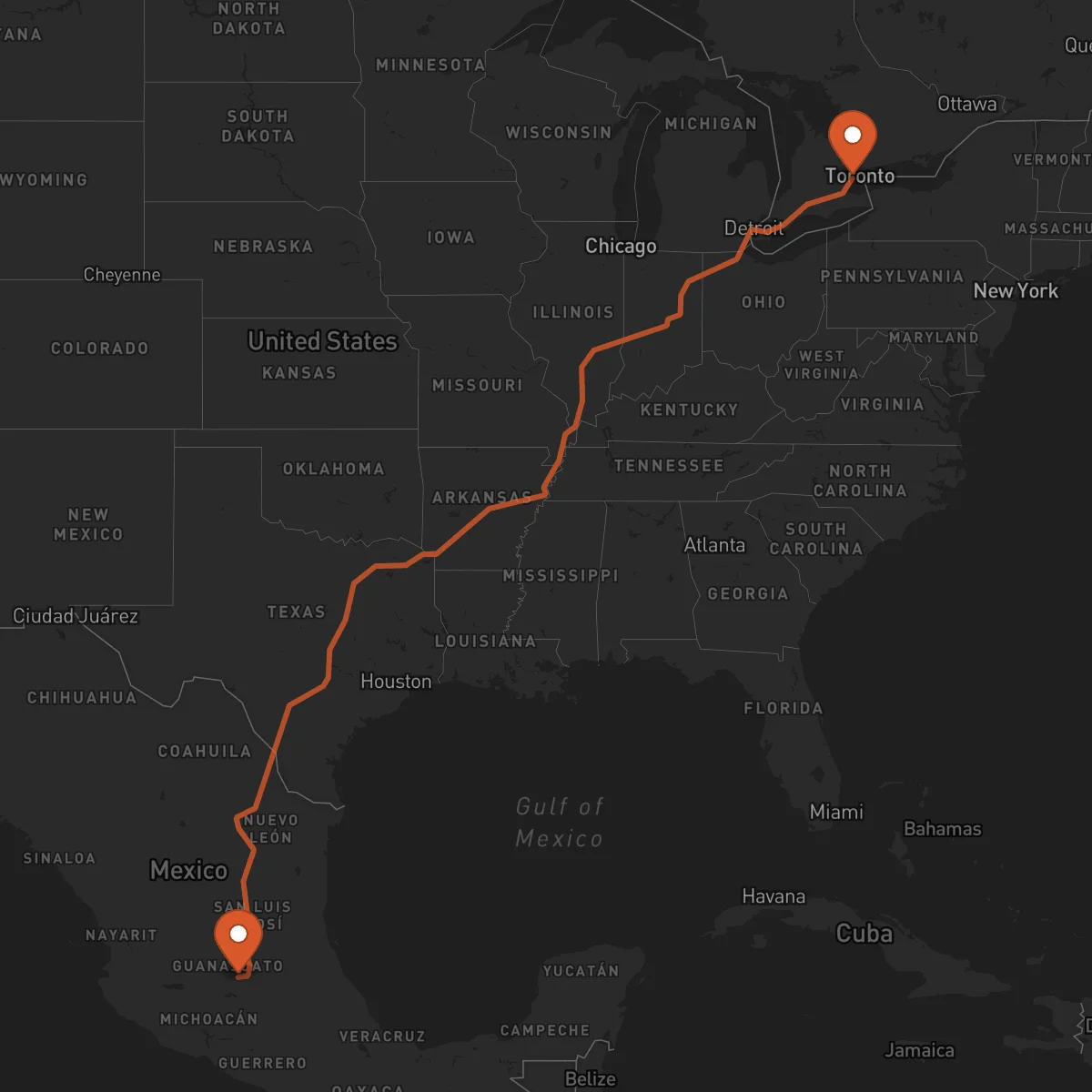
Celaya to Mississauga
Mississauga → CelayaFTL freight transportation service between Celaya and Mississauga. Reliable logistics solutions for your business.
Route Description
Everything you need to know about the corridor Celaya - Mississauga
The logistics corridor connecting Celaya, Guanajuato with Mississauga, Ontario represents a vital trade link between Mexico's industrial heartland and Canada's major logistics hub. This cross-border route spans approximately 3,228 kilometers and facilitates the movement of critical manufacturing components, automotive parts, and industrial equipment between North America's most important manufacturing regions. The corridor leverages Mexico's strategic position in global supply chains, connecting the Bajío region's manufacturing prowess with Canada's advanced industrial capabilities.
This transportation route serves primarily the automotive, aerospace, and electronics industries, with Celaya being a key manufacturing center for automotive components and Mississauga hosting numerous international manufacturing and distribution facilities. The corridor utilizes major transportation infrastructure including Mexico's Federal Highway 45D and Canada's Highway 401, two of North America's most important freight corridors. These modern highways provide efficient, reliable transportation for full truckload (FTL) shipments, ensuring timely delivery of goods between both countries.
Cross-border operations are facilitated through efficient customs procedures at key entry points, with Control Terrestre's certified transportation providers ensuring compliance with all regulatory requirements. Our C-TPAT and FAST certified partners streamline border crossings, reducing transit times and ensuring cargo security. Control Terrestre coordinates every aspect of this cross-border operation, from origin pickup in Celaya to final delivery in Mississauga, providing dedicated FTL services that maintain cargo integrity throughout the entire journey.
Services for this Route
Available services for the corridor Celaya - Mississauga
 Origin
Celaya
Celaya, located in the heart of Mexico's Bajío region, stands as a strategic logistics hub with excellent connectivity to major industrial centers. The city benefits from its proximity to key manufacturing clusters in Guanajuato and surrounding states, making it an ideal origin point for cross-border freight. Celaya's industrial park hosts numerous automotive suppliers and manufacturing facilities, creating a high demand for reliable transportation services to North American markets.
The city's transportation infrastructure includes direct access to Federal Highway 45D, Mexico's primary north-south corridor, and proximity to major rail terminals. Celaya's industrial sector focuses on automotive manufacturing, metal mechanics, and electronics, industries that require frequent, time-sensitive shipments to Canadian and U.S. markets. The city's growing logistics ecosystem, combined with its skilled workforce and industrial capabilities, positions it as a crucial origin point for companies seeking efficient cross-border transportation solutions.
 Destination
Mississauga serves as Canada's premier logistics and distribution hub, strategically located in the Greater Toronto Area near major international transportation gateways. The city's proximity to Toronto Pearson International Airport and the Port of Hamilton provides multimodal connectivity that enhances its role in North American supply chains. Mississauga's extensive industrial parks host thousands of manufacturing and distribution facilities, making it a critical destination for cross-border freight from Mexico.
The city's transportation infrastructure includes direct access to Highway 401, North America's busiest highway, and the nearby Queen Elizabeth Way (QEW), providing efficient connections to other major Canadian markets. Mississauga's economy is diverse, with strong representation in advanced manufacturing, pharmaceuticals, automotive, and technology sectors. These industries rely on consistent, reliable freight transportation from Mexican manufacturing centers, particularly for just-in-time inventory management and supply chain optimization.










