Celaya to Louisville
Louisville → CelayaFTL freight transportation service between Celaya and Louisville. Reliable logistics solutions for your business.
Route Description
Everything you need to know about the corridor Celaya - Louisville
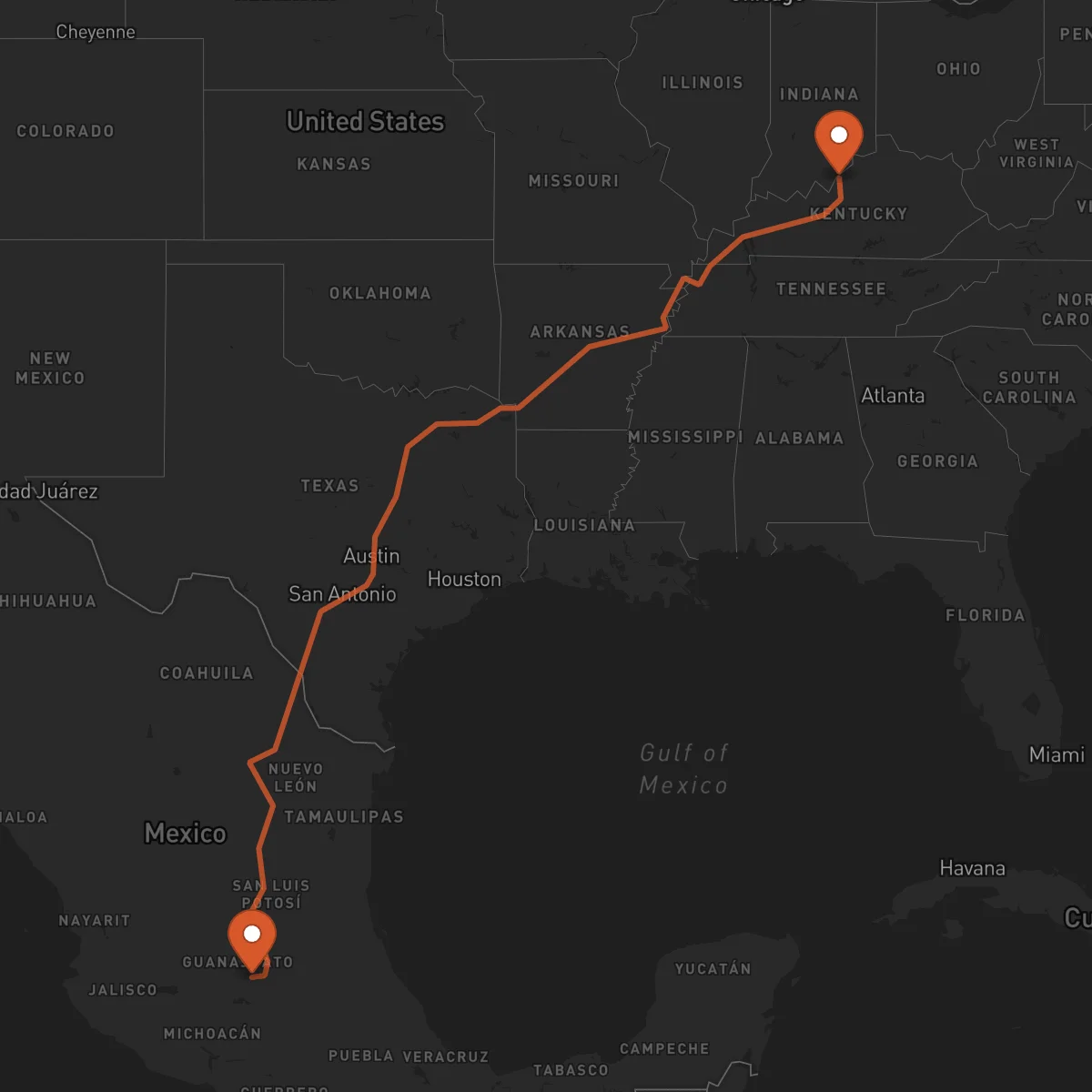
The logistics corridor connecting Celaya, Guanajuato, with Louisville, Kentucky, represents a vital trade link between Mexico's industrial heartland and one of the United States' most strategic logistics hubs. This 2,443 km cross-border route facilitates the movement of manufactured goods, automotive components, and industrial materials between two major economic regions. The corridor traverses key industrial zones in central Mexico before crossing at Laredo/Nuevo Laredo, continuing through the American Midwest to reach Louisville's extensive distribution network.
The industrial significance of this corridor is substantial, with Celaya serving as a major automotive manufacturing center within Mexico's Bajío region, while Louisville functions as a critical logistics node with UPS Worldport and numerous distribution centers. This route primarily serves the automotive, electronics, and manufacturing sectors, supporting just-in-time delivery systems and supply chain efficiency. The NAFTA/USMCA trade framework has further enhanced the importance of this corridor for cross-border commerce.
Transportation infrastructure along this route includes Mexico's Federal Highway 45, connecting to the Laredo border crossing, then transitioning to I-35 North and I-65 North through the United States. Control Terrestre manages this corridor with specialized cross-border expertise, handling all customs documentation, regulatory compliance, and secure cargo transfer between Mexican and U.S. transportation networks. Our C-TPAT-certified carriers ensure expedited processing at border crossings, while our experienced logistics team coordinates seamless door-to-door delivery from origin to destination.
Services for this Route
Available services for the corridor Celaya - Louisville
 Origin
Celaya
Celaya, located in the state of Guanajuato, Mexico, stands as a strategic logistics hub in the country's industrial Bajío region. Its central geographic position provides excellent connectivity to major manufacturing centers in Querétaro, León, and the greater Bajío industrial corridor. The city hosts significant automotive manufacturing facilities, including plants from major global manufacturers, making it a critical node in Mexico's automotive supply chain. Celaya's industrial parks offer modern warehousing and distribution capabilities, supported by a skilled workforce and proximity to key suppliers.
The transportation infrastructure in Celaya includes direct access to Federal Highway 45, which connects to major border crossings and ports. The city's logistics ecosystem benefits from Mexico's extensive road network, facilitating efficient distribution throughout the country. Celaya's strategic location, combined with its industrial base, makes it an ideal origin point for cross-border freight movements to U.S. markets, particularly for automotive parts, electronics, and manufactured goods requiring reliable transportation to North American destinations.
 Destination
Louisville
Louisville, Kentucky, serves as one of the most strategic logistics hubs in the United States, offering unparalleled access to major U.S. markets. The city's location in the Midwest provides distribution coverage to over half the U.S. population within a day's drive. Louisville International Airport hosts UPS Worldport, the largest automated package handling facility in the world, while the city's extensive network of interstate highways (I-64, I-65, I-71) ensures efficient ground transportation connectivity. The convergence of major rail lines and the Ohio River further enhances Louisville's multimodal transportation capabilities.
The economic landscape of Louisville is dominated by logistics, manufacturing, and healthcare sectors. The city hosts numerous distribution centers for major retailers and manufacturers, making it a critical node for supply chain operations. Louisville's infrastructure includes modern warehousing facilities, advanced inventory management systems, and a skilled logistics workforce. The city's strategic position as a gateway to both eastern and midwestern U.S. markets makes it an ideal destination for cross-border freight from Mexico, particularly for time-sensitive and high-value cargo requiring reliable distribution networks.










