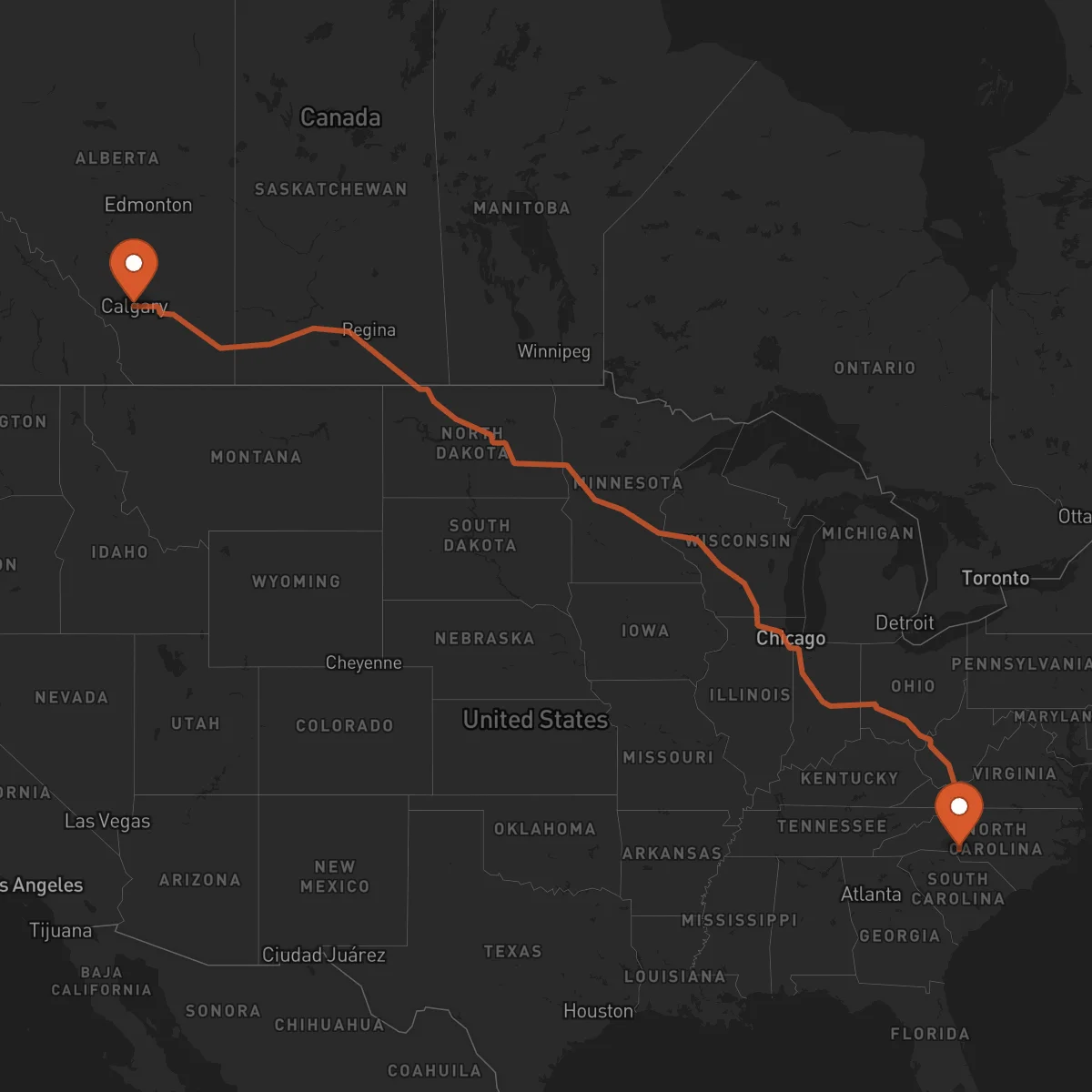
Calgary to Charlotte
Charlotte → CalgaryFTL freight transportation service between Calgary and Charlotte. Reliable logistics solutions for your business.
Route Description
Everything you need to know about the corridor Calgary - Charlotte
The Calgary-Charlotte corridor represents a vital cross-border connection between Canada's energy capital and one of the most dynamic logistics hubs in the southeastern United States. This 3,178 km route traverses diverse landscapes and connects two major economic regions, facilitating the flow of goods between Alberta's industrial base and North Carolina's manufacturing and distribution centers.
The corridor primarily utilizes Interstate 29 and Interstate 94 through the United States, connecting with major highways in Canada. The route crosses at key border points, with the most common being the Pembina-Emerson crossing in North Dakota, which offers efficient processing for commercial freight. This strategic pathway serves as a critical link for businesses operating across the North American Free Trade Agreement (USMCA) region.
Major industries utilizing this corridor include energy equipment and services, automotive parts, industrial machinery, and agricultural products moving from Canada's western provinces to the southeastern United States. Charlotte's position as a major financial center and its proximity to automotive manufacturing facilities in the Carolinas creates significant demand for reliable freight transportation services. Control Terrestre specializes in managing the complexities of cross-border operations, ensuring seamless customs clearance and compliance with regulations on both sides of the border.
Services for this Route
Available services for the corridor Calgary - Charlotte
 Origin
Calgary, located in Alberta, Canada, serves as a strategic logistics hub for western Canada. The city benefits from its proximity to the Canadian Rockies and its position as the center of Canada's energy industry. Calgary's transportation infrastructure includes extensive highway networks connecting to major Canadian cities and border crossings into the United States. The city's economy is driven by the energy sector, technology, and logistics services, with numerous warehouses and distribution centers supporting regional and international trade.
 Destination
Charlotte
Charlotte, North Carolina, stands as a major logistics and distribution center in the southeastern United States. The city's strategic location provides access to major East Coast markets within a day's drive. Charlotte benefits from its extensive highway network, including I-85 and I-77, which connect to major ports and manufacturing centers. The region's economy is diverse, with strong presence in banking, energy, and advanced manufacturing. Charlotte Douglas International Airport enhances the city's logistics capabilities, making it an ideal destination for freight transportation services.










