Bridgeport to Quebec City
Quebec City → BridgeportFTL freight transportation service between Bridgeport and Quebec City. Reliable logistics solutions for your business.
Route Description
Everything you need to know about the corridor Bridgeport - Quebec City
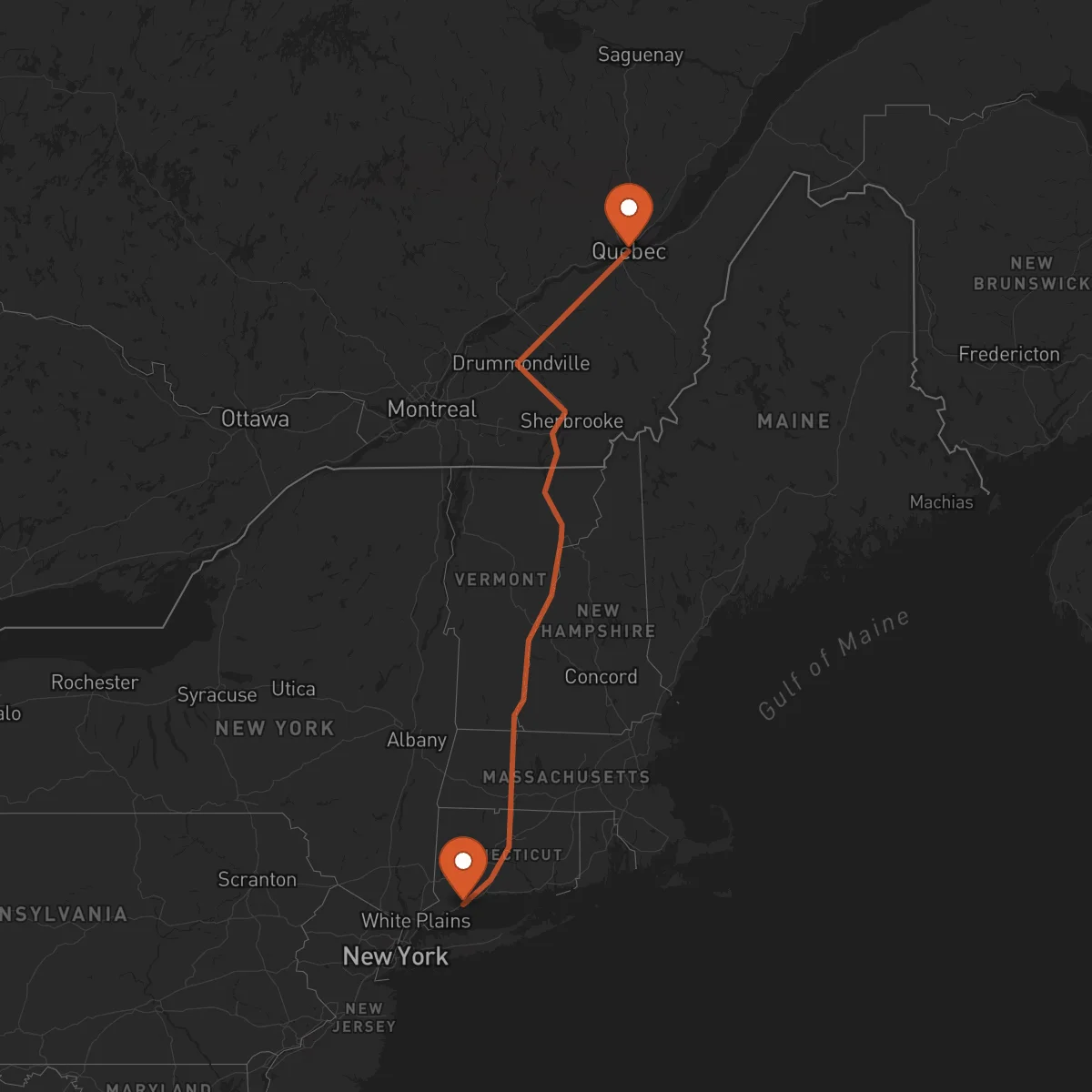
The logistics corridor connecting Bridgeport, Connecticut, to Quebec City, Quebec, represents a vital cross-border transportation route spanning approximately 646 kilometers. This corridor links the northeastern United States with Canada's French-speaking province, facilitating essential trade flows between these economic regions. The route traverses diverse terrain and crosses international boundaries, requiring expertise in customs procedures and cross-border logistics management.
The economic significance of this corridor stems from its connection between major industrial and commercial centers. Bridgeport serves as a gateway to the New York metropolitan area's extensive market, while Quebec City anchors a robust manufacturing and technology hub in eastern Canada. Key industries utilizing this corridor include automotive parts manufacturing, aerospace components, precision machinery, and consumer goods distribution. The route also supports the pharmaceutical and biotechnology sectors, which maintain strong presences in both Connecticut and Quebec.
Transportation infrastructure along this corridor primarily utilizes Interstate 95 North and Autoroute 20 East, providing reliable highway access. The corridor crosses at strategic border points, with the main crossing near Highgate Springs, Vermont, offering efficient processing for commercial vehicles. Control Terrestre facilitates seamless operations on this corridor through our network of certified carriers, ensuring compliance with customs regulations, providing real-time tracking, and offering specialized services for temperature-sensitive or high-value cargo that frequently moves between these markets.
Services for this Route
Available services for the corridor Bridgeport - Quebec City
 Origin
Bridgeport
Bridgeport, Connecticut, occupies a strategic position in the northeastern United States logistics network, situated along the Long Island Sound with proximity to major metropolitan areas including New York City, approximately 100 kilometers to the southwest. The city serves as a critical distribution point for the tri-state region, offering access to one of North America's most densely populated and economically active markets. Bridgeport's port facilities and highway connections, particularly Interstate 95, provide multimodal transportation options for freight movement.
The economic base of Bridgeport encompasses advanced manufacturing, healthcare, and financial services sectors. The region hosts numerous industrial facilities producing electronics, machinery, and precision instruments. The presence of several higher education institutions and research facilities contributes to a skilled workforce supporting technology and engineering industries. Transportation infrastructure includes the nearby Sikorsky Memorial Airport for air freight, extensive rail connections through Metro-North and freight rail services, and a comprehensive highway network facilitating efficient distribution throughout the northeastern corridor.
 Destination
Quebec City, Quebec, represents a major logistics hub in eastern Canada, strategically positioned along the St. Lawrence River with direct access to the Atlantic shipping lanes. The city serves as a critical gateway for goods moving between central Canada and northeastern U.S. markets, with its location approximately 200 kilometers northeast of Montreal providing alternative routing options for freight traffic. The metropolitan area's infrastructure includes comprehensive highway connections, notably Autoroute 20 and Autoroute 40, linking to the broader Canadian and U.S. transportation networks.
The economic landscape of Quebec City centers on advanced manufacturing, information technology, and tourism sectors. The region hosts significant aerospace industry presence, with major employers including manufacturing facilities and research centers. The city's industrial base includes food processing, electronics assembly, and precision instrument manufacturing. Transportation infrastructure encompasses Jean Lesage International Airport for air cargo operations, extensive rail connections through Canadian National Railway, and port facilities along the St. Lawrence River capable of handling various cargo types. The city's comprehensive logistics network supports both domestic Canadian distribution and cross-border trade with the United States.


Ready to ship your cargo?
Get a personalized quote for your freight.
Quote Now Bridgeport - Quebec City








