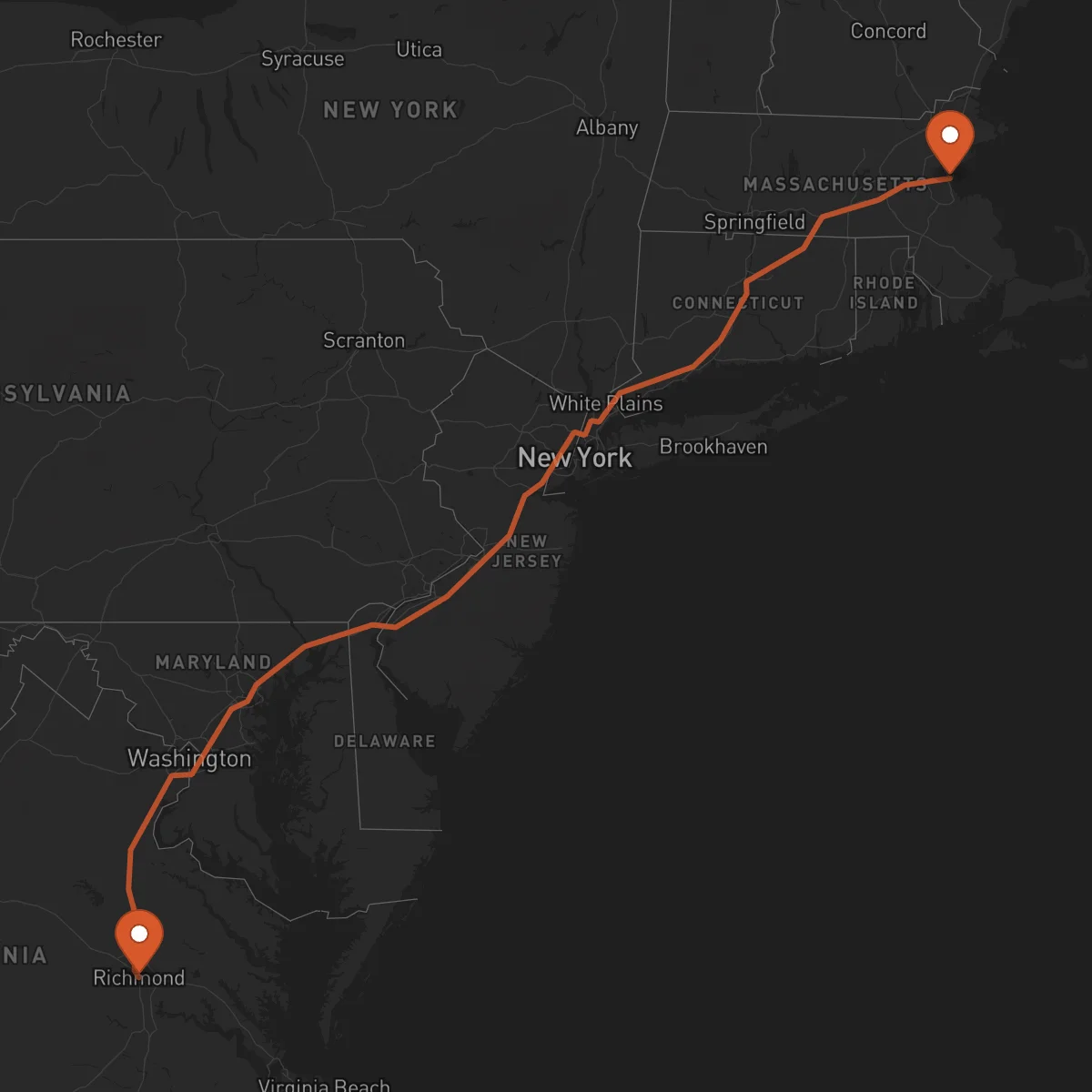
Boston to Richmond
Richmond → BostonFTL freight transportation service between Boston and Richmond. Reliable logistics solutions for your business.
Route Description
Everything you need to know about the corridor Boston - Richmond
The Boston-Richmond corridor connects two of the most important economic centers on the US East Coast, covering approximately 763 km. This route links Massachusetts' technology and education hub with Virginia's financial and industrial center, facilitating the flow of goods between the Northeast and Southeast regions. The corridor is vital for supply chains that require efficient connections between these high-consumption and production areas.
The region benefits from a robust industrial and commercial infrastructure. Boston stands out for its biotechnology, education, and advanced technology sectors, while Richmond is a key financial center with a strong presence in manufacturing, distribution, and government services. This complementarity generates significant freight traffic in both directions, requiring reliable transportation solutions.
Main industries using this corridor include technology and life sciences (Boston origin), financial services and government supplies (Richmond destination), as well as general consumer goods, industrial equipment, and e-commerce products. The route is particularly strategic for companies needing to connect with both the Northeast and Southeast markets efficiently.
Transportation infrastructure is excellent, with I-95 serving as the main artery connecting both cities. This highway allows for direct, high-capacity transportation, minimizing transit times and ensuring cargo availability. Control Terrestre optimizes operations on this corridor through our specialized providers, offering full truckload solutions that ensure cargo integrity and timely delivery between these two strategic points.
Services for this Route
Available services for the corridor Boston - Richmond
 Origin
Boston
Boston is a strategic logistics hub on the US East Coast, with a port (Port of Boston) that connects to international markets and an extensive network of highways including I-90 and I-93. Its Logan International Airport complements the multimodal infrastructure, facilitating the connection between air and ground cargo. The city's location in the Northeast allows efficient access to the entire region and Canada.
The main industries in Boston include biotechnology, with world-renowned research centers; higher education, with universities that generate significant freight traffic; technology and software development; and healthcare. The financial sector is also relevant, although smaller than in other East Coast cities. These industries generate constant demand for specialized transportation, particularly for high-value or time-sensitive cargo.
 Destination
Richmond
Richmond is strategically located in Virginia, serving as a gateway to the US Southeast. Its location at the fall line of the James River has historically made it a transportation hub, a characteristic it maintains today with excellent connectivity via I-95, I-64, and I-295. The Port of Richmond on the James River complements the highway infrastructure, allowing for multimodal transportation options.
The main industries in Richmond include financial services, with a strong presence of banks and insurance companies; government and public administration, due to its proximity to Washington D.C.; advanced manufacturing; and distribution and logistics. The city has experienced significant growth in e-commerce and retail distribution, generating increased demand for efficient freight transportation. Its central location on the East Coast makes it an ideal point for distribution to both the Northeast and Southeast.










