Boise to Winnipeg
Winnipeg → BoiseFTL freight transportation service between Boise and Winnipeg. Reliable logistics solutions for your business.
Route Description
Everything you need to know about the corridor Boise - Winnipeg
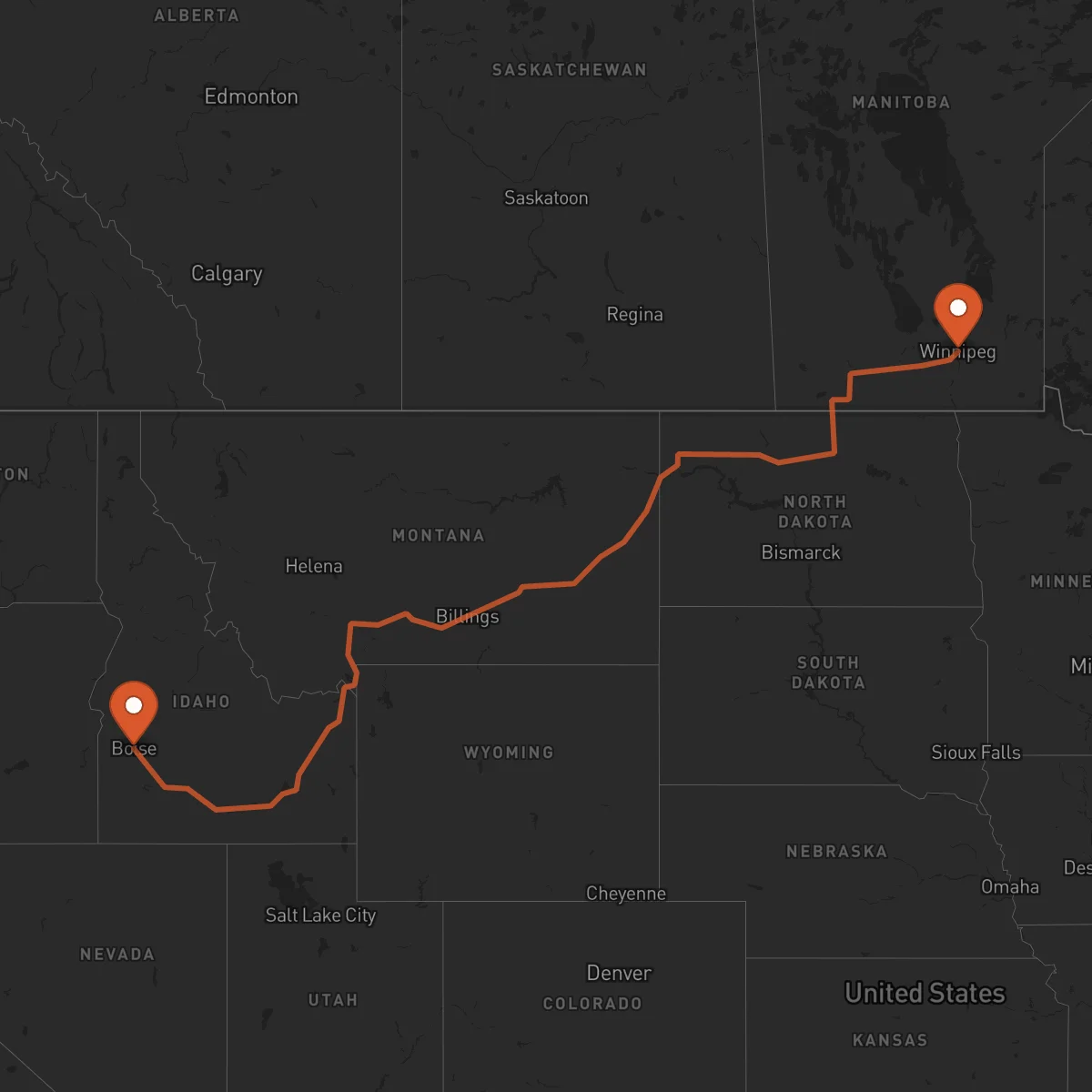
The Boise to Winnipeg corridor represents a vital cross-border logistics connection between the United States and Canada, spanning approximately 1,605 kilometers through the heart of North America. This route links Idaho's capital, Boise, with Manitoba's capital, Winnipeg, creating a strategic supply chain pathway that serves both national and international trade needs. The corridor traverses diverse terrain and crosses the international border at Portal, North Dakota, one of the major commercial entry points between the two countries.
The economic significance of this corridor extends across multiple industries, with Boise's growing technology and agricultural sectors connecting to Winnipeg's robust manufacturing, transportation, and agricultural industries. Companies along this route benefit from the complementary economic strengths of both regions, facilitating the movement of everything from agricultural products and electronics to industrial equipment and consumer goods. The corridor supports the integrated North American supply chain, enabling businesses to optimize their distribution networks across both countries.
Transportation infrastructure along this corridor primarily utilizes Interstate 84 and Interstate 15 in the United States, connecting to Canadian Highway 1 and Highway 75. This well-maintained highway system provides reliable transit for full truckload (FTL) freight services. Control Terrestre's expertise in cross-border operations ensures seamless customs clearance and compliance with both US and Canadian regulations, minimizing delays and optimizing transit times. Our strategic partnerships with certified carriers and customs brokers along this corridor enable us to provide efficient, reliable transportation solutions that meet the complex requirements of international freight movement.
Services for this Route
Available services for the corridor Boise - Winnipeg
 Origin
Boise
Boise, Idaho serves as a strategic logistics hub in the Pacific Northwest, offering excellent connectivity to major West Coast ports and inland markets. The city's location at the intersection of major transportation routes makes it an ideal origin point for freight distribution across the western United States and into Canada. Boise's economy is characterized by a strong technology sector, often referred to as the 'Silicon Slopes,' alongside traditional industries such as agriculture, food processing, and manufacturing. The city's growing population and business-friendly environment have attracted numerous companies establishing distribution centers and logistics operations in the region.
The transportation infrastructure in Boise includes access to Interstate 84, which runs east-west across southern Idaho, connecting to major markets in Utah, Oregon, and beyond. The Boise Airport provides air cargo services, while the nearby Port of Lewiston offers barge access to the Pacific Northwest via the Snake and Columbia Rivers. These multimodal capabilities, combined with the city's central location in the western United States, make Boise an efficient origin point for cross-border freight movements to Canada and other North American destinations.
 Destination
Winnipeg, Manitoba stands as a crucial logistics and distribution center in central Canada, strategically positioned at the confluence of the Red and Assiniboine Rivers. Known as the 'Gateway to the West,' Winnipeg serves as a critical transportation hub for goods moving between eastern and western Canada, as well as international trade with the United States. The city's economy is diverse, with strong sectors in manufacturing, transportation, agriculture, and financial services. Winnipeg's central location makes it an ideal consolidation point for regional distribution networks and a key player in Canada's supply chain infrastructure.
The city boasts excellent transportation infrastructure, including the Winnipeg James Armstrong Richardson International Airport, which handles significant air cargo traffic. Winnipeg's extensive highway network includes the Trans-Canada Highway and connections to the United States via Highway 75, facilitating efficient ground transportation. The city is also served by major rail lines, including Canadian National Railway and Canadian Pacific Railway, providing intermodal capabilities. Winnipeg's proximity to the Canada-US border and its role as a distribution center for Manitoba and surrounding provinces make it a vital destination for cross-border freight operations, particularly for companies seeking to serve the central Canadian market.










