Birmingham to Concord
Concord → BirminghamFTL freight transportation service between Birmingham and Concord. Reliable logistics solutions for your business.
Route Description
Everything you need to know about the corridor Birmingham - Concord
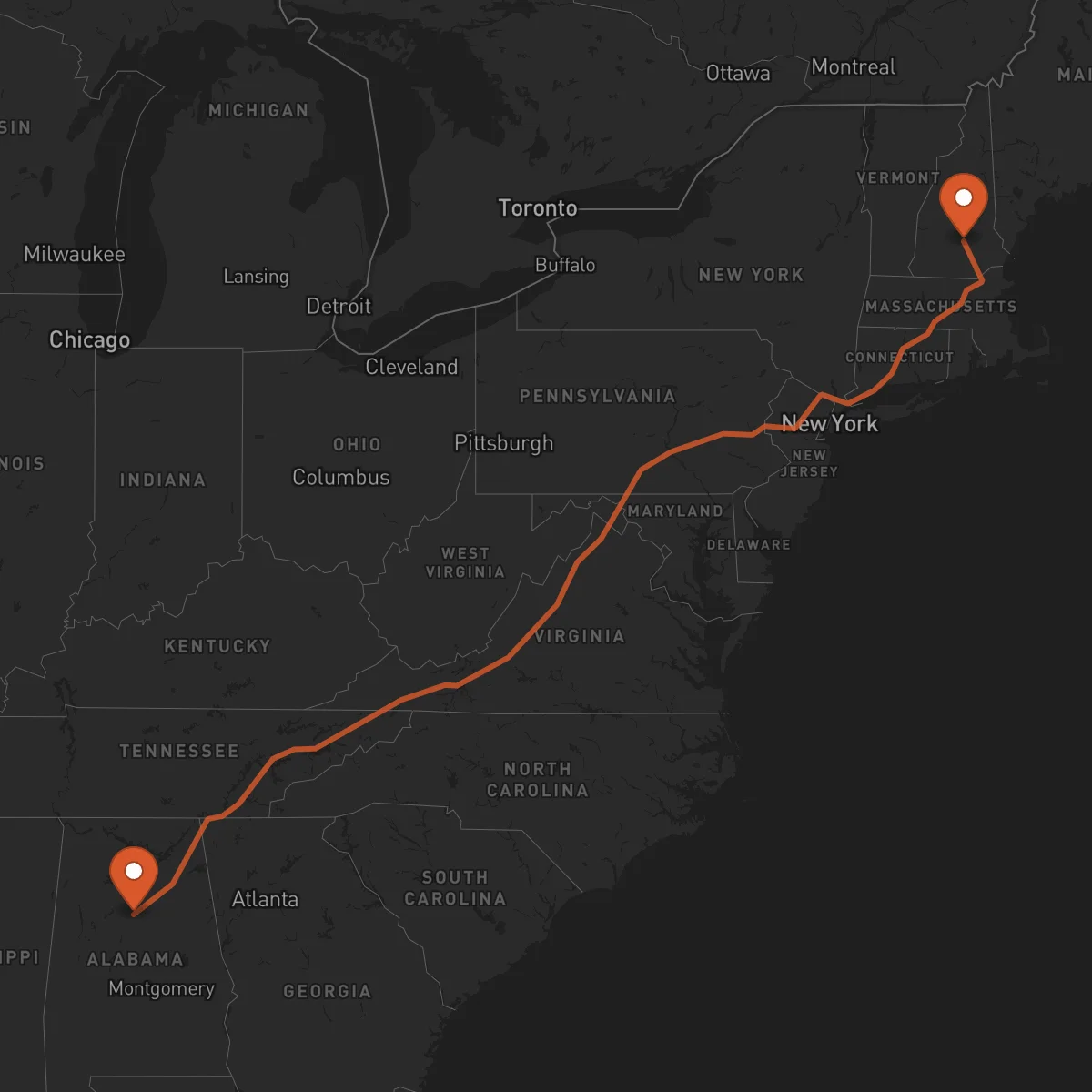
The Birmingham to Concord logistics corridor represents a critical freight route spanning the southeastern United States to the northeastern region. This 1,708 km domestic connection serves as a vital artery for commerce, linking industrial production centers in Alabama with consumer markets and distribution networks in New Hampshire. The strategic importance of this corridor lies in its ability to efficiently move goods across multiple states, connecting diverse economic regions while offering manufacturers and distributors access to both raw material sources and end consumers.
The corridor traverses through multiple economic zones, transitioning from the manufacturing-heavy South to the technology and service-oriented Northeast. Along this route, goods pass through states with varying economic strengths, including Tennessee's automotive industry, Pennsylvania's manufacturing base, and New York's financial and technological sectors. This diversity creates a robust ecosystem for freight transportation, with each region contributing unique demands and supply chain requirements that shape the flow of goods along this corridor.
Manufacturing, automotive, retail distribution, and technology sectors heavily utilize this transportation route. Birmingham's industrial output moves to New England's consumer markets, while New England's manufactured products and technology components travel southward. Additionally, the corridor supports the movement of agricultural goods from southern states to northern markets and seasonal products moving in both directions. The consistent demand from these diverse industries creates a steady flow of freight, making this corridor a reliable choice for full truckload transportation.
The corridor primarily utilizes Interstate 65 north from Birmingham to Nashville, then I-40 east to Knoxville, followed by I-81 north through Virginia and Pennsylvania, and finally I-93 north into New Hampshire. This well-maintained highway system provides efficient connectivity with minimal congestion points, allowing for reliable transit times. Control Terrestre leverages our strategic network of transportation providers to offer seamless FTL services along this corridor. Our alliance of experienced carriers understands the unique demands of this route, from navigating varied terrain and weather conditions to meeting industry-specific requirements. We provide dedicated transportation solutions that accommodate specialized cargo needs, including temperature-sensitive, hazardous materials, and oversized freight.
Services for this Route
Available services for the corridor Birmingham - Concord
 Origin
Birmingham
Birmingham, Alabama, serves as a strategic logistics hub in the southeastern United States, positioned at the crossroads of major transportation arteries. The city's central location within the state provides efficient access to both domestic and international markets via extensive highway networks, rail connections, and proximity to the Port of Mobile. Birmingham-Shuttlesworth International Airport further enhances its connectivity, offering air cargo capabilities for time-sensitive shipments. This strategic positioning makes Birmingham an ideal origin point for freight destined throughout the eastern United States and beyond.
Birmingham's economy is diverse, with strong representation in manufacturing, healthcare, banking, and education. The region is particularly known for its production of iron and steel, automotive parts, and fabricated metals. Additionally, the city has a growing presence in biotechnology, information technology, and corporate headquarters. These industries generate significant freight volumes, requiring reliable transportation solutions to connect with suppliers and markets across the country.
Birmingham boasts a robust transportation infrastructure that supports efficient freight movement. The city is served by multiple interstate highways, including I-20, I-59, and I-65, providing direct connections to major markets. CSX Transportation and Norfolk Southern operate extensive rail networks in the area, complementing trucking operations. The Birmingham Regional Intermodal Facility offers additional logistics capabilities, while numerous trucking terminals and distribution centers throughout the metropolitan area provide essential support services for freight transportation.
 Destination
Concord
Concord, New Hampshire, serves as a key logistics point in New England's transportation network. While smaller than other New England cities, its location in the Merrimack Valley provides strategic access to both New Hampshire's interior and the broader northeastern market. The city benefits from proximity to major metropolitan areas including Boston, Manchester, and Portland, while maintaining connections to Canada via nearby border crossings. This positioning makes Concord an important distribution center for goods serving New Hampshire and neighboring states.
Concord's economy features a strong presence in government services, healthcare, insurance, and manufacturing. The state government is a major employer, with numerous state agencies and departments headquartered in the city. Additionally, Concord has developed significant manufacturing capabilities, particularly in precision electronics, industrial machinery, and paper products. The retail sector also contributes substantially to the local economy, with distribution centers serving both local and regional markets.
Concord's transportation infrastructure supports efficient freight movement through the region. The city is directly connected via Interstate 93, providing north-south access to the broader interstate system. U.S. Route 3 and New Hampshire Route 9 offer additional connections to eastern and western markets. While lacking a major airport with significant cargo facilities, Manchester-Boston Regional Airport is approximately one hour away, providing air cargo options. The region benefits from a network of trucking companies and logistics providers that specialize in serving New England's unique market conditions.










