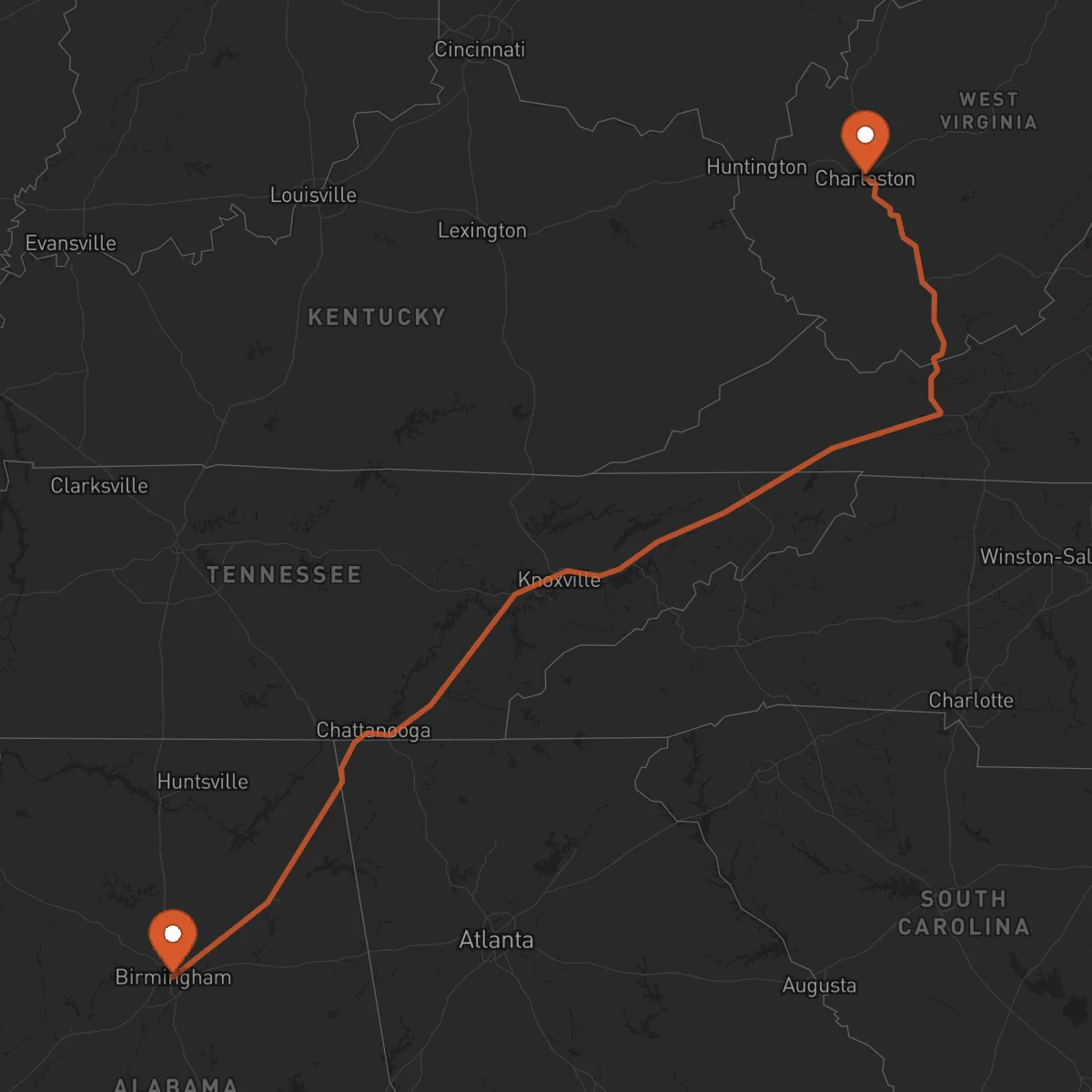
Birmingham to Charleston
Charleston → BirminghamFTL freight transportation service between Birmingham and Charleston. Reliable logistics solutions for your business.
Route Description
Everything you need to know about the corridor Birmingham - Charleston
The Birmingham to Charleston logistics corridor represents a vital transportation artery connecting the industrial heart of Alabama with the economic hub of West Virginia. Spanning approximately 711 kilometers, this route facilitates the efficient movement of goods between the Southeast and Appalachian regions, serving as a critical link in the national supply chain. The strategic positioning of this corridor allows for seamless connectivity between major production centers and distribution networks, enabling businesses to optimize their logistics operations across state lines.
The region traversed by this corridor encompasses diverse economic landscapes that drive significant freight demand. Alabama's industrial base, particularly around Birmingham, complements West Virginia's manufacturing and energy sectors. This economic diversity creates a robust market for freight transportation services, with the corridor serving as the backbone for connecting suppliers, manufacturers, and end-users. The route facilitates trade in both directions, enabling efficient resource allocation and market access for businesses operating across these states.
Multiple industries rely heavily on the Birmingham-Charleston corridor for their supply chain needs. Manufacturing sectors, including automotive, aerospace, and heavy equipment production, constitute a substantial portion of freight movement. Energy-related industries, particularly those involved in coal, natural gas, and chemical production, also utilize this route extensively. Additionally, retail distribution centers and healthcare facilities depend on this corridor for timely delivery of goods and materials, underscoring its importance to both industrial and commercial sectors.
The corridor benefits from a well-developed highway infrastructure primarily consisting of Interstate 20, which connects Birmingham to the eastern regions before transitioning into other interstate systems that lead toward Charleston. Control Terrestre leverages its extensive network of certified transportation providers to offer comprehensive FTL solutions along this corridor. Our dedicated services ensure that shipments receive priority handling, with specialized equipment options including dry vans, refrigerated units, and flatbeds. Our providers maintain C-TPAT, FAST, and other relevant certifications, ensuring secure and compliant transportation for various cargo types on this critical route.
Services for this Route
Available services for the corridor Birmingham - Charleston
 Origin
Birmingham
Birmingham's strategic location makes it a pivotal logistics hub in the Southeast United States. Situated at the crossroads of major transportation routes, the city serves as an ideal distribution center for regional and national supply chains. Birmingham's extensive transportation infrastructure includes multiple interstate highways (I-20, I-59, I-65), rail connections, and proximity to the Port of Birmingham, facilitating efficient movement of goods in all directions. The city's economy is anchored by diverse industries including manufacturing, healthcare, banking, and education, with particular strength in metal production, automotive manufacturing, and chemical processing. This industrial base generates significant freight demand for both raw materials and finished products, making Birmingham a critical origin point for freight transportation throughout the region.
 Destination
Charleston
Charleston, West Virginia, serves as a strategic logistics gateway connecting industrial production centers with markets throughout the Appalachian region and beyond. The city's location at the confluence of the Elk and Kanawha Rivers historically established it as a transportation hub, a role further enhanced by its modern infrastructure. Charleston's economy is driven by diverse sectors including healthcare, education, government, and manufacturing, with significant presence in chemical production, utilities, and automotive parts. The city benefits from transportation infrastructure that includes interstate highways (I-77, I-64), a growing rail network, and proximity to regional airports, making it an ideal distribution center for both incoming raw materials and outgoing finished products.


Ready to ship your cargo?
Get a personalized quote for your freight.
Quote Now Birmingham - Charleston








